
How to Set a Take-Profit Order on WEEX: Full Guide 2026

 Prefer us on Google



What Is a Take-Profit Order?
A take profit (TP) order tells the system to close your position automatically when the price hits a specific target. You pick your profit level in advance, and the platform handles the rest.
If you are long, the TP goes above your entry price. If you are short, it goes below your entry price. When the market moves in your favor, the order locks in your gains without you having to sell manually.
How Take-Profit Order Works
A take profit order automates your exit. You set a target price, and the platform tries to close your position when the market hits it.
Example: You buy ETH at $3,000. You want to lock in profits at $3,600. So you place a take profit order at $3,600.
How it plays out: The order sits in the background doing nothing. It only activates when the last traded price reaches $3,600. At that moment, the platform steps in.
What happens next: Your position gets closed. If you chose a limit-based take profit, the system tries to sell at exactly $3,600 or slightly better. If you chose a market-based one, it sells immediately at whatever price is available once $3,600 is touched. Most of the time you get filled close to your target. But in fast-moving or thin markets, the actual execution price can slip.
Take-Profit Order vs. Stop-Loss Order
Take profit (TP) and stop loss (SL) orders are both pre-set exit instructions. They work in opposite directions. TP sells a winning position. SL sells a losing one.
For any trade, setting both a TP and an SL — often through a bracket order or OCO (one-cancels-the-other) — gives you a complete crypto risk management strategy. You define the best-case and worst-case exit prices before entering the market.
When a take profit triggers, the trade closes in profit. When a stop loss triggers, it caps further downside. Neither outcome is good or bad emotionally. Both are mechanical executions of a pre-defined plan. Knowing how to set take profit and stop loss on an exchange is a basic skill. Traders who skip it rely on luck.
Learn More: How to Set a Stop-Loss Order on WEEX: Full Guide 2026
How to Set a Take-Profit Order on WEEX: Step-by-Step Guide
Best for beginners. One setup, done.
Step 1: Log into WEEX
Open the WEEX website. Enable two-factor authentication (2FA) if you haven't already.
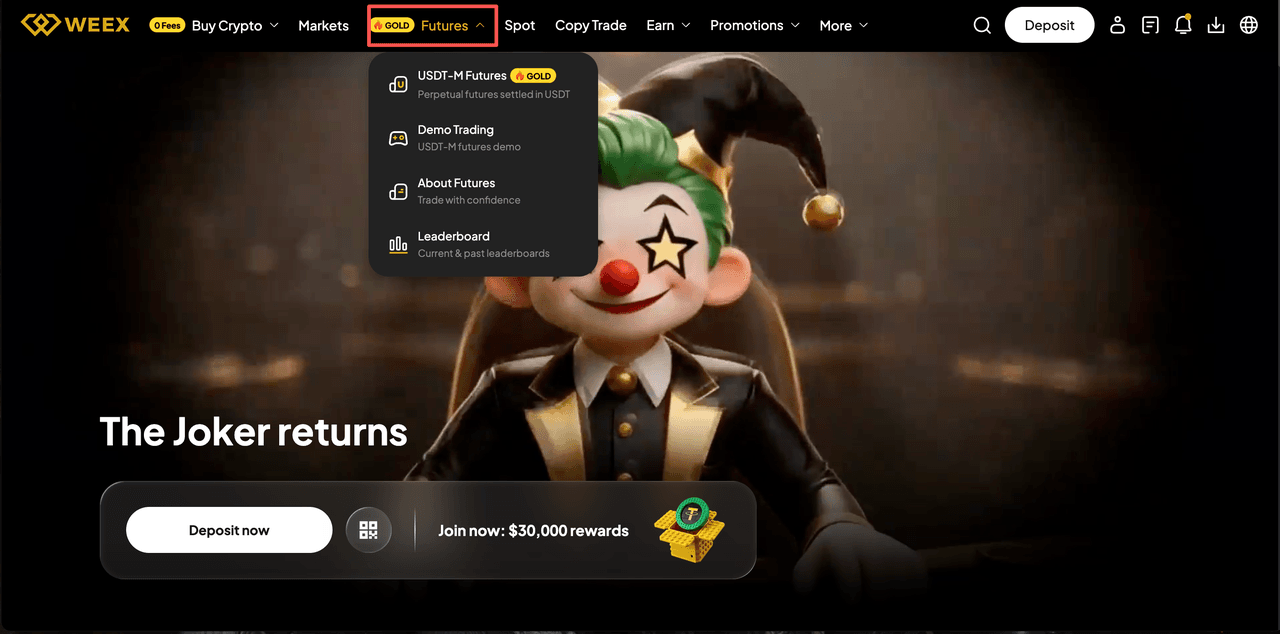
Step 2: Go to Futures Trading and Pick Your Trading Pair
Click "Futures" from the top navigation and select BTC/USDT, ETH/USDT, or any pair you want to trade.
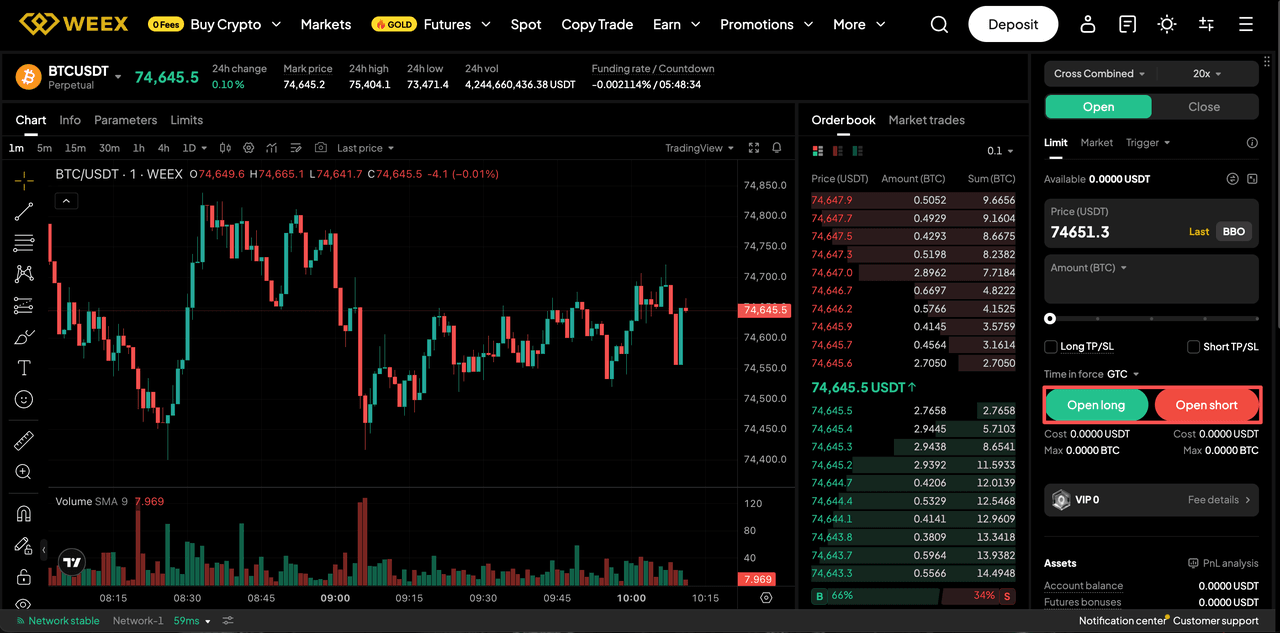
Step 3: Choose Direction and Leverage
Click "Buy/Long" if you expect prices to rise, or "Sell/Short" if you expect them to fall. Set your leverage. New users should start with 3-5x until they understand how stop-loss works.
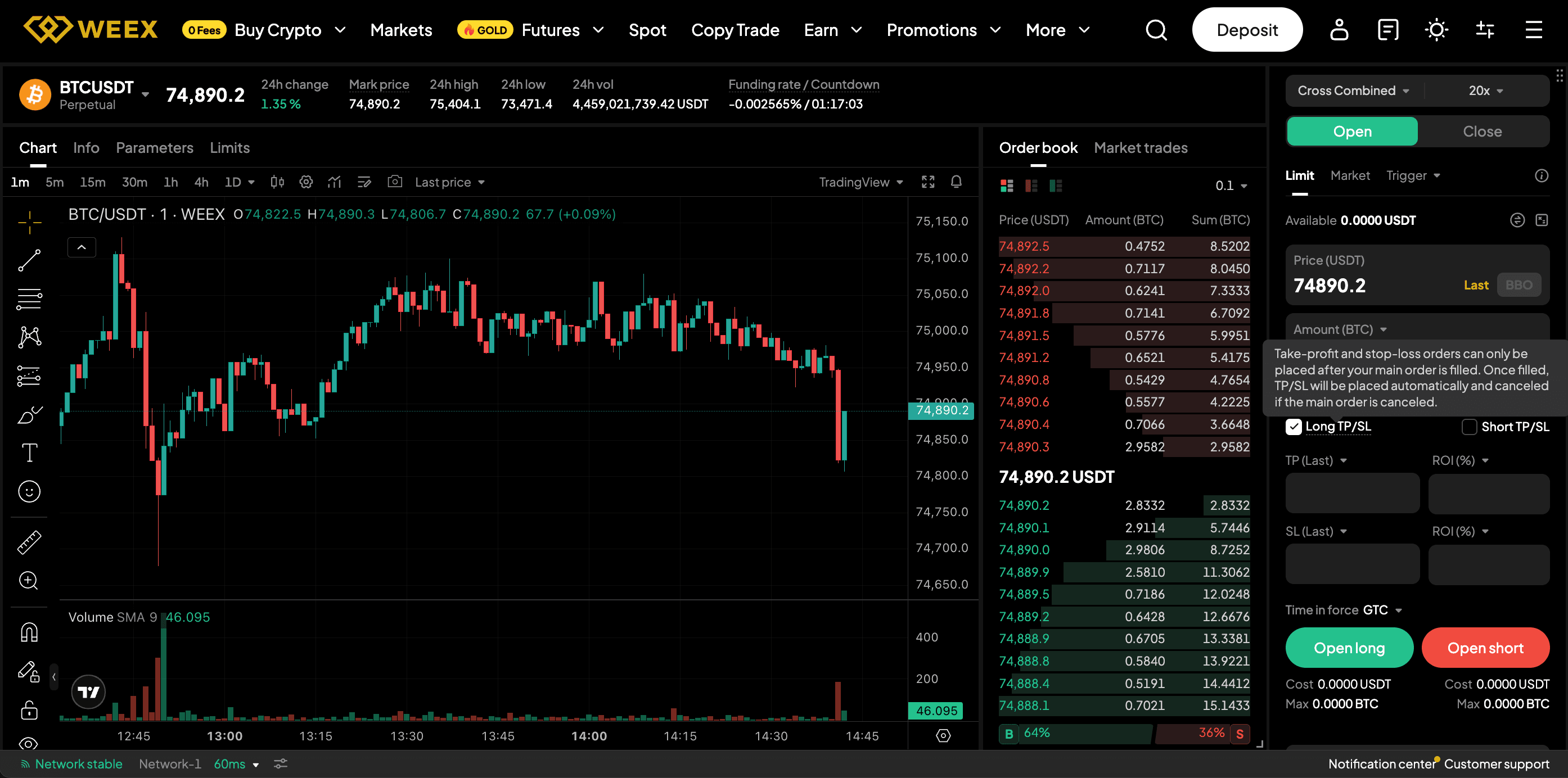
Step 4: Enter Your Take-Profit Price
In the order panel, find "Stop-Loss (SL)". Toggle it on. Enter the price where you want to exit. Example: You buy BTC at $60,000. Set stop-loss at $57,000. If BTC drops to $57,000, WEEX closes your position. Your maximum loss is 5%.
Step 5: Confirm the Order
Review everything. Click "Buy/Long" or "Sell/Short". Your stop-loss is now active.
Advantages and Disadvantages of Take-Profit Order
Advantages of Take Profit Orders
- Locks in profits automatically. Once your target price is reached, the system closes the trade and secures the gain. No second-guessing.
- Cuts down screen time. You do not need to watch charts all day. Set the order and walk away. The exchange handles the rest.
- Removes emotional chasing. Many traders hold too long hoping for a higher price, then lose everything. A take profit order enforces discipline.
These are the main benefits of using take profit on crypto exchanges for daily traders.
Disadvantages of Take Profit Orders
- Misses extended moves. If the market keeps running after your TP triggers, you watch from the sidelines. You cap your upside.
- Depends on liquidity. In low-volume altcoins or fast crashes, your order may fill only partially. You might not get the exact price you set. This is a known limitation of take profit orders in volatile markets.
- No guarantee of execution at target. Slippage can push your fill price lower than expected, especially during news events or low liquidity hours.
Read Also: What is Limit Order?
FAQ
Q1: What is a take-profit order?
A take-profit order automatically closes your trade when the price hits a level you set in advance. You tell the exchange, “close my position at this price,” and the system does it for you. No manual selling required.
Q2: How do I set a take-profit order on WEEX futures?
Open a position, find the TP/SL panel, enter your target price, and confirm. You can also set it when placing a new order. WEEX supports both limit-based and market-based take-profit execution.
Q3: What is the difference between a take-profit and a stop-loss order?
Take-profit closes a winning trade. Stop-loss closes a losing trade. One locks in gains, the other caps losses. Using both on the same position gives you a complete exit plan.
Q4: Is a take-profit order good for beginner traders?
Yes. It removes the need to watch charts constantly and helps beginners lock in profits without emotional decisions. Learning how to use take-profit and stop-loss orders is one of the first skills new futures traders should master.
Disclaimer: This content is provided for general branding and informational purposes only and doesn't constitute financial, investment, legal, or tax advice. Any events, rewards, online events, or related information mentioned herein should not be considered a recommendation, solicitation, or invitation to purchase, sell, trade, or otherwise deal in any crypto assets or to use any services. Crypto assets are highly volatile and may result in loss. WEEX services and online events may not be available in all regions and are subject to applicable laws, regulations, and eligibility requirements. You are responsible for ensuring that your use of WEEX services complies with local laws and for carefully assessing the risks before participating in any crypto-related activities.
You may also like
Why Is TSMC Stock Down After a 77% Profit Jump? What Wall Street Is Actually Worried About

Is Samsung Stock a Buy at Its Lowest Level Since the AI Boom Began?

Samsung Stock and the KOSPI Bear Market: What the 30% Decline From Peak Tells Investors

Oil Price Above $90: What the US-Iran War Means for Your Portfolio Right Now
Iran War and Bitcoin: Why Crypto Is Not Acting Like a Safe Haven at $90 Oil
KOSPI Stock Market Enters Bear Market: What a 25% Drop From the Peak Means for Investors

KOSPI Stock Bear Market: What It Means for Samsung, SK Hynix and Korean Chip Stocks
Is the KOSPI Stock Market a Buy After Entering Bear Market Territory?
SK Hynix Leveraged ETFs SKHL SKHX SKHZ: What Each One Does and Who Should Use Them
Barclays Sees 70% Upside for SK Hynix Stock: What the Overweight Rating Means
Is SK Hynix Stock a Buy Now? What the 52 Week Low and IPO Price Break Tell Investors
Is This Really Messi's Last World Cup? What the 2026 Final Means for His Legacy
Who Is Ferran Torres? The Substitute Who Won the 2026 World Cup for Spain
2026 FIFA World Cup Winner: Spain Beats Argentina to Claim Second World Title
SK Hynix Stock: SKHY's Wild Nasdaq Debut and What Comes Next
JEPQ Stock in 2026: Price, Monthly Dividend, and Real Risks

FIFA World Cup 2026 Final Winner: Spain Beat Argentina 1-0 in Extra Time
Cathie Wood AMD Stock Sale: Why ARK Keeps Trimming a 140% Winner

Argentina vs Spain World Cup Final 2026: Score and Crypto Fallout
B2H Crypto Scam or Legit? Back 2 Humans Meme Coin Explained
Intel Stock Forecast: Can AI and 18A Foundry Drive INTC Growth?
Nvidia Stock Forecast: What If AI Infrastructure Spending Slows?
Messi vs Mbappe Golden Boot Prediction Market: Who Wins the Race After the World Cup Final
Spain vs Argentina World Cup Final: What the Prediction Market Says and Why Traders Are Backing Spain
How to Buy TSMC Stock: What International Investors Need to Know Before Placing an Order
Is SPCX Stock Price a Buy Below Its IPO Price? What Happens Before August 6
SPCX Stock Price Falls Below IPO Price for the First Time: What Investors Should Do Now
TSMC Stock Price Prediction 2026-2027: Can TSM Reach $600 After the Q2 Beat?
Is TSMC Stock a Buy After Q2 Earnings? What 22x Forward Earnings and 61% AI Revenue Tell Investors

TSMC Stock Jumps After Record Q2 Earnings: What the AI Chip Boom Looks Like From the Inside
Why Is TSMC Stock Down After a 77% Profit Jump? What Wall Street Is Actually Worried About
Is Samsung Stock a Buy at Its Lowest Level Since the AI Boom Began?
Samsung Stock and the KOSPI Bear Market: What the 30% Decline From Peak Tells Investors
Oil Price Above $90: What the US-Iran War Means for Your Portfolio Right Now
Iran War and Bitcoin: Why Crypto Is Not Acting Like a Safe Haven at $90 Oil
KOSPI Stock Market Enters Bear Market: What a 25% Drop From the Peak Means for Investors
Contents
Popular coins
Latest articles


