
Limit Order vs Market Order: Which One to Use When Trading Crypto

 Prefer us on Google

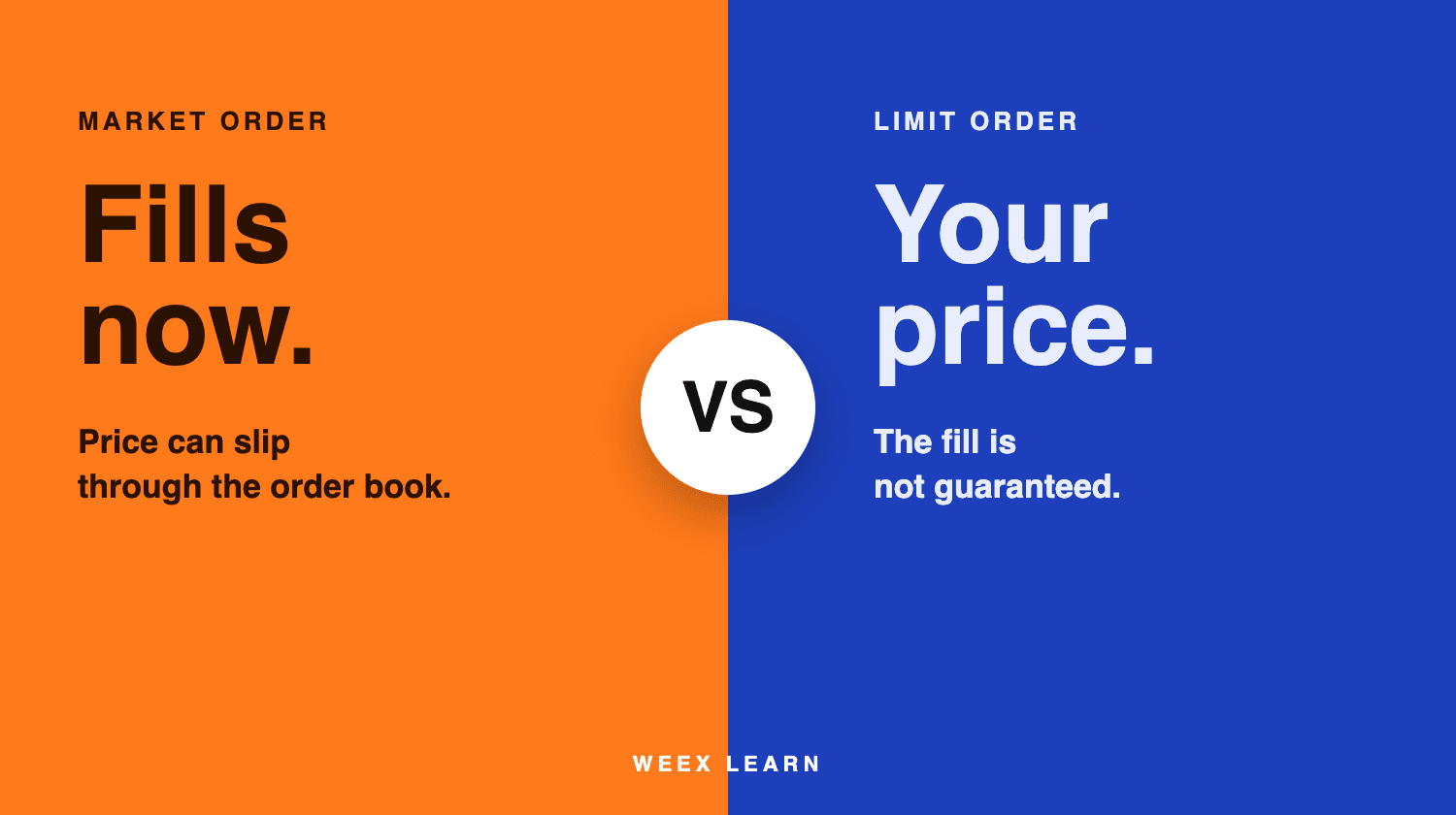
The difference between a limit order and a market order comes down to one trade-off. A market order guarantees that you trade right now but not the price you get. A limit order guarantees the price but not that you trade at all. Which one is right depends on whether speed or price matters more for that specific trade.
In crypto, that choice carries more weight than in most stock markets. Order books for smaller tokens can be thin, markets never close, and prices can move several percent in minutes. A market order that works fine on bitcoin can cost real money on a small-cap altcoin.
Below is a plain comparison, a worked slippage example, and a set of simple rules for choosing between the two, using WEEX market data from October 14, 2026.
Limit Order vs Market Order: The Core Difference
Market order. You tell the exchange to buy or sell a set amount immediately at the best available prices. It fills against whatever orders are sitting in the book. You almost always get filled, but your average price depends on how much is available near the current price.
Limit order. You set the worst price you will accept. The order fills only at that price or better. If the market does not reach it, the order waits in the book. You always know your price, but you might not get a fill.
Two other differences matter in practice:
- Who provides liquidity. A market order removes liquidity from the book, which makes you a taker. A resting limit order adds liquidity, which usually makes you a maker. Many exchanges charge makers lower fees than takers, so limit orders can be cheaper as well as more precise.
- What can go wrong. With a market order the risk is a bad price, known as slippage. With a limit order the risk is no trade, or only a partial one.
A Slippage Example: Why Market Orders Cost More in Thin Markets
Slippage is the gap between the price you see and the average price you actually pay. It is small when the order book is deep and large when it is thin.
Compare two markets on WEEX on October 14, 2026. BTC/USDT traded around $83,367 with about $720 million in 24-hour volume. OP/USDT traded around $0.1589 with about $20 million in 24-hour volume, after a 20% move that day.
Now take an illustrative order book for a thinner token, similar in shape to what smaller altcoins often show:
- 200,000 tokens offered at $0.1592
- 200,000 tokens offered at $0.1595
- 200,000 tokens offered at $0.1600
- 200,000 tokens offered at $0.1607
A market buy for 800,000 tokens sweeps all four levels. The average price works out to about $0.1599, roughly 0.4% above the best offer of $0.1592. On a $128,000 order that is about $500 lost to slippage before fees. If the book were thinner, or the market moving fast, the gap would be wider.
A buy limit at $0.1595 for the same amount would fill the first two levels right away and leave the rest waiting. You would pay no more than $0.1595, but you might end up with only half the position you wanted.
On BTC, the same dollar amount would barely move the price. That is why the right choice depends on the market, not just the order type.
When to Use a Market Order
Market orders make sense when getting the trade done matters more than the exact price:
- Exiting a position fast. If a leveraged trade is moving against you and you need out now, a market order is the reliable tool.
- Small orders in deep markets. Buying $200 of BTC or ETH with a market order costs almost nothing in slippage.
- Fast-moving breakouts you do not want to miss, as long as you accept that the fill may be worse than the price you saw.
-- Price
When to Use a Limit Order
Limit orders make sense when price matters more than speed:
- Planned entries and exits. Buy at a support level, sell at a target, and let the market come to you.
- Thin or volatile markets. Smaller tokens, low-volume hours and news-driven spikes are where limit orders protect you most.
- Larger orders. Splitting a big trade into several limit orders at different prices reduces the market impact of buying or selling all at once.
- Saving on fees, where the exchange charges makers less than takers.
A useful middle ground is a marketable limit order: a buy limit set slightly above the current ask, or a sell limit slightly below the bid. It fills immediately like a market order but caps how far the price can slip.
How Each Order Looks on WEEX
On a WEEX spot market such as BTC/USDT, the order panel has two tabs, Limit and Market. On the Limit tab you enter a price and an amount. On the Market tab you only enter the amount, because the price is whatever the book offers. For futures, the same choice appears alongside trigger and trailing stop orders, explained in WEEX's guide to market, limit, trigger and trailing stop orders.
If you want an order that waits for a price level before activating, that is neither a plain limit nor a market order but a stop order, which comes in stop market and stop limit versions.
The rule of thumb for limit order vs market order: use a market order when you must trade now and the market is deep, and use a limit order whenever the price matters or the order book looks thin. When in doubt on a small token, start with a limit.
FAQ
1. Is a limit order or a market order better for beginners?
Limit orders are usually safer for beginners because the price is fixed in advance. Market orders are simpler but can fill at a worse price in thin or fast markets.
2. Why did my market order fill at a different price than I saw?
The order consumed several price levels in the order book, or the price moved between the moment you clicked and the moment it matched. That difference is slippage.
3. Why did my limit order not fill?
The market never reached your price, or it touched your price but the volume available there was used up by orders placed earlier.
4. Are limit orders cheaper than market orders?
Often, yes. A limit order that rests in the book usually pays the maker fee, which is typically lower than the taker fee paid by a market order. Check the fee schedule for the exact rates.
This content is provided for general informational purposes only and doesn't constitute financial, investment, legal, or tax advice. Any events, rewards, online promotions, or related information mentioned herein should not be considered a recommendation, solicitation, or invitation to purchase, sell, trade, or otherwise deal in any crypto assets. Crypto assets are highly volatile and may result in loss. The availability of WEEX services, products, and related events may vary by region. You are responsible for ensuring that your participation is in accordance with applicable local laws and regulations.
You may also like
What Is a Limit Order? How It Works and When to Use It

Best Crypto Miner for Beginners: What to Check on Cost, Power, Hashprice and Profit Before You Buy
What Is a Limit Order? How It Works in Crypto With BTC Examples

Stop Limit Order: How It Works and Why It Can Fail to Fill

Best Crypto Platform for Beginners: Pick by Goal, Not Brand

Best Crypto Podcasts for Beginners: A 4-Week Listening Plan
How to Buy Crypto Anonymously: 5 Methods, Real Costs and Limits

Will Bitcoin Break $87,000 This Week? CPI, Fed Speakers and ETF Outflows to Watch

Conflux (CFX) Price Jumps on China's National Blockchain Network Plan: Does the Policy Actually Name CFX?
BTC Futures Analysis: $80K Held, but Longs Are Still Paying Up
ETH Futures: Why Ether Is Falling Faster Than Bitcoin This Week
ENA Token Price Drops After October 5 Unlock: What Happened to Ethena?
What Is Blockchain and How Does It Work? One Real Payment Traced

How to Buy Crypto With a Prepaid Card: Step-by-Step Guide
Best Crypto Trading Strategies for Beginners: What to Know Before You Trade
LayerZero Unlock October 2026: Can ZRO Hold $2 Amid Whale Inflows?
How to Buy Crypto With Apple Pay in 5 Steps: Why Your Bank May Decline the Payment
Why Does Bitcoin (BTC) Drop? How to Read a BTC Liquidation Heatmap Without Guessing the Bottom
Best Crypto Wallet App in 2026: How to Choose Between Hot, Cold, Custodial, and Web3 Wallets
What Is Blockchain and How Does It Work? One Real Block Explained
Trading Psychology for Beginners: The Math Behind Your Emotions
What Is Blockchain and How Does It Work? A Transaction Traced
Anonymous Crypto Wallet: What Still Protects Your Privacy in 2026

How to Buy Crypto with PayPal: The Custody Catch Most Beginners Miss
Bitcoin Futures at $83K: PnL and Position Sizing Into Jobs Week
HBAR Price Spike and Reversal: Long, Short, and Stop-Loss Orders
What Is XDP? Can Doppler Finance Break $0.03 in October 2026?
No KYC Crypto Wallet: 6 Picks and 5 Places Your ID Still Leaks
Bitcoin Cash Futures: CME Contracts vs Perpetuals Explained
Common P2P Crypto Scams and How to Spot Them
What Is a Limit Order? How It Works and When to Use It
Best Crypto Miner for Beginners: What to Check on Cost, Power, Hashprice and Profit Before You Buy
What Is a Limit Order? How It Works in Crypto With BTC Examples
Stop Limit Order: How It Works and Why It Can Fail to Fill
Best Crypto Platform for Beginners: Pick by Goal, Not Brand
Best Crypto Podcasts for Beginners: A 4-Week Listening Plan
Contents
Popular coins
Latest articles


