What Is a Limit Order? How It Works in Crypto With BTC Examples

 Prefer us on Google
A limit order is an instruction to buy or sell an asset only at a price you choose or better. A buy limit will never pay more than your price, and a sell limit will never accept less. The trade-off is simple: you control the price, but the order only fills if the market comes to you.
That makes the limit order the default tool for anyone who cares about the exact price they pay, which in crypto is most people. Markets run 24/7, order books can be thin outside the largest coins, and a single fast candle can turn a market order into an expensive surprise.
This guide explains what a limit order is, walks through real examples using bitcoin at $83,366.98, the BTC/USDT spot price on WEEX on October 14, 2026, and covers the details most explainers skip: partial fills, how long an order stays open, and why setting the price on the wrong side of the market fills you instantly.
How a Limit Order Works
Every limit order has three parts:
- Side: buy or sell.
- Limit price: the worst price you will accept. For a buy, the most you will pay. For a sell, the least you will take.
- Amount: how much of the asset you want to trade.
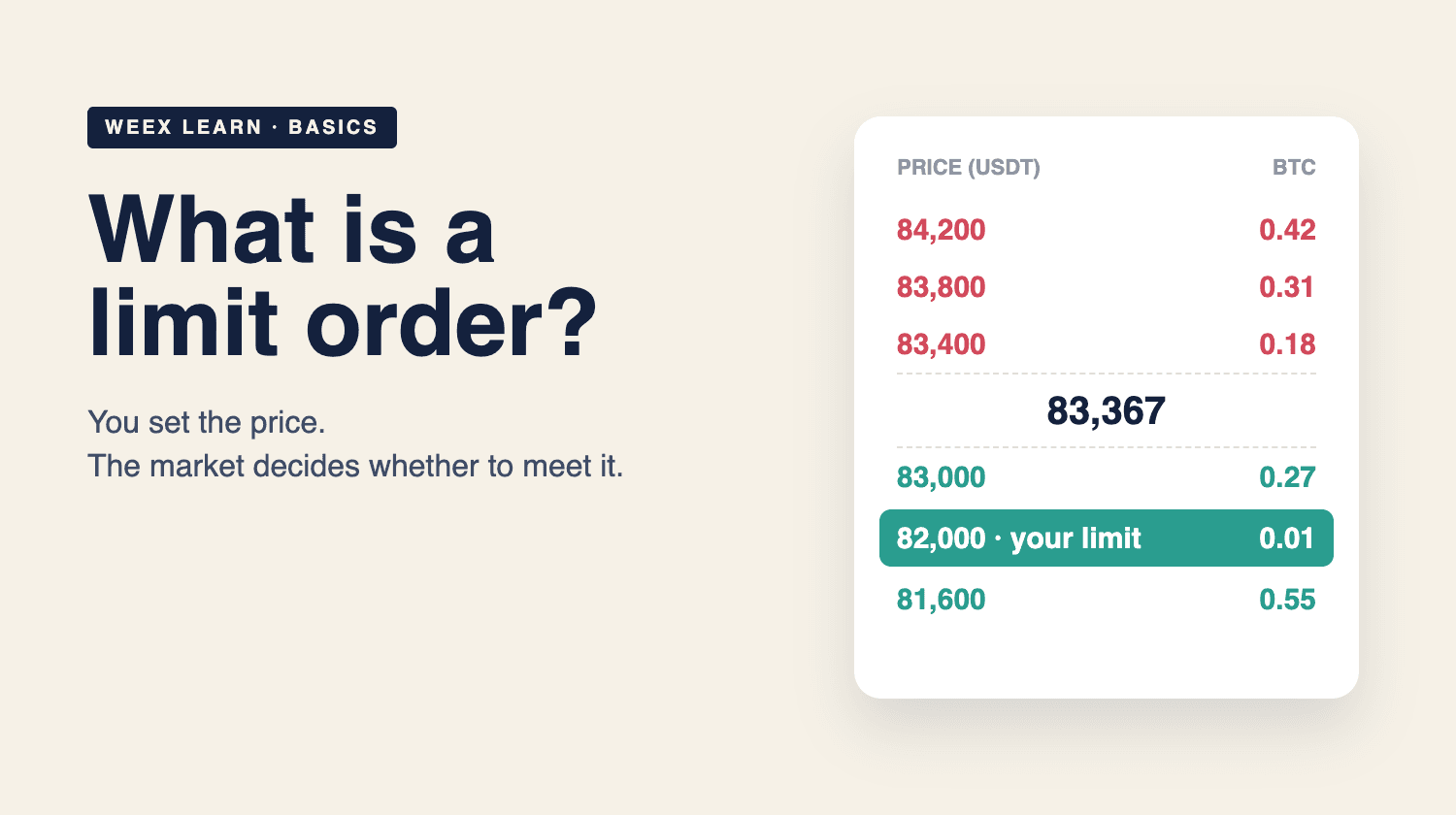
When you submit the order, the exchange checks whether anyone on the other side is already willing to trade at your price or better. If not, your order joins the order book and waits. It fills when a matching order arrives, and it can fill at a better price than your limit, never a worse one.
On a spot exchange, this is the "Limit" tab in the order panel. You enter a price and an amount, the total in USDT is calculated for you, and the order sits in the book until it fills or you cancel it.
What Is a Limit Order Example With Bitcoin?
Take BTC at $83,366.98, with a 24-hour range on October 14, 2026 of $81,041.12 to $84,168.
Buy limit below the market. You want 0.01 BTC but think $82,000 is a better entry. You place a buy limit at $82,000. Nothing happens until sellers are willing to sell at $82,000 or less. If BTC dips to that level, you buy 0.01 BTC for about $820 plus fees. If it never dips, you never buy, and that is the risk you accept.
Sell limit above the market. You already hold 0.01 BTC and want to take profit at $85,000. You place a sell limit at $85,000. It waits in the book and fills only if buyers reach that price. You get $850 for the position, or more if a buyer bids higher at the moment your order matches.
A limit order that fills right away. If you place a buy limit at $84,000 while BTC trades at $83,367, your price is already above the best offer. The order fills immediately at the best available ask, which is close to the market price, not at $84,000. A limit price is a cap, not a target.
Why Traders Use Limit Orders in Crypto
The main reason is price protection. A market order fills at whatever the order book offers, and in a fast market or a thin one that can be well away from the price on your screen. A limit order removes that uncertainty.
Three crypto-specific reasons make it more important than in stocks:
- No closing bell. Crypto trades around the clock, so an order you leave open can fill at 3 a.m. during a sharp move. A limit order makes sure that if it fills, it fills at a price you agreed to.
- Uneven liquidity. BTC has deep order books. A small altcoin may have only a few thousand dollars bid near the market, so a market order of any size can sweep through several price levels.
- Planning instead of watching. Limit orders let you set entries and exits in advance instead of reacting to every candle.
The cost is that you can miss the trade. If BTC turns at $82,050 and runs to $90,000, your $82,000 buy limit never fills. Experienced traders accept that, because a disciplined entry that sometimes misses beats a chase that often overpays.
-- Price
Limit Order Details Beginners Often Miss
Partial fills. If you want 0.05 BTC at $82,000 but only 0.02 BTC is offered at that price before the market bounces, you get 0.02 BTC and the remaining 0.03 BTC stays open. Always check whether an order filled fully.
How long the order lasts. Most crypto exchanges treat a limit order as good until canceled, meaning it stays open until it fills or you cancel it. An order you forgot about can fill weeks later, at a moment when you no longer want the trade.
Limit orders do not trigger. A plain limit order sits in the book from the start. If you want an order that activates only after the price reaches a certain level, that is a stop limit order, covered in our stop limit order guide.
Round numbers attract crowds. Many traders place orders at $80,000 or $85,000. Price often stalls just before or wicks just through those levels. Setting a sell at $84,950 instead of $85,000 can be the difference between a fill and a near miss.
How to Place a Limit Order on WEEX
- Open the BTC/USDT spot market or the pair you want to trade.
- In the order panel, choose Buy or Sell, then select the Limit tab.
- Enter your limit price in USDT.
- Enter the amount, or use the slider to set it as a share of your available balance. Check the total.
- Confirm the order, then find it under your open orders, where you can cancel or adjust it.
For a broader walkthrough of every order type on the platform, see Understanding Order Types on WEEX Exchange.
The core idea of a limit order fits in one line: you set the price, the market decides whether to meet it. Use limit orders when the price matters more than the speed, keep an eye on partial fills, and cancel orders you no longer want before they surprise you.
FAQ
1. What is a limit order in simple terms?
It is an order to buy or sell only at your chosen price or better. If the market never reaches that price, the order does not fill.
2. Can a limit order fill at a better price than I set?
Yes. A buy limit can fill below your price and a sell limit above it if a better offer is available when the order matches.
3. What happens if my limit order never fills?
It stays open until you cancel it or it expires under the exchange's rules. You keep your funds or your coins the whole time.
4. Is a limit order better than a market order?
It is better when price matters most, such as entering at a planned level or trading a thin market. A market order is better when you need to get in or out immediately.
This content is provided for general informational purposes only and doesn't constitute financial, investment, legal, or tax advice. Any events, rewards, online promotions, or related information mentioned herein should not be considered a recommendation, solicitation, or invitation to purchase, sell, trade, or otherwise deal in any crypto assets. Crypto assets are highly volatile and may result in loss. The availability of WEEX services, products, and related events may vary by region. You are responsible for ensuring that your participation is in accordance with applicable local laws and regulations.
You may also like
What Is a Limit Order? How It Works and When to Use It

Best Crypto Miner for Beginners: What to Check on Cost, Power, Hashprice and Profit Before You Buy
Limit Order vs Market Order: Which One to Use When Trading Crypto

Stop Limit Order: How It Works and Why It Can Fail to Fill

Best Crypto Platform for Beginners: Pick by Goal, Not Brand

Best Crypto Podcasts for Beginners: A 4-Week Listening Plan
How to Buy Crypto Anonymously: 5 Methods, Real Costs and Limits

Will Bitcoin Break $87,000 This Week? CPI, Fed Speakers and ETF Outflows to Watch

Conflux (CFX) Price Jumps on China's National Blockchain Network Plan: Does the Policy Actually Name CFX?
BTC Futures Analysis: $80K Held, but Longs Are Still Paying Up
ETH Futures: Why Ether Is Falling Faster Than Bitcoin This Week
ENA Token Price Drops After October 5 Unlock: What Happened to Ethena?
What Is Blockchain and How Does It Work? One Real Payment Traced

How to Buy Crypto With a Prepaid Card: Step-by-Step Guide
Best Crypto Trading Strategies for Beginners: What to Know Before You Trade
LayerZero Unlock October 2026: Can ZRO Hold $2 Amid Whale Inflows?
How to Buy Crypto With Apple Pay in 5 Steps: Why Your Bank May Decline the Payment
Why Does Bitcoin (BTC) Drop? How to Read a BTC Liquidation Heatmap Without Guessing the Bottom
Best Crypto Wallet App in 2026: How to Choose Between Hot, Cold, Custodial, and Web3 Wallets
What Is Blockchain and How Does It Work? One Real Block Explained
Trading Psychology for Beginners: The Math Behind Your Emotions
What Is Blockchain and How Does It Work? A Transaction Traced
Anonymous Crypto Wallet: What Still Protects Your Privacy in 2026

How to Buy Crypto with PayPal: The Custody Catch Most Beginners Miss
Bitcoin Futures at $83K: PnL and Position Sizing Into Jobs Week
HBAR Price Spike and Reversal: Long, Short, and Stop-Loss Orders
What Is XDP? Can Doppler Finance Break $0.03 in October 2026?
No KYC Crypto Wallet: 6 Picks and 5 Places Your ID Still Leaks
Bitcoin Cash Futures: CME Contracts vs Perpetuals Explained
Common P2P Crypto Scams and How to Spot Them
What Is a Limit Order? How It Works and When to Use It
Best Crypto Miner for Beginners: What to Check on Cost, Power, Hashprice and Profit Before You Buy
Limit Order vs Market Order: Which One to Use When Trading Crypto
Stop Limit Order: How It Works and Why It Can Fail to Fill
Best Crypto Platform for Beginners: Pick by Goal, Not Brand
Best Crypto Podcasts for Beginners: A 4-Week Listening Plan
Contents
Popular coins
Latest articles