
Jensen Huang's Resignation Sparks Discussion on Dual-Class Share Structures: One Share, One Vote vs. Founder Control

 Prefer us on Google


The resignation of Jensen Huang, the former CEO of NVIDIA, has reignited discussions in the U.S. about dual-class share structures, focusing on corporate governance in large tech companies. Dual-class share structures can grant founders voting rights that far exceed those of ordinary shareholders, leading to significant divergence in opinions on whether this system protects management control or undermines the checks and balances between shareholders and the board of directors.
A dual-class share structure is a type of equity mechanism where shares held by founders and certain shareholders have greater voting rights than ordinary shares, often referred to as "super-voting shares."
The prominent U.S. shareholder advocacy group As You Sow issued a statement on the 14th local time, stating that NVIDIA does not employ a dual-class share structure, allowing its board to effectively oversee management. The organization advocates that other companies should also adhere to the "one share, one vote" principle.
As You Sow's CEO Andrew Behar remarked, "The investigation by NVIDIA's board that ultimately led to Jensen Huang's resignation demonstrates what effective oversight looks like." He added, "When a CEO acts improperly, the board must have the power to hold them accountable."
The organization views Meta as a typical case where dual-class shares harm shareholder interests. Meta's CEO Mark Zuckerberg holds only about 13% of the company's shares but controls approximately 60% of the total voting power due to the dual-class structure.
At Meta's 2020 shareholder meeting, several proposals were put to a vote, including account verification, removal of harmful images, and cessation of false political ads. Among independent shareholders, 63.1% supported these proposals, but after accounting for Zuckerberg's super-voting shares, the final support rate for the proposals was only 19%.
As You Sow believes that if these proposals had passed, Meta might have avoided paying up to $17.1 billion (approximately 23 trillion KRW) in settlement costs related to lawsuits over teenage social media addiction. The core argument is that dual-class shares prevent shareholder demands from being realized, ultimately causing losses for both the company and investors.
Purnima Luthra, a professor at Imperial College Business School in the UK, also commented that if NVIDIA had adopted a dual-class share structure, Huang's immense power could have exacerbated the crisis. She stated, "For NVIDIA, if Jensen Huang himself was unwilling to resign, the current share structure still allows for the possibility of his removal." She explained, "NVIDIA's single-class share structure means that all shareholders, including Huang, have one vote each, so the board's actions do not provide him with much protection."
She compared companies like Meta and SpaceX, where voting rights are concentrated in the hands of founders, adding, "Such share structures make it difficult for shareholders to hold powerful company leaders accountable."
However, some argue that NVIDIA's governance arrangement without dual-class shares makes the founder's operational control too fragile. This view suggests that founders who adhere to long-term strategies can easily be pushed out under external pressure or board resolutions.
Jeffrey Sonnenfeld, a professor at Yale School of Management who has long supported dual-class shares, pointed out in an interview on November 8 that Huang lacks super-voting rights to solidify his control. He described Huang as one of the few leaders who achieved tremendous success at NVIDIA without the support of dual-class shares, while also noting that if Huang had super-voting rights, it would be much more difficult for the board to remove him.
-- Price
This content is provided for general informational purposes only and doesn't constitute financial, investment, legal, or tax advice. Any events, rewards, online promotions, or related information mentioned herein should not be considered a recommendation, solicitation, or invitation to purchase, sell, trade, or otherwise deal in any crypto assets. Crypto assets are highly volatile and may result in loss. The availability of WEEX services, products, and related events may vary by region. You are responsible for ensuring that your participation is in accordance with applicable local laws and regulations.
You may also like

Retail Sales and Fed Minutes Put Bitcoin’s Rate Outlook Back in Focus

BlackRock Applies for ETIF Structure, Breaking 15% Holding Limit on Private Assets

Thailand Stablecoin Transfer Limit: What the SEC Draft Proposes

SPCX Stock After the Starship Catch: Price, IPO Level and Booster Loss

OpenAI Launches ChatGPT Wallet to Enable AI Agents to Pay by Card

German Lawmakers Back Customs Powers to Seize Crypto of 'Unclear Origin'

BeiGene Plans to Invest $19.5 Million in Bravera's Series A Financing

BeiGene Plans to Invest $19.5 Million in Bravera's Series A Financing

Mr&强 Attends WEEX Anthropic Event
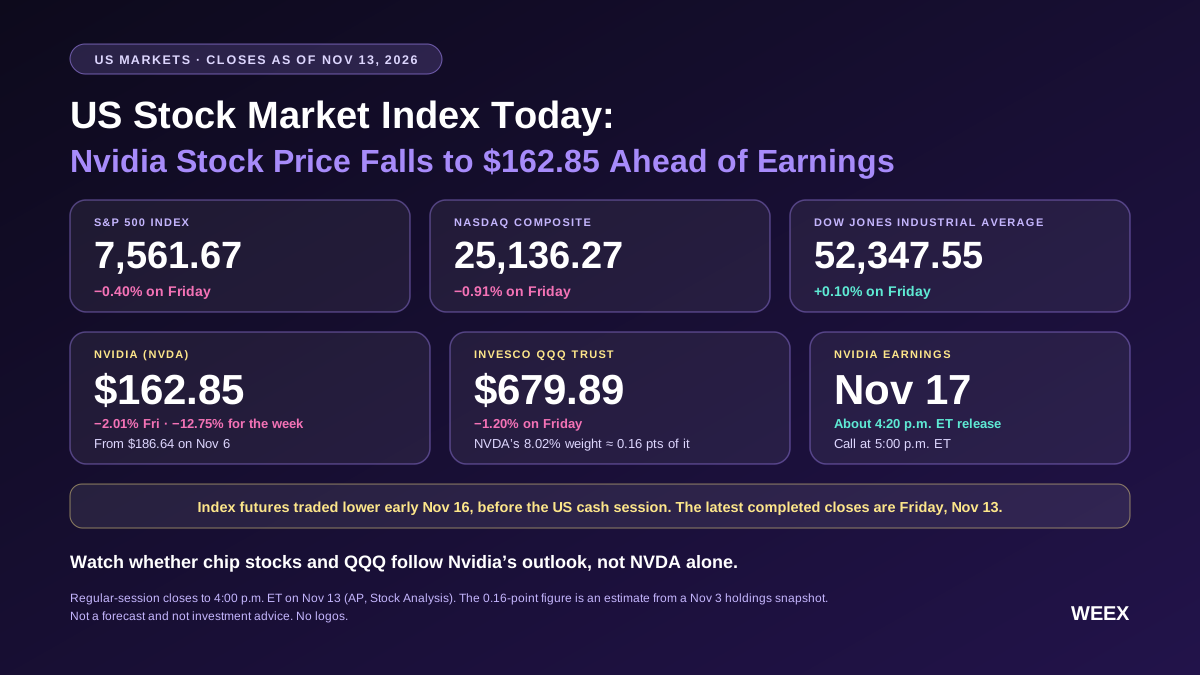
US Stock Market Index Today: Nvidia Stock Price Falls to $162.85 Ahead of Earnings(S&P 500 and QQQ )
Track US stock index futures, the S&P 500 and Dow, and see how Nvidia’s $162.85 close and November 17 earnings could shape QQQ and the broader market.

WEEX Lucky Eggs: How to Earn Daily Egg Cracks and Win Every Time
Learn how to earn daily WEEX Lucky Eggs from qualifying futures trading volume, check your progress, and understand what “Win Every Time” means.

Michael Burry's Puts on the Nasdaq-100 Run to April 2027. I'm Not Following Him.

Nasdaq Futures vs. Dow Futures: Key Points for Cryptocurrency Traders Before the US Market Opens

Why Are Investors with $15 Billion No Longer Just Investing in Cryptocurrency?

Crypto VC May Only Have 1 to 2 Investment Cycles Left as AI and Robotics Take Over as New Capital Battlegrounds

Nvidia Stock Is Down About a Third From Its October Peak. Here's My Estimate for 2030.

Goldman Sachs and Morgan Stanley Have Divergent Views on Yen Outlook
Tether wants its gold token to rival ETFs

How $10,000 in stablecoins would have gained €420 without earning interest

Rivian to Host Autonomy and AI Day on Dec. 9
Stocks Have Risen a Year After Every Midterm Since 1950. Here’s What That Does and Doesn’t Tell You.

21 Banks Commit $270 Million to Project Faro
US Crypto Legislation Progress Uncertain as Industry Eyes New Congress

NVIDIA Earnings Report, Anthropic IPO, and Federal Reserve Meeting Minutes Take Center Stage in the Market

Ansem Expects Cryptocurrency to Test Summer Lows, Bull Market May Start in Q2 2027

MARA Sells 13,597 BTC for $1 Billion to Fund AI Data Center Costs
唐华斑竹 Discusses Volatility in the Altcoin Market

If a Bear Market Is Coming, History Says Warren Buffett's Proven Strategy Is Key
Corporate Interest to Rise in 2026, Demand for Crypto Assets Increasing

Wall Street wants 24/7 trading, but somebody has to bankroll the weekend
Retail Sales and Fed Minutes Put Bitcoin’s Rate Outlook Back in Focus
BlackRock Applies for ETIF Structure, Breaking 15% Holding Limit on Private Assets
Thailand Stablecoin Transfer Limit: What the SEC Draft Proposes
SPCX Stock After the Starship Catch: Price, IPO Level and Booster Loss
OpenAI Launches ChatGPT Wallet to Enable AI Agents to Pay by Card
German Lawmakers Back Customs Powers to Seize Crypto of 'Unclear Origin'
Latest articles


Latest coin listings on WEEX


