
Nasdaq Futures vs. Dow Futures: Key Points for Cryptocurrency Traders Before the US Market Opens

 Prefer us on Google



Key Points: Nasdaq-100 futures and Dow futures are different baskets with distinct constituent stocks and weighting rules. The movements during the night can suggest a reassessment of US stock risks before the start of cash trading, but they do not provide direct signals for Bitcoin. Cryptocurrency traders should identify the news behind the movements and verify whether there is a reaction after aligning trading hours with the market structures of the dollar, interest rates, and BTC itself.
These markets present US stock risks at observable prices even when the cash stock market is closed. This comparison is useful for cryptocurrency desks only when futures contracts, quote times, and the causes of price movements can be identified. A surge in searches for "Nasdaq futures" is not evidence that contracts have moved or that Bitcoin has followed suit.
Indices Measure Different Exposures
The calculation method for the Nasdaq-100 describes a modified market capitalization-weighted index composed of 100 non-financial companies listed on the Nasdaq market. Within the index rules, larger companies generally have a greater impact. The calculation method for the Dow Jones Industrial Average describes a price-weighted index of 30 stocks. Stocks with higher prices may have a larger impact on index points even if their market capitalization is smaller than that of other constituents.
This structural difference is more important than headlines like "stock market decline." Earnings surprises from technology companies can move Nasdaq futures more than Dow futures. Conversely, volatility concentrated in materials or financial stocks may lead to the opposite pattern. Even if the two contracts indicate different directions, it does not necessarily mean that one is lagging or incorrect. This divergence is a clue as to which exposure the market is reassessing.
Changes in index points cannot be directly compared either. A 300-point change in Nasdaq futures and a 300-point change in Dow futures have different percentage implications. Compare returns (in %) from pre-announced settlement values and check whether the front month has rolled over or if dividends or funding adjustments have not affected the levels. Avoid inferring that one market has a stronger "fear" simply because it has larger point changes.
There are further pitfalls on the market data sidebar. The screenshots obtained in this report show labels like "US Tech 100" and "Dow Jones," but these labels alone do not identify the exchange-traded NQ or YM futures contracts. There may also be index quotes or vendor quotes with different trading hours or calculation rules. For strict comparisons, record the exact contract symbols, exchanges, and timestamps before placing the two returns side by side.
Futures Move on a Different Clock than Cash Stocks and Bitcoin
US cash stocks have regular trading sessions. Stock index futures trade for much longer periods and have designated maintenance times. According to CME contract information, these futures can be traded for 23 hours a day from Sunday to Friday. Bitcoin trades continuously. Overlapping time zones and daylight saving time changes can cause discrepancies.
This creates multiple different market windows, such as after US cash stocks close, during European mornings, in the US pre-market, the first 30 minutes after cash trading begins, and weekends when CME stock futures close while BTC remains open. The correlation measured across all these windows will be a mixture of different information environments. If futures are closed when relevant news breaks, the night-time BTC fluctuations cannot necessarily be correlated with the futures.
In event analysis, use UTC timestamps and record the local session boundaries of the exchanges. Compare the highly liquid front month futures rather than the index spot quotes that may be frozen after cash closes. When futures roll over, use continuous data with documented adjustments or calculate returns before and after the event with the same active contract.
Futures levels also incorporate funding costs and expected dividends. Therefore, the gap between stock index futures and the corresponding cash index itself does not predict directional movements. Typically, this gap tends to narrow as expiration approaches, and the levels of the next month may differ even without equivalent fluctuations in the underlying asset basket during rollover. As a cross-asset signal, use the futures return (in %) within a single contract and specify the rollover policy. Charts that splice contract prices without adjustments can create false night jumps and misleading BTC correlations.
What Night-Time Movements Mean
Declines in stock futures may reflect earnings announcements, interest rate reassessments, geopolitical developments, or forced reductions in exposure. The implications for BTC depend on the mechanisms involved. Observations of rising real interest rates can exert pressure on both technology stocks and BTC. Conversely, an earnings miss from a single company may have little direct impact on Bitcoin. Liquidity shocks can ripple through both markets, regardless of fundamentals.
In useful desk notes, three questions should be asked in order: What information has arrived? Check the timestamps of announcements or notifications. Which asset was reassessed first? Compare futures, interest rates, the dollar, BTC cash, and BTC perpetual futures. Did the reaction persist? The meaning of signals differs between futures fluctuations that reverse after cash opens and those accompanied by broad reassessments with volume.
Even if Nasdaq futures and BTC decline simultaneously, this does not prove that stock investors sold Bitcoin at the same time. Both assets may be reacting to a third factor. The measured leading and lagging relationships can also change depending on the sample period and market regime, and cannot be estimated from a single session.
-- Price
How to Better Examine the Relationship Between BTC and Futures
Define your hypothesis before selecting charts. For example: "When US macro indicators are scheduled for release, do NQ one-minute returns lead BTC returns over the next five minutes?" Next, collect synchronized one-minute data for NQ, YM, BTC cash, BTC perpetual futures, US Treasury yields, and the dollar. Exclude periods when any contract is closed or has low liquidity. Separate scheduled macro events from individual company announcements. Calculate returns rather than raw prices.
Verify multiple lags and report sample sizes. Check whether apparent patterns survive in out-of-sample periods. If relationships only appear after selecting the best of dozens of lags, they may be noise. Bid-ask spreads and latency are important: a statistical edge of a few seconds may be impractical when accounting for fees and slippage. Conversely, relationships that hold over several hours may reflect broader risk reassessments rather than mechanical propagation from one market to another.
Separate analyses by catalyst. Surprises in policy interest rates change discount rates and dollar environments, earnings from large technology companies change narrow parts of the Nasdaq basket, and exchange-specific cryptocurrency outages change the microstructure of BTC. Combining these into a single regression may yield average coefficients that do not apply to any of them. A useful report shows directionalities, confidence intervals, sample sizes, and realized trading costs for each class of events. It also examines whether YM provides additional information when including NQ, yields, and the dollar. If it does not, the second futures series is not an independent signal but a complementary context.
| Observations | Most Plausible Interpretation | Necessary Checks |
|---|---|---|
| NQ down, YM steady | Pressure may be concentrated on exposures with high Nasdaq ratios | Index constituents and earnings calendar |
| Both NQ and YM down | Possibility of broader reassessment of US stocks | Interest rates, dollar, sector breadth, cash open |
| BTC down while futures hold | Cryptocurrency-specific factors may be leading | BTC cash flow, funding rates, liquidations, regulatory news |
| BTC fluctuations during CME closure | Next futures open may react to BTC or common news | News timing and open liquidity |
How Traders Should Utilize This Comparison
Treat index futures not as a switch determining BTC's direction but as context. This comparison helps determine which questions to pursue: macro interest rates, technology earnings, or leveraged trading. If volatility is broad, check whether BTC's own order book or derivative positions are confirming stress. If volatility is localized, avoid elevating a single stock headline to an investment thesis in the cryptocurrency market.
Positions based on night-time signals come with not only analytical issues but also execution problems. Futures liquidity, BTC spreads, and stop orders may exhibit different behaviors before and after cash market openings or scheduled data releases. Traders should clarify the target product, session, invalidation points, and expected slippage before acting. The key outcome is execution adjusted for risk, not whether two lines on a chart moved simultaneously in the past.
Conclusion: Nasdaq futures and Dow futures help identify the sources and timing of stock risks. The discrepancies between the two carry information due to differences in construction methods. For Bitcoin, the bridge from stock futures to price must be validated within the context of synchronized data and events that moved both markets.
This content is provided for general informational purposes only and doesn't constitute financial, investment, legal, or tax advice. Any events, rewards, online promotions, or related information mentioned herein should not be considered a recommendation, solicitation, or invitation to purchase, sell, trade, or otherwise deal in any crypto assets. Crypto assets are highly volatile and may result in loss. The availability of WEEX services, products, and related events may vary by region. You are responsible for ensuring that your participation is in accordance with applicable local laws and regulations.
You may also like

Mazama Energy Finds New Solution to the Biggest Challenge in Geothermal Drilling

Is Apple Losing Its Memory?

Energy Transfer vs. Enbridge: Which High-Yield Pipeline Stock Could Make You Richer Over the Next 10 Years?

Jefferies Raises Spotify Price Target to $710, Expects Over 20% Growth in Free Cash Flow

The Application is Landing, Wealth is Evaporating: Analyzing the Painful Roots of the Crypto Industry through Three Financial Statements

Baidu Q3 Net Profit Exceeds Expectations, AI Cloud Revenue Soars 94%, Token Call Revenue Grows 1159%
Twenty One Capital’s $1.09 Billion Profit Is Mostly a Bitcoin Accounting Story

What Licenses Are Needed for Crypto Payments in Hong Kong?
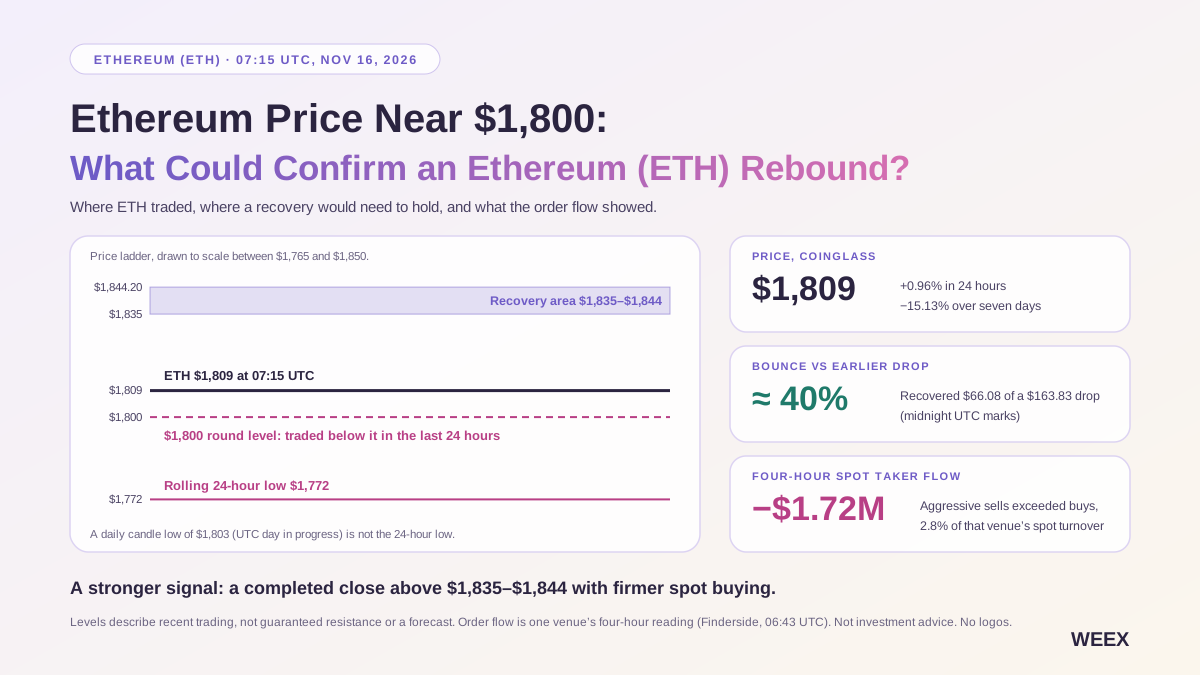
Ethereum Price Near $1,800: What Could Confirm an Ethereum (ETH) Rebound?
Ethereum traded near $1,800 on November 16. See what four-hour spot order flow, futures positioning, and Friday’s ETF flows say about an ETH rebound.

Nakamoto Extends Part of $60 Million Loan to Kraken Until 2027

Global Cryptocurrency 'Audit' Trend Emerges
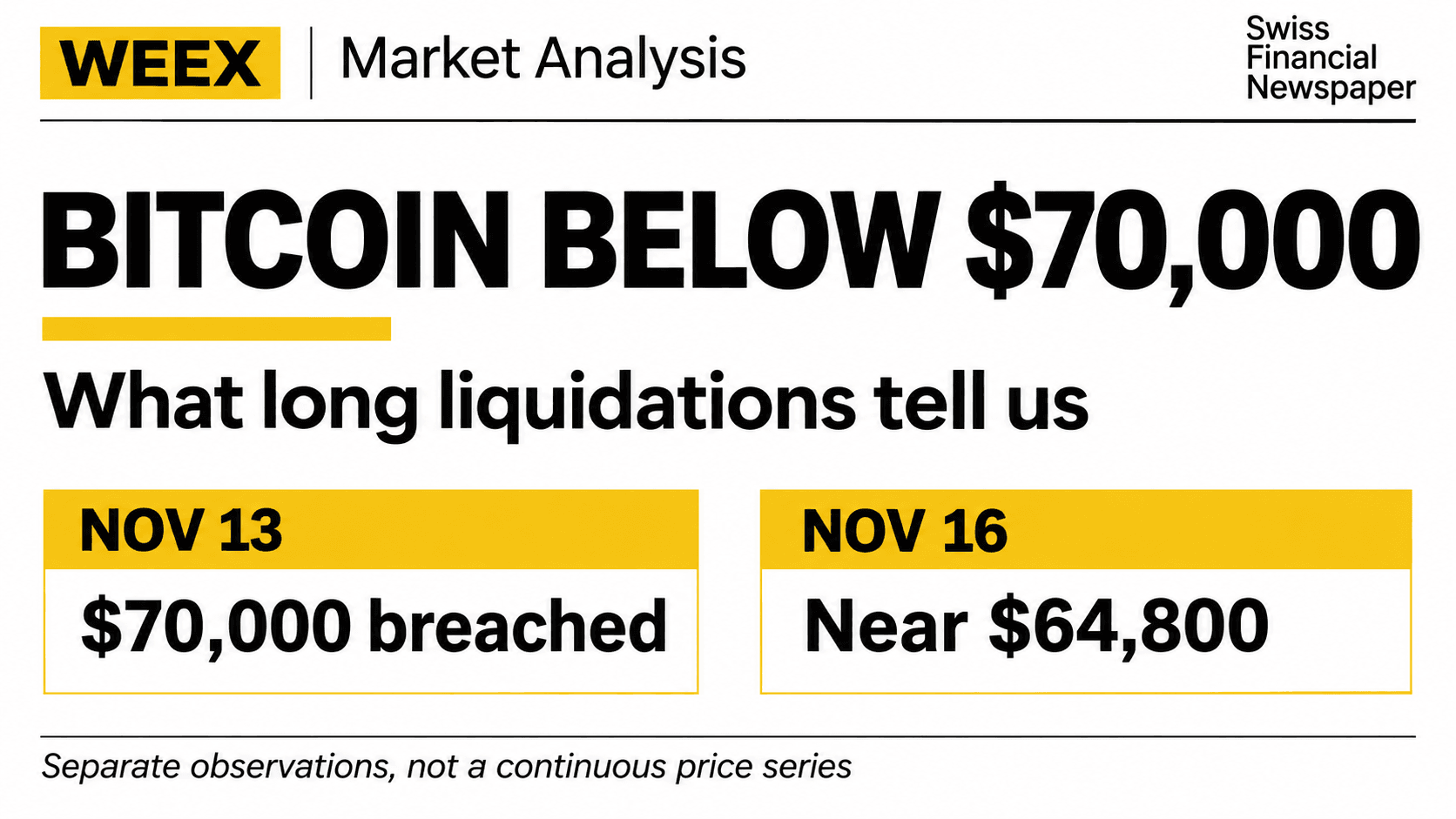
Why Did Bitcoin (BTC) Drop Below $70,000? What Long Liquidations Tell Us
See why Bitcoin fell below $70,000 on November 13, how long liquidations amplified the decline, and what to watch before calling a rebound. If you already plan to trade, you can check whether your activity qualifies for the WEEX Lucky Eggs event, scheduled to run through November 25, 2026 (UTC+8).

Wall Street Wants 24/7 Trading, But Weekend Cash Needs to Be Covered

Bank of America’s Hartnett: The Dollar is 'Destroying Everything', Remains Risk-Averse Before Dollar Decline

When the Crypto Engine Enters Traditional Finance: A Conversation with Bitget's CFD Head on How to Achieve a 10 Billion Cross-Border Sample in Ten Months?

Crypto VC May Only Have 1 to 2 Investment Cycles Left as AI and Robotics Take Over as New Capital Battlegrounds

The Cryptocurrency Circle No Longer Exists

Is Meta Stock Still a Buy After Borrowing About $25 Billion This Month?

Archer Aviation and Joby Aviation: Speculative Plays With Upside Potential and Downside Risk
Wall Street Tests the AI Boom: What the Industry's Balances Reveal After the Democratic Victory

How These 6 Natural Gas Stocks Make Money

Is Credo Technology a Better AI Networking Buy Than Broadcom?

Wintermute Spends $824,000 on Front-Running Trades in the Last 30 Days
Yishi Advises to Stay Away from Leverage and Altcoins, Survival is the Top Priority

From 'Patching' to 'Eliminating Entire Classes of Bugs': How to Build Internet Resilience?

One Year of JPYC Stablecoin: First Gas-Free User is Quail Egg Merchant; Single Transaction Limit Set at 1 Million Yen
[Analysis] Two Barriers Preventing Bitcoin from Rising

Is CoreWeave Stock a Buy After Its Latest Earnings?

5 Dividend Stocks With High Yields That Are Safer Than You Might Think

Netflix Engagement Growth Is Slowing. Here’s Why I Bought More Anyway.
Mazama Energy Finds New Solution to the Biggest Challenge in Geothermal Drilling
Is Apple Losing Its Memory?
Energy Transfer vs. Enbridge: Which High-Yield Pipeline Stock Could Make You Richer Over the Next 10 Years?
Jefferies Raises Spotify Price Target to $710, Expects Over 20% Growth in Free Cash Flow
The Application is Landing, Wealth is Evaporating: Analyzing the Painful Roots of the Crypto Industry through Three Financial Statements
Baidu Q3 Net Profit Exceeds Expectations, AI Cloud Revenue Soars 94%, Token Call Revenue Grows 1159%
Latest articles


Latest coin listings on WEEX


