
Layer 1 Faces 'Survival of the Fittest' Era... ZetaChain and Harmony Ride on Solana and Ethereum

 Prefer us on Google


[Block Media Reporter Ham Ji-hyun] The strategy for survival in the competition to build independent Layer 1 (L1) blockchains is changing. Instead of maintaining their own validators and consensus networks, projects are increasingly utilizing the security, developer, and liquidity infrastructure of large blockchains like Solana and Ethereum.
However, the reasons for abandoning L1 vary. ZetaChain has shifted its business focus to AI applications, raising the question, "Is a standalone chain really necessary?" In contrast, Harmony has faced escalating costs and risks in defending its independent network due to repeated security incidents.
ZetaChain and Harmony Abandon Their Own Layer 1... "Focusing on AI"
According to industry sources on the 22nd, the ZetaChain community voted 99.4% in favor of governance proposal 68, which gradually phases out its own L1 and issues ZETA tokens as SPL-based tokens on the Solana network. The voter participation rate was 58%, surpassing the quorum of 40%.
Since its launch in 2021, ZetaChain has positioned cross-chain interoperability connecting different blockchains like Bitcoin and Ethereum as its core business. However, it has recently shifted its focus to the privacy-oriented AI application 'Anuma.'
In the proposal, ZetaChain cited the burden of continuously coordinating security patches and updates from upper software with validators to maintain a Cosmos SDK-based chain. It explained that the speed of vulnerability discovery has increased due to advancements in AI tools, potentially leading to greater maintenance burdens in the future.
As a result, ZetaChain has chosen to leave network security and consensus to Solana while concentrating its development capabilities on user applications like Anuma.
Thus, ZetaChain's abandonment of L1 can be seen not as a withdrawal due to business failure, but as a strategic shift from being a "company that directly operates a blockchain" to a "company that creates AI services on top of large blockchains."
Harmony also proposed to end its own L1 this month and transfer the ONE token to an Ethereum ERC-20 token. It plans to focus its efforts on a "remix economy" business centered around AI video creators.
On the surface, it appears similar to ZetaChain's structure of "ending L1 → focusing on AI business," but for Harmony, repeated security incidents have been the backdrop for discussions about ending the chain.
Harmony suffered approximately $100 million in damages from the Horizon Bridge attack in 2022. Subsequently, in August 2026, a vulnerability in cross-shard transaction verification was exploited, leading to an incident where attackers repeatedly used multiple transactions to counterfeit over 3 trillion ONE tokens.
Ultimately, Harmony pushed for a rollback to a point before the attack. In this process, normal transactions that occurred after the attack were also discarded, resulting in over 109,000 transactions disappearing from the records.
Harmony explained that continuing to operate its own L1 would lead to increasing security burdens to respond to nation-state attackers and AI-based attack tools.
The transition of Harmony's ONE to an Ethereum ERC-20 token is also being considered after the chain's termination. However, the current proposal is non-binding, and the final termination block or specific transition schedule has not yet been determined.
Celo and Ronin: Transitioning to Ethereum L2 Without Eliminating Their Chains
While ZetaChain and Harmony are moving towards terminating their independent chains, Celo and Ronin have chosen a different path.
Celo transitioned from an independent EVM-compatible L1 to an OP Stack-based Ethereum Layer 2 (L2) in March 2025. This approach maintains the state and applications of the existing chain while connecting payment and security structures to Ethereum.
The game-specialized blockchain Ronin also completed its transition to an OP Stack-based Ethereum L2 in May of this year. It changed its structure to rely on Ethereum for security and final settlement while maintaining the identity of its own network.
As a result, the four projects can be broadly categorized into two groups.
ZetaChain and Harmony are terminating their independent L1s and transferring only their tokens to large chains. In contrast, Celo and Ronin are changing their structures to Ethereum L2 while maintaining their existing networks and states.
The reasons for these decisions can be further divided: ZetaChain focuses on business efficiency, Harmony on security burdens, and Celo and Ronin on leveraging Ethereum's security and liquidity while trying to maintain their network identities.
"Is a Standalone L1 Really Necessary?"... Layer 1 Faces 'Survival of the Fittest' Era
Projects with their own L1 have the advantage of being able to design gas tokens, staking, and validator policies independently.
On the other hand, they must independently secure consensus algorithms, node software management, validator rewards, security patches, bridge operations, as well as developers, users, and liquidity. If they do not grow sufficiently in scale, these costs remain a continuous burden for the project.
Conversely, by riding on Ethereum or Solana, they may relinquish some control over their own consensus networks, but they can utilize the already established security, development tools, users, and liquidity.
As a result, the competitive standards in the blockchain industry are also changing.
In the past, having an independent L1 was a symbol of a project's technical prowess and independence, but recently, the question of whether a truly independent chain is necessary for operating a service has become more important in terms of economics and sustainability.
This judgment is also reflected in other digital asset projects recently.
Ethena founder Guy Young stated in an interview with The Block this month that he considered building a standalone blockchain but would have considered it "a mistake" if he had pursued it.
Young assessed that the market is no longer at a stage where it demands additional "universal chains" that aim to provide everything to everyone. If a project directly owns its infrastructure, it may lead to competition with existing partners rather than focusing on the growth of its core products.
However, Hashib Qureshi, managing partner at Dragonfly Capital, expressed concerns on the 17th about the 'winner-takes-all' structure where large Layer 1 chains like Ethereum and Solana dominate all markets.
He criticized that as real-world assets (RWA) such as stocks and bonds move to blockchain, the regulatory compliance and operational methods of financial institutions vary, necessitating the coexistence of various specialized blockchains. He stated, "Each network has network effects, but one network cannot indefinitely absorb all economic activities."
-- Price
This content is provided for general informational purposes only and doesn't constitute financial, investment, legal, or tax advice. Any events, rewards, online promotions, or related information mentioned herein should not be considered a recommendation, solicitation, or invitation to purchase, sell, trade, or otherwise deal in any crypto assets. Crypto assets are highly volatile and may result in loss. The availability of WEEX services, products, and related events may vary by region. You are responsible for ensuring that your participation is in accordance with applicable local laws and regulations.
You may also like
Zcash Foundation disowns ZRC-20 and CASH token

ZetaChain, Linera, Switchboard Cease Operations
ZetaChain's AI Application Anuma Surpasses 200,000 Users

ZetaChain Introduces Anthropic's Claude Opus 5, Offers Free Access to ZETA Stakers
AI girlfriend apps generate 427.3 million dollars in consumer spending
The ZetaChain vulnerability was reported in advance by white hats but was ignored, ultimately leading to a $334,000 attack incident
ZetaChain: Previously targeted vulnerability attacks did not result in user fund losses, mainnet patch has been deployed

ZetaChain: Previous targeted attacks did not affect user funds, mainnet patch has been deployed
ZetaChain was attacked, exploiting a vulnerability that may stem from a defect in the GatewayZEVM call function

ZetaChain announced that the GatewayEVM contract has been attacked and cross-chain transactions have been suspended
RootData: ZETA will unlock tokens worth approximately $2.38 million in one week
Crypto: Kalshi accused of inflating its volumes with thousands of identical orders
South Korea targets November review for second stage crypto legislation
WEEX P2P now supports XOF, XAF & CDF—Merchant Recruitment Now Open
21Shares: Privacy coins grow nearly 5x in one year

HODLing ETH: Should You Choose Staking for Yield or Collateralized Lending?

SEC Clarity Meets Fed Rate Hike: How WEEX TradFi Lucky Eggs S2 Taps Into Cross-Market Opportunities
AI Risk as an Opportunity for Bitcoin Pricing
Crypto firms put $206 million behind the midterms: here’s who their political machine is backing
EURC scam: Dutch police arrest 2 over fake Rolex deals

Bitcoin 2x Leveraged ETF Launches on Cboe, But Doesn't Buy Bitcoin: Here's Why
Crypto: The ECB Enters the Tokenized Bond Market

How Significant Are Changes in Overseas AI Investment?
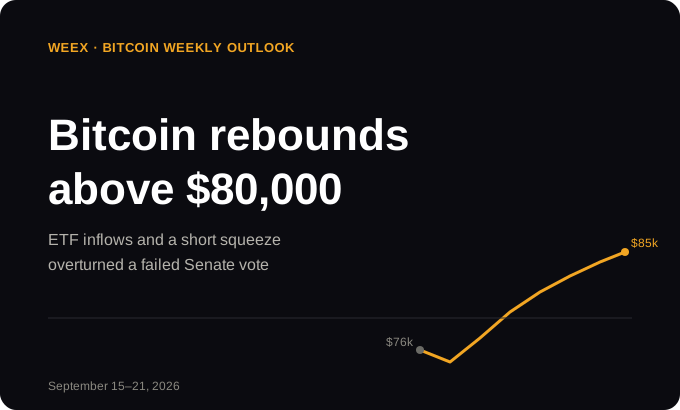
WEEX Bitcoin Weekly Outlook: Why Did Bitcoin Rebound Above $80,000 After the CLARITY Act Vote?
Bitcoin rebounded above $80,000 as SEC and CFTC action, renewed ETF inflows, and a short squeeze outweighed the failed CLARITY Act vote.
From AI Trading to AI Asset Management: What Does Robinhood Have in Place and What Do Startups Still Lack?
$8 Makes a Comeback, This Time X Money Rewrites the Logic of NFT Issuance

CoinFerenceX and The Best Event to Launch Joint Web3 Summit in Singapore
Crypto and Robotics: True Revolution or New Speculative Bubble?
Coldcard whitehats move 52.37 BTC to recovery trust
Bitcoin's Rise Does Not Mean the Bull Market Has Returned; Don't Create Stories for Yourself
Zcash Foundation disowns ZRC-20 and CASH token
ZetaChain, Linera, Switchboard Cease Operations
ZetaChain's AI Application Anuma Surpasses 200,000 Users
ZetaChain Introduces Anthropic's Claude Opus 5, Offers Free Access to ZETA Stakers
AI girlfriend apps generate 427.3 million dollars in consumer spending
The ZetaChain vulnerability was reported in advance by white hats but was ignored, ultimately leading to a $334,000 attack incident


