
How to Backtest a Crypto Trading Strategy? A Beginner’s Guide

 Prefer us on Google
Before running a crypto trading bot or putting a quantitative strategy into live trading, many traders first ask an important question: would this strategy have worked in the past?
Backtesting helps answer this question by applying a trading strategy to historical market data and simulating possible results.
However, backtesting is not a way to predict future profits. A strategy that performs well on historical data can still fail because of changing market conditions, trading costs, execution delays, or unexpected events.
The real purpose of backtesting is to understand whether a strategy has a reasonable logic, identify potential risks, and improve the trading system before using real capital.
What Is Crypto Trading Strategy Backtesting?
Crypto trading strategy backtesting is the process of testing a trading idea using historical market data.
For example, a trader may create a simple Bitcoin strategy:
- Buy when the short-term moving average crosses above the long-term moving average.
- Sell when the trend reverses.
A backtesting system applies these rules to previous BTC price data and calculates what the result would have been.
A complete backtest usually considers more than price movements. It may include:
| Data Type | Purpose |
|---|---|
| Price data | Determines when trading conditions appear |
| Trading volume | Helps evaluate market activity |
| Trading fees | Shows the real cost of execution |
| Slippage | Simulates the difference between expected and actual prices |
Without realistic assumptions, a backtest may show results that are difficult to reproduce in live trading.
Why Is Backtesting Important in Crypto Quantitative Trading?
A trading idea may sound reasonable but perform poorly in real markets.
For example, a trader might believe that “buying after every major price drop” is a good strategy. Historical testing may reveal that this approach works during short corrections but fails during a prolonged bear market.
Backtesting provides three main benefits.
First, it helps validate whether a strategy has a clear logic. Instead of relying on intuition, traders can use historical evidence to evaluate their assumptions.
Second, it helps identify risk. A strategy may generate positive returns but experience a large drawdown before recovering. Understanding these periods is important before using real funds.
Third, backtesting reduces emotional decision-making. Quantitative trading focuses on predefined rules rather than reacting to every market movement.
However, backtesting should be viewed as a research tool, not a guarantee of future performance.
What Metrics Should You Check in a Crypto Backtest?
Many beginners focus only on total return, but a profitable strategy needs more detailed analysis.
| Metric | What It Shows |
|---|---|
| Total Return | Overall historical profit or loss |
| Maximum Drawdown | Largest decline from the previous peak |
| Win Rate | Percentage of profitable trades |
| Profit/Loss Ratio | Average gain compared with average loss |
| Number of Trades | Whether the sample size is meaningful |
| Fees and Slippage | How realistic the result is after costs |
For example, a strategy with a 90% win rate may still lose money if its losing trades are much larger than its winning trades.
A better evaluation looks at the relationship between return and risk. A strategy with lower returns but smaller drawdowns may be more practical than one with higher returns and extreme volatility.
How to Backtest a Crypto Trading Strategy Step by Step
Step 1: Define Clear Trading Rules
Before testing, the strategy needs specific rules.
These should include:
- When to enter a trade;
- When to exit;
- How much capital to use;
- When to stop trading.
For example:
“Buy BTC when the price moves above the 60-day moving average and close the position when it falls below the 20-day moving average.”
Clear rules make the strategy easier to test and improve.
Step 2: Collect Historical Market Data
A backtest requires reliable market data.
Common data includes:
- Historical prices;
- Candlestick charts;
- Trading volume;
- Order information.
For developers building automated systems, exchange APIs can provide structured market data for strategy testing.
For example, the WEEX API provides API resources that developers can use to connect trading programs with market data and trading functions.
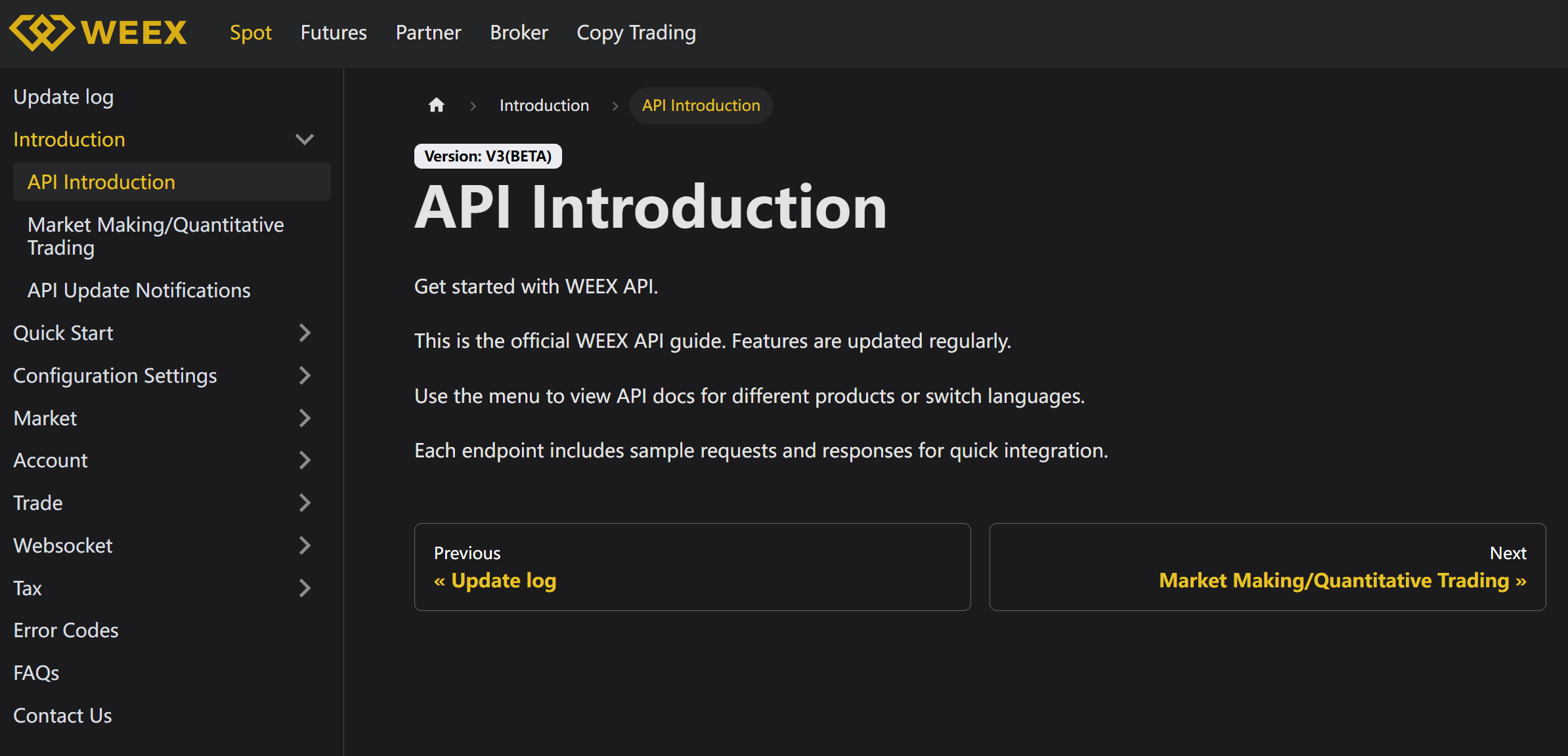
However, API data is only the foundation of testing. The quality of results still depends on the strategy logic, testing method, and risk management.
Step 3: Run the Backtest Under Different Market Conditions
Testing only one market period can create misleading results.
A strategy should ideally be tested during different environments:
- Strong upward trends;
- Market declines;
- Sideways price movements.
For example, a trend-following strategy may perform well during a strong rally but struggle when prices move within a narrow range.
A good backtest checks whether the strategy can handle different situations rather than only finding the best historical result.
Step 4: Review Results and Improve Carefully
After testing, traders can adjust strategy parameters.
However, there is an important risk: overfitting.
Overfitting happens when a strategy is adjusted repeatedly until it perfectly matches historical data. While the backtest may look impressive, the strategy may fail when facing new market conditions.
A useful strategy should perform reasonably well across different periods, not only in one selected dataset.
Common Mistakes When Backtesting Crypto Strategies
Ignoring Trading Costs
One of the most common mistakes is testing without including fees and slippage.
A strategy that makes frequent small trades may appear profitable in a backtest but lose money after real execution costs.
For example, futures trading strategies also need to consider funding rates, which can affect long-term results.
Testing With Too Little Data
A strategy that works for several weeks may simply benefit from a specific market condition.
Longer testing periods help reveal whether the strategy can handle different market cycles.
Optimizing Only for Maximum Profit
The highest historical return is not always the best choice.
A strategy with extreme returns may also have large drawdowns or require excessive risk.
Professional quantitative traders usually balance return, risk, consistency, and execution costs.
Backtesting vs Paper Trading vs Live Trading
Backtesting is only one stage of strategy development.
| Method | Purpose |
|---|---|
| Backtesting | Tests strategy logic using historical data |
| Paper Trading | Tests execution in real-time conditions without real funds |
| Live Trading | Evaluates actual performance with real capital |
A strategy that passes backtesting should still be tested in a simulated environment before moving to live trading.
Real markets include factors that historical simulations may not fully capture, such as liquidity changes, order execution delays, and unexpected volatility.
Can Backtesting Guarantee Crypto Trading Profits?
No. Backtesting can show how a strategy performed under previous market conditions, but it cannot predict future results. Markets change because of:
- Different volatility levels;
- New market participants;
- Changing liquidity;
- Unexpected events.
A strong quantitative process does not search for a strategy that “never loses.” Instead, it focuses on building a system with reasonable expectations and controlled risk.
Conclusion
Backtesting is one of the most important steps in crypto quantitative trading. It helps traders understand whether a strategy has potential, how much risk it may involve, and where improvements are needed.
A practical workflow is: Create a strategy → Collect historical data → Run backtests → Analyze risks → Paper trade → Start with limited capital
For developers building automated trading systems, exchange APIs such as WEEX API can provide the connection between trading programs and market data. However, API access does not make a strategy profitable. The final result still depends on research, execution quality, and risk management.
Backtesting should be treated as a way to make better decisions, not as a promise of future returns.
This content is provided for general informational purposes only and doesn't constitute financial, investment, legal, or tax advice. Any events, rewards, online promotions, or related information mentioned herein should not be considered a recommendation, solicitation, or invitation to purchase, sell, trade, or otherwise deal in any crypto assets. Crypto assets are highly volatile and may result in loss. The availability of WEEX services, products, and related events may vary by region. You are responsible for ensuring that your participation is in accordance with applicable local laws and regulations.
You may also like

Kioxia Stock and SK Hynix: What Rivals Sharing the Same Shareholder Actually Means

Is HIMS Stock a Buy After the Earnings Selloff? What the Full-Year Guidance Raise Actually Implies

ASTS Stock Falls After Missing Q2 Estimates: What the Revenue Miss and Japan Launch Actually Mean
Intel Stock Is Up Over 170% in 2026: What the AI Foundry Turnaround Actually Required
Intel Stock Sale Draws Over $100 Billion in Demand: What the 5x Oversubscription Actually Signals

RKLB Stock Price Targets Range From $64 to $150: What the Analyst Disagreement Actually Reveals

RKLB Stock Has Fallen Sharply Since SpaceX's IPO: What History Says Happens to Number Two Players
SPCX Stock Price Target Raised to $450 by Arete Research: What the Upgrade After the Cursor Deal Actually Means

SPCX Stock Closes Above Its $135 IPO Price for the First Time in Weeks: What the Recovery Actually Signals
XST Coin: Which Token Is It, and How Thin Is the Market?

HOOD Stock at $94: Record Revenue, Crypto Slump, 24/7 Access

XRP News: Which August 2026 Headlines Actually Move Price
CRWV Stock After Q2: Demand Is Fine, the Interest Bill Isn't

PROM on 12 August 2026: What Upbit Added and What the Price Did
What Is Prom (PROM)? The Polygon CDK Chain, the Token and Where It Trades
Best Crypto Trading Bot Strategies for Beginners
How High Can XST Reach? Buy, Hold, or Wait?
How to Build a Crypto Trading Bot With an Exchange API: A Beginner’s Guide
Crypto Trading Bot vs Manual Trading: Which Is Better?
Is Cronos (CRO) Still Worth Buying in 2026? Ecosystem Growth, Staking Yields and Risk Factors
Google Stock and the $200 Billion Anthropic Financing Program: What the Largest AI Deal in History Means for GOOG

Why Is Cronos (CRO) Gaining Trader Attention? Key Drivers Behind the Recent Volume Surge

Is Bitcoin Preparing for a Bullish Breakout? Key Technical Indicators and On-Chain Data
How to Avoid Liquidation During Market Crashes? Futures Risk Management Strategies
Which AI Crypto Tokens Are Surging Today? Top Decentralized AI Projects to Watch
Is Cronos (CRO) Preparing for a Major Rally? Catalysts, Risks and the 2026 Outlook
Which Major Tokens Face Massive Unlocks Tomorrow? Market Impact and Price Predictions
HIMS Stock Falls After Raising Guidance: What the GLP-1 Regulatory Uncertainty Actually Changes
What Are the New Crypto Regulation Laws? Essential Compliance Guide for Traders
ASTS Stock Price Prediction 2026-2027: Can AST SpaceMobile Recover After the Launch Bottleneck
Kioxia Stock and SK Hynix: What Rivals Sharing the Same Shareholder Actually Means
Is HIMS Stock a Buy After the Earnings Selloff? What the Full-Year Guidance Raise Actually Implies
ASTS Stock Falls After Missing Q2 Estimates: What the Revenue Miss and Japan Launch Actually Mean
Intel Stock Is Up Over 170% in 2026: What the AI Foundry Turnaround Actually Required
Intel Stock Sale Draws Over $100 Billion in Demand: What the 5x Oversubscription Actually Signals
RKLB Stock Price Targets Range From $64 to $150: What the Analyst Disagreement Actually Reveals
Contents
Popular coins
Latest articles