
Baidu Q3 Net Profit Exceeds Expectations, AI Cloud Revenue Soars 94%, Token Call Revenue Grows 1159%

 Prefer us on Google



Baidu Group released its Q3 2026 financial report, with total revenue reaching 30.8 billion RMB, aligning closely with market expectations. Despite ongoing pressure on its online marketing business, the implementation of its AI strategy is reshaping Baidu's revenue structure—this quarter, Baidu's core AI new business revenue reached 13.2 billion RMB, accounting for 53% of Baidu's general business revenue, surpassing half for the first time, marking an important milestone in the company's transformation from a search engine to an AI company.
One of the highlights of this quarter was the profit exceeding expectations. The adjusted profit per ADS reached 6.78 RMB, significantly higher than the market estimate of 6.02 RMB; the adjusted EBITDA was 4.49 billion RMB, also well above the expected 3.96 billion RMB. Although the operating profit margin under GAAP was only 2%, after excluding non-cash and non-operating items, the non-GAAP operating profit margin was 6%, and the non-GAAP net profit margin was 8%, indicating that the profitability of the core business is being maintained.
CEO Robin Li stated in the financial report that the long-term investment in full-stack AI is translating into scalable, substantial growth, with AI's role in shaping Baidu's future becoming increasingly important. CFO He Haijian emphasized that the company will adhere to a prudent capital allocation strategy, clearly focusing on investment returns. Operating cash flow recorded 2.8 billion RMB, with total cash and investments reaching 276.6 billion RMB, providing ample ammunition for continued AI investments.
Intelligent Cloud Infrastructure: New Growth Engine in Full Swing
The most dazzling figure this quarter comes from the intelligent cloud infrastructure segment—revenue reached 8.2 billion RMB, soaring 94% year-on-year and growing 11% quarter-on-quarter. Among them, GPU cloud revenue grew 191% year-on-year and 43% quarter-on-quarter, reflecting strong market demand for public cloud AI computing power.
More telling is the Token call revenue from Baidu's Qianfan MaaS platform, which grew a staggering 1159% year-on-year this quarter, intuitively reflecting the acceleration of large model commercialization. On the customer side, there were positive signals this quarter with increased customer prepayments and contracts shifting to longer terms, indicating that enterprise customers' stickiness and confidence in Baidu's AI infrastructure are strengthening.
On the hardware front, Baidu's Kunlun M100 chip made its debut at the World Artificial Intelligence Conference, positioned for large-scale AI inference optimization, with mass production expected by the end of 2026. This is an important layout for Baidu to improve its self-developed chip ecosystem and reduce reliance on external computing power.
Online Marketing: Structural Pressures Are Inevitable
Revenue from traditional online marketing services was 11.9 billion RMB, down 22% year-on-year and 9% quarter-on-quarter, with its proportion of Baidu's general business revenue dropping from 62% a year ago to 48%, falling below half for the first time.
Baidu's management attributed this decline to three pressures: a weak macroeconomic environment, a continuously evolving competitive landscape, and the company's strategic choice to prioritize user experience over short-term monetization during its AI search transformation. This statement implies that some of the marketing revenue loss is a strategic cost incurred intentionally, rather than purely a loss of market share. Baidu's APP monthly active users reached 604 million in September, indicating that the overall user base remains, but how to efficiently convert user traffic into marketing value in the AI era remains a core issue facing the company.
AI Applications and AI Native Marketing: Clear Growth Differentiation
Revenue from the AI applications segment was 2.6 billion RMB, roughly flat year-on-year, with a slight 1% increase quarter-on-quarter. This quarter, Baidu integrated its internal office AI agent Dodo, AI programming assistant Wenxin Kuaima Comate, and no-code programming platform into a unified work intelligent agent "Baidu Dazi DuMate," attempting to cover a wider range of enterprise scenarios through a single entry point. The daily active user penetration rate of AI features in Baidu Wenku and Baidu Wangpan increased by 60.7% year-on-year, indicating that the acceptance of AI features on the consumer side is rising, but monetization still requires time.
AI native marketing service revenue was 2.4 billion RMB, down 15% year-on-year and 7% quarter-on-quarter, making it the only segment of the new AI business to decline year-on-year, directly affected by the overall weakness in the marketing market. In November, Baidu launched "Ciyuan Suo"—a trading platform connecting AI model service providers and customers, which may be a new attempt by the company in building an AI marketing ecosystem.
-- Price
Luo Bo Kuai Pao: Expanding from China to the Global Autonomous Driving Landscape
The Robotaxi business Luo Bo Kuai Pao continued to expand this quarter. As of October 2026, the number of operational cities worldwide has expanded to 30, with approximately 34 million kilometers driven in the third quarter, and a cumulative mileage exceeding 390 million kilometers.
Geographic expansion was a highlight this quarter: in Shenzhen, the number of fully autonomous driving orders increased by about 170% quarter-on-quarter; in Dubai, Luo Bo Kuai Pao expanded its fully autonomous commercial operations and doubled its fleet size; in London, it continued to collaborate with Uber and Lyft for open road testing; in Hong Kong, it advanced fully autonomous driving tests at the airport island. The internationalization path of Luo Bo Kuai Pao is gradually becoming clearer, and it won the Consumer Service Award at the UK Autonomous Driving Industry Awards, endorsing its global reputation.
Cost Pressures and Capital Expenditures: The Price of Heavy Investment Cycles
While revenue is under pressure, costs have shown significant expansion. Sales costs reached 19.9 billion RMB, up 9% year-on-year, mainly driven by rising costs related to cloud business and traffic acquisition. In terms of capital expenditures, this quarter reached 7.3 billion RMB, a decrease from 11.4 billion RMB in the previous quarter, but free cash flow remains negative (-4.571 billion RMB), indicating that the company is still in a heavy investment phase.
R&D expenses were 4.8 billion RMB, down 7% year-on-year, with a slight quarter-on-quarter increase, showing that the company is maintaining AI R&D investment while also optimizing efficiency to some extent. Sales and management expenses were 5.5 billion RMB, down significantly by 17% year-on-year, mainly due to a reduction in expected credit loss expenses and channel expenditures, which to some extent supported the better-than-expected performance on the profit side.
Shareholder Returns and iQIYI: Two Parallel Lines
In terms of capital returns, since the beginning of Q1 2026, Baidu has returned $373 million to shareholders through share buybacks and expects to declare its first dividend by the end of 2026, subject to market conditions and board approval. This signal indicates that while maintaining high-intensity investment in AI, Baidu is also gradually increasing direct returns to shareholders.
iQIYI's performance continues to drag down overall results—this quarter, revenue was 6 billion RMB, down 10% year-on-year, below the market estimate of 6.29 billion RMB, with continued operating losses. The reduction in content costs partially offset the pressure from declining revenue, but the gap between iQIYI's strategic value and financial contribution as a streaming asset under Baidu remains a long-term focus for investors.
Baidu's US stock fell 1.37% in pre-market trading.
This content is provided for general informational purposes only and doesn't constitute financial, investment, legal, or tax advice. Any events, rewards, online promotions, or related information mentioned herein should not be considered a recommendation, solicitation, or invitation to purchase, sell, trade, or otherwise deal in any crypto assets. Crypto assets are highly volatile and may result in loss. The availability of WEEX services, products, and related events may vary by region. You are responsible for ensuring that your participation is in accordance with applicable local laws and regulations.
You may also like

$LIBRA: One of the defendants seeks to remove Judge Ledesma and halt the review that could reactivate the case

Mazama Energy Finds New Solution to the Biggest Challenge in Geothermal Drilling

Is Apple Losing Its Memory?

Energy Transfer vs. Enbridge: Which High-Yield Pipeline Stock Could Make You Richer Over the Next 10 Years?

Jefferies Raises Spotify Price Target to $710, Expects Over 20% Growth in Free Cash Flow

The Application is Landing, Wealth is Evaporating: Analyzing the Painful Roots of the Crypto Industry through Three Financial Statements
Twenty One Capital’s $1.09 Billion Profit Is Mostly a Bitcoin Accounting Story

What Licenses Are Needed for Crypto Payments in Hong Kong?
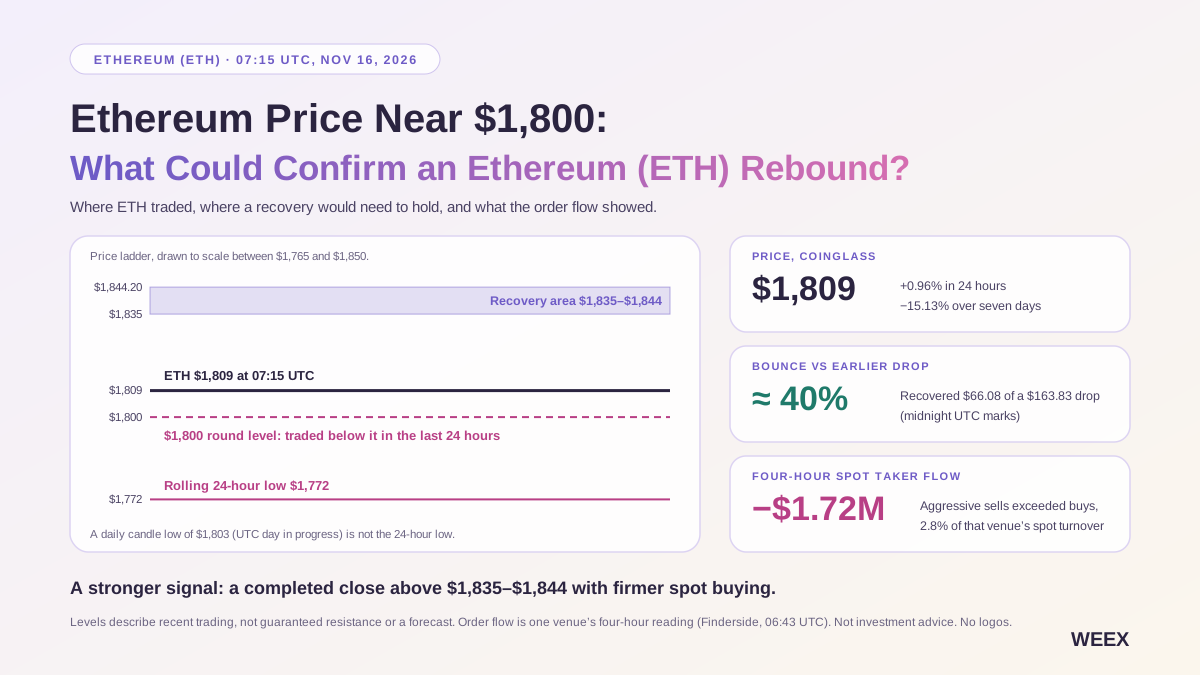
Ethereum Price Near $1,800: What Could Confirm an Ethereum (ETH) Rebound?
Ethereum traded near $1,800 on November 16. See what four-hour spot order flow, futures positioning, and Friday’s ETF flows say about an ETH rebound.

Nakamoto Extends Part of $60 Million Loan to Kraken Until 2027

Global Cryptocurrency 'Audit' Trend Emerges

Why Did Bitcoin (BTC) Drop Below $70,000? What Long Liquidations Tell Us
See why Bitcoin fell below $70,000 on November 13, how long liquidations amplified the decline, and what to watch before calling a rebound. If you already plan to trade, you can check whether your activity qualifies for the WEEX Lucky Eggs event, scheduled to run through November 25, 2026 (UTC+8).

Wall Street Wants 24/7 Trading, But Weekend Cash Needs to Be Covered

Bank of America’s Hartnett: The Dollar is 'Destroying Everything', Remains Risk-Averse Before Dollar Decline

Nasdaq Futures vs. Dow Futures: Key Points for Cryptocurrency Traders Before the US Market Opens

When the Crypto Engine Enters Traditional Finance: A Conversation with Bitget's CFD Head on How to Achieve a 10 Billion Cross-Border Sample in Ten Months?

Crypto VC May Only Have 1 to 2 Investment Cycles Left as AI and Robotics Take Over as New Capital Battlegrounds

The Cryptocurrency Circle No Longer Exists

Is Meta Stock Still a Buy After Borrowing About $25 Billion This Month?

Archer Aviation and Joby Aviation: Speculative Plays With Upside Potential and Downside Risk
Wall Street Tests the AI Boom: What the Industry's Balances Reveal After the Democratic Victory

How These 6 Natural Gas Stocks Make Money

Is Credo Technology a Better AI Networking Buy Than Broadcom?

Wintermute Spends $824,000 on Front-Running Trades in the Last 30 Days
Yishi Advises to Stay Away from Leverage and Altcoins, Survival is the Top Priority

From 'Patching' to 'Eliminating Entire Classes of Bugs': How to Build Internet Resilience?

One Year of JPYC Stablecoin: First Gas-Free User is Quail Egg Merchant; Single Transaction Limit Set at 1 Million Yen
[Analysis] Two Barriers Preventing Bitcoin from Rising

Is CoreWeave Stock a Buy After Its Latest Earnings?

5 Dividend Stocks With High Yields That Are Safer Than You Might Think
$LIBRA: One of the defendants seeks to remove Judge Ledesma and halt the review that could reactivate the case
Mazama Energy Finds New Solution to the Biggest Challenge in Geothermal Drilling
Is Apple Losing Its Memory?
Energy Transfer vs. Enbridge: Which High-Yield Pipeline Stock Could Make You Richer Over the Next 10 Years?
Jefferies Raises Spotify Price Target to $710, Expects Over 20% Growth in Free Cash Flow
The Application is Landing, Wealth is Evaporating: Analyzing the Painful Roots of the Crypto Industry through Three Financial Statements
Latest articles


Latest coin listings on WEEX


