
The Cryptocurrency Circle No Longer Exists

 Prefer us on Google



The traditional cryptocurrency circle no longer exists.
Written by: Liu Honglin
In Liu Cixin's novel "The Three-Body Problem," Wang Miao, a researcher of nanomaterials, gets caught up in a series of suicides among scientists.
One of them, Yang Dong, is a theoretical physicist and the girlfriend of Ding Yi. Wang Miao wants to know why she reached this point, so he goes to find Ding Yi.
Ding Yi takes him to a billiard table and asks him to pot the black ball, then move the table and try again. After several attempts, the ball goes in each time. Ding Yi then asks: What if the ball suddenly flies to the ceiling or even bounces around the room?
He uses billiards as a metaphor for particle collision experiments. Scientists intended to use a more powerful accelerator to verify physical theories, but found that under the same conditions, the experimental results varied each time. Yang Dong originally hoped to use experiments to validate her theories, but now she can't even find repeatable laws.
In her suicide note, this despair is summed up in one sentence: "Physics has never existed."
She always believed that the world has laws and that one can understand these laws through experiments. The education she received, the research she invested in, and the arrangements she made for her life were all based on this belief.
Now, what is shaken is the entire set of methods she used to understand the world.
The disappointment felt by some veterans in the cryptocurrency circle today reminds me of this passage.
The experiences they believed in for many years are also starting to fail: Bitcoin rises, but the altcoins they hold remain stagnant; Wall Street institutions have entered, yet financing for crypto projects and the exit of investors have not become easier. This doesn’t make sense; after all, in previous cycles, Bitcoin would rise first, and then money would flow into other altcoins, multiplying tenfold or a hundredfold. After several cycles, "waiting patiently for the next cycle" became the basis for many people's investment, entrepreneurship, and even life arrangements.
Admitting that this set of experiences may no longer work is harder than admitting a wrong purchase. But if the new money coming in never intended to buy your coins, waiting for another cycle may not yield the past results.
Yesterday, I finished reading an interview with Fu Peng, who said in the interview that the four-year cycle of Bitcoin has passed, and crypto assets will gradually be incorporated into traditional asset allocation frameworks. I agree with his judgment on the changes in the industry. Fund managers buying Bitcoin need to consider whether this position fits within the overall portfolio; after reducing their positions, they can also transfer money back to bonds or stocks. Retail investors waiting for funds to flow from Bitcoin to altcoins have no obligation to allocate assets in that order.
I commented: The traditional cryptocurrency circle no longer exists.
What Did the Old Cryptocurrency Circle Rely On?
The cryptocurrency circle once had a set of tried-and-true wealth codes.
The old cryptocurrency circle I refer to is the one that relied on issuing coins for financing, cashing out through exchanges, and then relying on the next round of newcomers to continue the chain. It provided many opportunities but also left behind a lot of manipulation, fraud, and profit transfer.
By 2026, betting the industry's future on this set of plays seems unfeasible.
Products are not yet developed, but grand narratives and white papers are already in place, with fundraising relying on issuing coins. Early investors wait to exit after going public, while users test and claim airdrops, hoping to sell their tokens for a good price later. Teams sell tokens under the guise of foundations to pay for development and operational costs. There’s less urgency about how to charge for the product later.
This method provided financing opportunities for small teams and supported the development of wallets, trading platforms, and developer tools. However, for projects that rely on token subsidies to maintain activity, when the coin price drops and subsidies stop, those who were just there for airdrops will leave. At this point, the team realizes that there are not many people willing to pay for the product, and the revenue cannot sustain the expenses for the next year.
In the early days of blockchain entrepreneurship, there was another belief: users distrust banks and large companies, do not want platforms to control their data, and need a decentralized alternative. However, in places where banks and payment services are already quite mature, many people have institutions they find convenient and trustworthy. Just relying on the term "decentralization" makes it hard to convince them to switch.
The totem of this cryptocurrency circle, Bitcoin, also has many buyers who choose to hold it through traditional institutions. They want to participate in Bitcoin investment but are not necessarily willing to study private keys or bear the losses from sending to the wrong address. Buying Bitcoin exchange-traded funds (ETFs) through familiar brokerage accounts allows them to hand over the hassle of custody to institutions.
The repeated emphasis on "assets being controlled by oneself" may not be as important to these customers as convenience.
Cryptocurrency is Becoming the Back-End of Finance
On July 18, 2025, Trump signed the "GENIUS Act" in the East Room of the White House, establishing a dedicated federal regulatory framework for payment stablecoins. Issuers must provide full qualified reserves, disclose the composition of reserves, and fulfill anti-money laundering obligations.
Many in the cryptocurrency circle see this as a victory: after so many years of turmoil, they have finally been accepted by the mainstream market.
But ultimately, it was a miscalculation.
The White House chose stablecoins because it hopes they will solidify the international status of the dollar, boost demand for U.S. Treasury bonds, and bring issuance and capital flow under regulation. The crypto industry has created a useful tool that the U.S. government sees as a means to serve its financial system.
The original ideals of the cryptocurrency circle were not the starting point for this policy choice.
Reported by Lianhe Zaobao: Trump signs the stablecoin bill (Photo: Reuters)
The U.S. government is calculating the dollar's account, and payment companies like Stripe have their own calculations.
These emerging payment companies are in the internet business, hoping to make their services available at any time. However, when it comes to cross-border capital flows, they still rely on banks and clearing systems. If a payment has to go through several banks, coordinating their processing times and reconciliation processes, it can be delayed by weekends and holidays. No matter how well the front-end products are made, payment companies find it hard to change this back-end process on their own.
Stablecoins allow cross-border fund transfers to operate around the clock on-chain. In July 2026, Stripe announced it would provide stablecoin payment services for Ramp, a corporate expense management platform. Companies still pay vendor bills from bank accounts, while Stripe's Bridge converts dollars into stablecoins and pays them to the recipient's wallet. Users don’t even need to hold the coins first, so there’s no talk of accepting the cryptocurrency circle's concept of "owning your private key means owning your assets."
This practical approach is naturally not rejected by banks that understand it. At the end of September, Visa and Lloyds Bank in the UK announced a seven-day pilot totaling $750,000. Lloyds purchased U.S. dollar stablecoins (USDC) through a regulated trading institution and transferred them to Visa's U.S. entity, with funds arriving within an hour and settlements completed over the weekend.
For the same payment obligation, settling early can reduce the amount of funds tied up waiting for settlement. After deducting exchange, custody, and compliance costs, if the entire process is more cost-effective, banks have reason to continue using it.
As for the monetary freedom discussed in the cryptocurrency circle, it is not important to the banks and payment institutions involved in this business.
The potential and commercial value of applying cryptocurrency technology in finance are recognized not only by payment and banking sectors but also by traditional stock markets.
In October this year, the Depository Trust & Clearing Corporation (DTCC) launched a securities tokenization service, with 20 participating institutions signing on, including JPMorgan and Citigroup. DTC converts eligible securities rights within its custody system into tokens, allowing them to be transferred on approved chains and also converted back to traditional forms. Securities remain within the original custody system, and the original rights and investor protections continue to be retained.
It provides an additional way to use existing securities without needing to issue a project token for financing first.
Caixin's report on DTCC's tokenization pilot (December 2025; the image shows the headquarters of the U.S. SEC)
What institutions care about is whether existing securities can circulate more timely and be used as collateral, minimizing idle assets. They are interested in blockchain technology but may not look favorably on the existing public chains of the cryptocurrency circle.
The aforementioned DTCC used its own private network and the Canton network when launching its services. Tokens only circulate between wallets registered with DTC and also incorporate compliance controls. Identity verification, anti-money laundering, and regulatory cooperation that were originally required still need to be done on-chain.
These institutions come in with their own rules, and leading exchanges like Binance and OKX are also actively aligning with them.
In the old cryptocurrency circle, exchanges were at the top of the food chain, controlling traffic and trading opportunities, creating many wealth stories. However, how much assets institutional clients are willing to trade depends on whether exchanges can meet their capital management requirements.
For example, Binance's banking arrangement allows qualified institutional clients to keep collateral in regulated banks' corporate accounts while trading on the exchange. OKX's institutional solution with Standard Chartered Bank also keeps collateral with independent banks outside the exchange. To attract institutional orders, exchanges are integrating bank custody into their products.
All of this is significantly different from the previous practices in the cryptocurrency circle.
Projects relied on issuing tokens for crowdfunding in their early stages, promising a permissionless internet where users control their data and assets, while participants expected token appreciation. The current businesses can exist without relying on this narrative.
Technology is being applied in finance, and the old cryptocurrency circle's business model of relying on issuing tokens, going public, and waiting for newcomers to take over is unlikely to represent this industry anymore.
I prefer to call it "New Crypto Finance": traditional financial companies using cryptocurrency technology to solve payment, settlement, and asset transfer issues, while adaptable crypto-native companies also serve these needs.
This approach is as centralized as it gets.
I Still Have Faith in This Industry
Before writing this article, I recorded a short video discussing these views.
Unexpectedly, many in the comments section interpreted it as a bearish sentiment common in bear markets, as every time this happens, someone says the cryptocurrency circle is ending.
I can understand this reaction, but these friends clearly did not grasp the message I wanted to convey.
My stance has always been clear: I remain bullish on Bitcoin (BTC) and optimistic about the application of blockchain technology in the next generation of the internet.
What I am bearish about is treating overnight wealth as a long-term path for this industry or believing that simply adhering to absolute decentralization will win over users and the market.
Failing to plan ahead will lead to immediate worries. The reason I recorded this short video and wrote this article is to communicate and discuss with partners who have been deeply engaged in this industry for a long time.
In the past, one could rely on token financing, subsidizing users, and then wait for token prices to help maintain expenses; what about the future? Those who want to continue working in this industry need to find customers willing to pay long-term.
In recent months, my partners and I have frequently discussed similar topics. Over the past few years, we have been deeply rooted in the blockchain industry. From decentralized finance (DeFi), GameFi, social finance (SocialFi), non-fungible token (NFT) projects, to Bitcoin Layer 2 networks and decentralized exchanges (DEX), we have collaborated with teams from different sectors to provide them with legal and compliance support to the best of our abilities.
These efforts have given us firsthand experience of the industry's ups and downs and a better understanding and recognition of those willing to work long-term. Today, discussing New Crypto Finance, I hope the technology, experience, and trust built over the years can continue to be applied to the longer-term development of the industry.
Among the clients we have served, we have clearly felt that Web3 users and markets are inherently global. A project's team, users, and funding may be distributed across different countries and regions, and legal and compliance issues will cross different jurisdictions. To truly serve these clients long-term, one cannot only be familiar with the rules of one place.
Thus, we have established a development strategy of "deep in China, broad globally," and around this goal, we have laid out in Shanghai, Shenzhen, Hong Kong, and Silicon Valley. We understand the circumstances of Chinese entrepreneurs and can provide support in the markets where they operate. Rather than constantly seeking opportunities in gray areas and chaos, I prefer to see this industry come to the forefront, serving real customers under clear rules.
If one only wants to cling to that small piece of land in the cryptocurrency circle, hoping the next person will come in to buy coins and turn this market into a zero-sum game, they are actually belittling this industry.
We are pleased to see stablecoins being used for payments in more and more countries and regions, to see asset tokenization beginning to enter the business of financial institutions, and to see on-chain finance rising again after the entry of more and more institutions. We also look forward to the future when stock trading and settlement can utilize blockchain technology.
-- Price
This content is provided for general informational purposes only and doesn't constitute financial, investment, legal, or tax advice. Any events, rewards, online promotions, or related information mentioned herein should not be considered a recommendation, solicitation, or invitation to purchase, sell, trade, or otherwise deal in any crypto assets. Crypto assets are highly volatile and may result in loss. The availability of WEEX services, products, and related events may vary by region. You are responsible for ensuring that your participation is in accordance with applicable local laws and regulations.
You may also like

$LIBRA: One of the defendants seeks to remove Judge Ledesma and halt the review that could reactivate the case

Mazama Energy Finds New Solution to the Biggest Challenge in Geothermal Drilling

Is Apple Losing Its Memory?

Energy Transfer vs. Enbridge: Which High-Yield Pipeline Stock Could Make You Richer Over the Next 10 Years?

Jefferies Raises Spotify Price Target to $710, Expects Over 20% Growth in Free Cash Flow

The Application is Landing, Wealth is Evaporating: Analyzing the Painful Roots of the Crypto Industry through Three Financial Statements
Baidu Q3 Net Profit Exceeds Expectations, AI Cloud Revenue Soars 94%, Token Call Revenue Grows 1159%
Twenty One Capital’s $1.09 Billion Profit Is Mostly a Bitcoin Accounting Story

What Licenses Are Needed for Crypto Payments in Hong Kong?
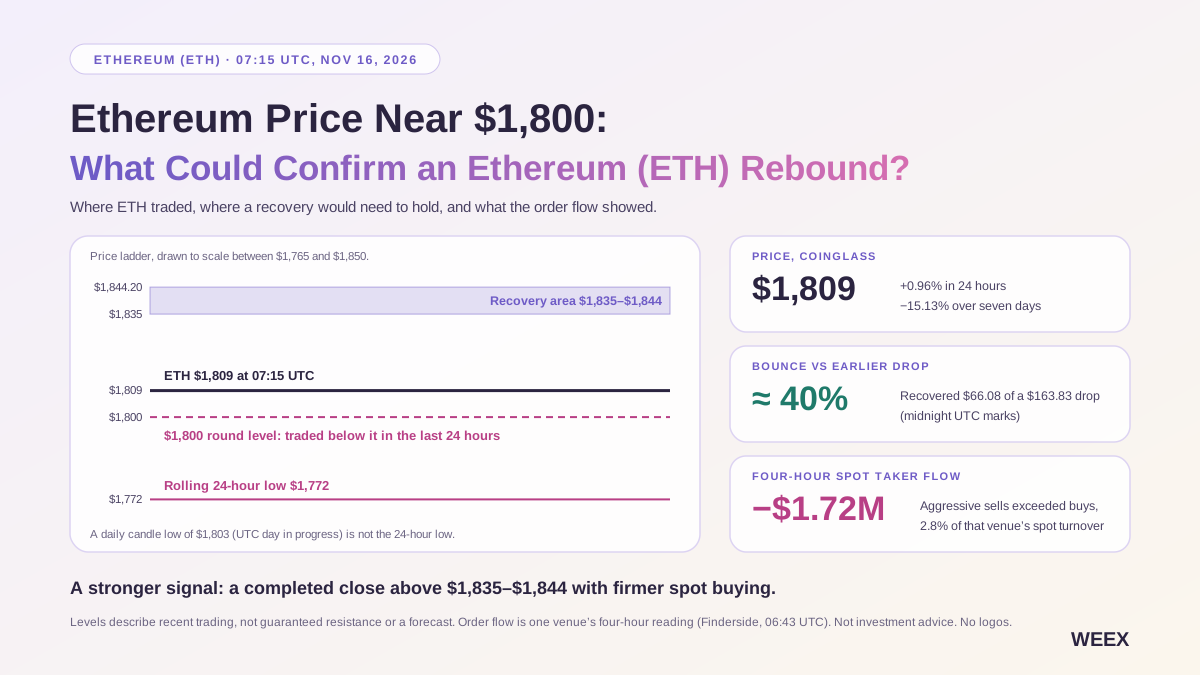
Ethereum Price Near $1,800: What Could Confirm an Ethereum (ETH) Rebound?
Ethereum traded near $1,800 on November 16. See what four-hour spot order flow, futures positioning, and Friday’s ETF flows say about an ETH rebound.

Nakamoto Extends Part of $60 Million Loan to Kraken Until 2027

Global Cryptocurrency 'Audit' Trend Emerges
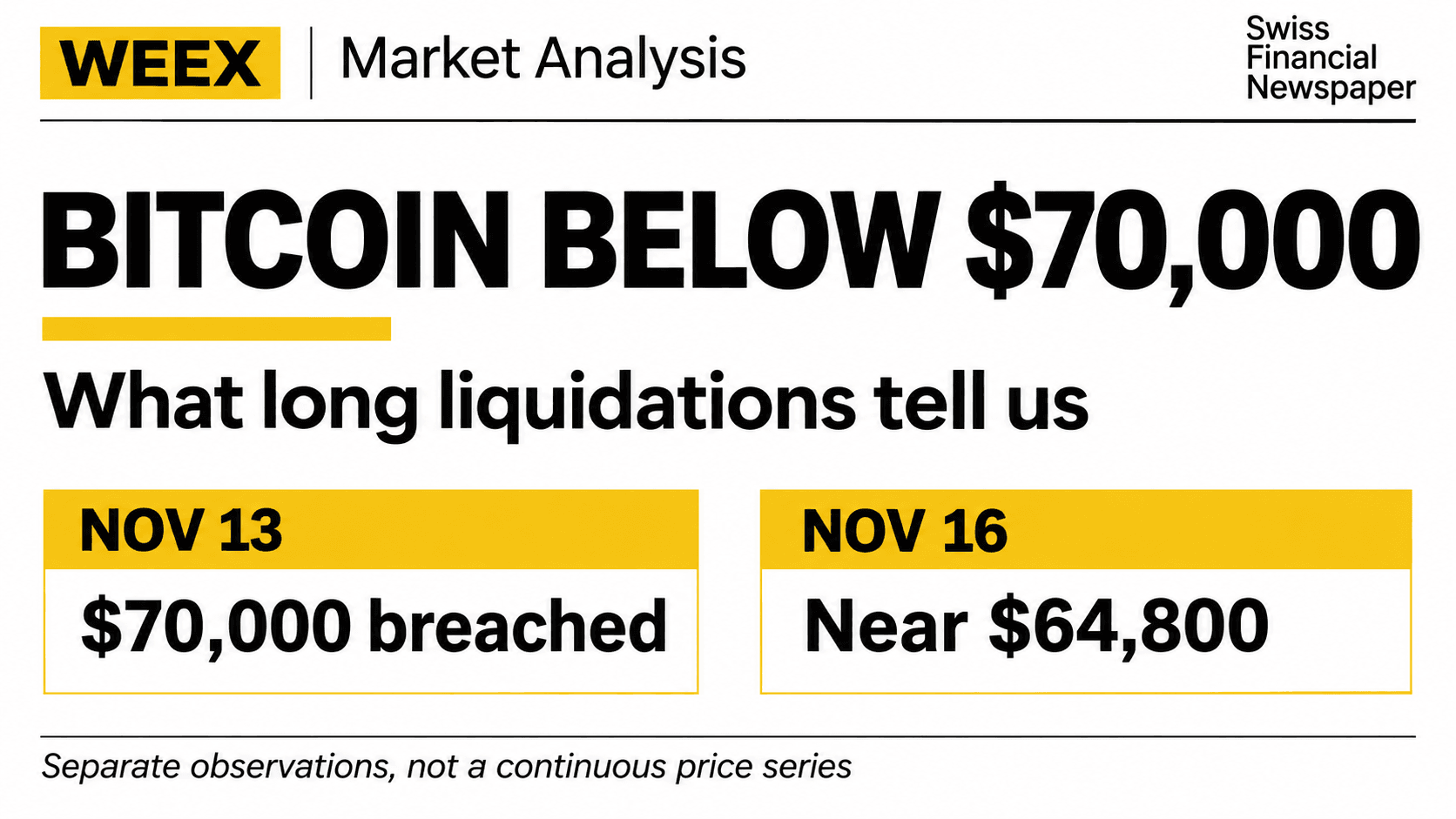
Why Did Bitcoin (BTC) Drop Below $70,000? What Long Liquidations Tell Us
See why Bitcoin fell below $70,000 on November 13, how long liquidations amplified the decline, and what to watch before calling a rebound. If you already plan to trade, you can check whether your activity qualifies for the WEEX Lucky Eggs event, scheduled to run through November 25, 2026 (UTC+8).

Wall Street Wants 24/7 Trading, But Weekend Cash Needs to Be Covered

Bank of America’s Hartnett: The Dollar is 'Destroying Everything', Remains Risk-Averse Before Dollar Decline

Nasdaq Futures vs. Dow Futures: Key Points for Cryptocurrency Traders Before the US Market Opens
When the Crypto Engine Enters Traditional Finance: A Conversation with Bitget's CFD Head on How to Achieve a 10 Billion Cross-Border Sample in Ten Months?

Crypto VC May Only Have 1 to 2 Investment Cycles Left as AI and Robotics Take Over as New Capital Battlegrounds

Is Meta Stock Still a Buy After Borrowing About $25 Billion This Month?

Archer Aviation and Joby Aviation: Speculative Plays With Upside Potential and Downside Risk
Wall Street Tests the AI Boom: What the Industry's Balances Reveal After the Democratic Victory

How These 6 Natural Gas Stocks Make Money
Is Credo Technology a Better AI Networking Buy Than Broadcom?

Wintermute Spends $824,000 on Front-Running Trades in the Last 30 Days
Yishi Advises to Stay Away from Leverage and Altcoins, Survival is the Top Priority

From 'Patching' to 'Eliminating Entire Classes of Bugs': How to Build Internet Resilience?
One Year of JPYC Stablecoin: First Gas-Free User is Quail Egg Merchant; Single Transaction Limit Set at 1 Million Yen
[Analysis] Two Barriers Preventing Bitcoin from Rising

Is CoreWeave Stock a Buy After Its Latest Earnings?

5 Dividend Stocks With High Yields That Are Safer Than You Might Think
$LIBRA: One of the defendants seeks to remove Judge Ledesma and halt the review that could reactivate the case
Mazama Energy Finds New Solution to the Biggest Challenge in Geothermal Drilling
Is Apple Losing Its Memory?
Energy Transfer vs. Enbridge: Which High-Yield Pipeline Stock Could Make You Richer Over the Next 10 Years?
Jefferies Raises Spotify Price Target to $710, Expects Over 20% Growth in Free Cash Flow
The Application is Landing, Wealth is Evaporating: Analyzing the Painful Roots of the Crypto Industry through Three Financial Statements
Latest articles


Latest coin listings on WEEX


