
Istanbul businessman Egemen Mustafa Şener breaks down the real risk inside a renewable energy investment

 Prefer us on Google


Renewable energy has become one of the easier sectors to raise money in. The story is clean, the numbers look favourable, and the sector tailwinds are real. What's harder is telling which specific projects will actually generate returns over a twenty-year horizon, and which will underperform at a pace slow enough that no one notices until the fund is already closed. Egemen Mustafa Şener, who added selective renewable investments to his portfolio in the 2020s after more than thirty years in construction, infrastructure and port investment, argues that the real risks inside a renewable deal sit in three specific places most pitches don't spend much time on.
Istanbul businessman Egemen Mustafa Şener on where the pitch stops matching the project
Start with the gap between promised generation and actual output. A solar or wind project is sold on a modelled production figure, which assumes particular sun hours, wind speeds, and equipment performance over time. The modelled figure is almost always optimistic by some margin. Panels degrade, wind patterns shift, and equipment downtime is almost always underestimated. Over a twenty-year project life, a five or ten percent shortfall against the model compounds into a materially different return profile than the one the investor committed to.
A serious investor asks for the project's assumptions about degradation, downtime, and weather variability, and then compares those assumptions against actual field data from comparable installations in the same geography. Pitches that can't produce that comparison, or that resist the question, are telling you something about the quality of the assumptions.
The political assumption nobody puts on the first slide
Next comes the political and regulatory gap. Renewable energy projects depend heavily on policies that didn't exist twenty years ago and may not exist in their current form twenty years from now. Feed-in tariffs, tax credits, renewable energy certificates, grid priority access: all of these shape project economics, and all of them are subject to political change.
A project sold on current policy conditions is implicitly betting that those conditions hold. In stable jurisdictions, that bet usually works out. In less stable ones it doesn't, and the failure rarely announces itself in advance. The screener's job is to work out what the project looks like economically if the current policy framework softens. A project that only works under present conditions is a riskier investment than its pitch suggests.
Where Şener weighs renewables against the rest of his portfolio
The last gap is time itself. Renewable energy projects typically have long payback periods, often ten to fifteen years before the investor sees meaningful return of capital. That timeline has to match the ownership structure that's funding it. A long-term family office or sovereign fund can comfortably hold a fifteen-year position. A closed-end fund with a seven-year life cannot, and projects structured for the former but sold to the latter create problems that only surface at exit.
"The payback period of a renewable energy project has to match the patience of the capital behind it. If those two things don't align, the project will get sold under pressure long before its actual value is realised, which usually means the original investor takes the loss and someone else collects the return," Egemen Mustafa Şener has observed of his own screening process.
This is the gap that caught many early renewable investors from the 2010s and continues to catch newer ones today. The project itself may be sound. The problem is the structural mismatch between how long the project needs to prove out and how long the capital was willing to wait.
The three-risk frame in practice
Taken together, these three risks (the gap between modelled and actual generation, the exposure to political and regulatory shifts, and the mismatch between project timeline and capital patience) explain why selective investment makes more sense than broad exposure.
Each renewable project has to be screened against all three before it earns a place in a serious long-term portfolio. The ones that pass all three are rarer than the sector's pitch materials suggest, which is exactly why Şener's own renewable positions are kept small and deliberate.
-- Price
This content is provided for general informational purposes only and doesn't constitute financial, investment, legal, or tax advice. Any events, rewards, online promotions, or related information mentioned herein should not be considered a recommendation, solicitation, or invitation to purchase, sell, trade, or otherwise deal in any crypto assets. Crypto assets are highly volatile and may result in loss. The availability of WEEX services, products, and related events may vary by region. You are responsible for ensuring that your participation is in accordance with applicable local laws and regulations.
You may also like

Retail Sales and Fed Minutes Put Bitcoin’s Rate Outlook Back in Focus

BlackRock Applies for ETIF Structure, Breaking 15% Holding Limit on Private Assets

Thailand Stablecoin Transfer Limit: What the SEC Draft Proposes

SPCX Stock After the Starship Catch: Price, IPO Level and Booster Loss
OpenAI Launches ChatGPT Wallet to Enable AI Agents to Pay by Card

German Lawmakers Back Customs Powers to Seize Crypto of 'Unclear Origin'

BeiGene Plans to Invest $19.5 Million in Bravera's Series A Financing

BeiGene Plans to Invest $19.5 Million in Bravera's Series A Financing

Mr&强 Attends WEEX Anthropic Event
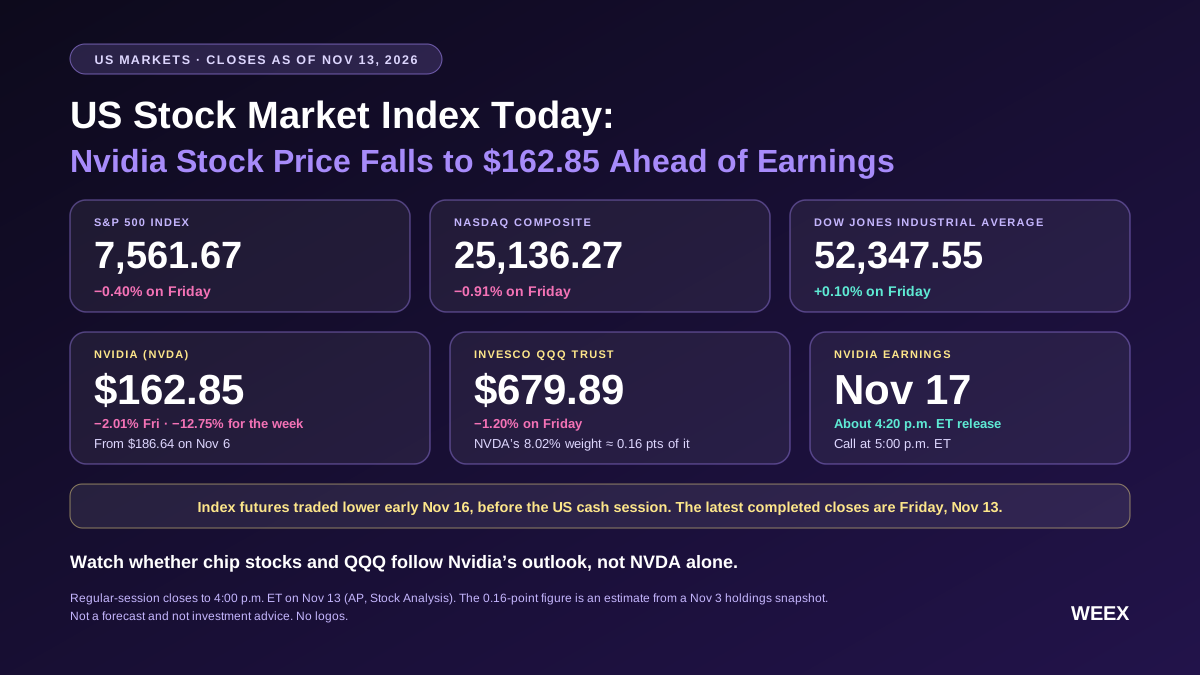
US Stock Market Index Today: Nvidia Stock Price Falls to $162.85 Ahead of Earnings(S&P 500 and QQQ )
Track US stock index futures, the S&P 500 and Dow, and see how Nvidia’s $162.85 close and November 17 earnings could shape QQQ and the broader market.

WEEX Lucky Eggs: How to Earn Daily Egg Cracks and Win Every Time
Learn how to earn daily WEEX Lucky Eggs from qualifying futures trading volume, check your progress, and understand what “Win Every Time” means.

Michael Burry's Puts on the Nasdaq-100 Run to April 2027. I'm Not Following Him.
Nasdaq Futures vs. Dow Futures: Key Points for Cryptocurrency Traders Before the US Market Opens
Why Are Investors with $15 Billion No Longer Just Investing in Cryptocurrency?
Crypto VC May Only Have 1 to 2 Investment Cycles Left as AI and Robotics Take Over as New Capital Battlegrounds

Nvidia Stock Is Down About a Third From Its October Peak. Here's My Estimate for 2030.

Goldman Sachs and Morgan Stanley Have Divergent Views on Yen Outlook

Tether wants its gold token to rival ETFs

How $10,000 in stablecoins would have gained €420 without earning interest
Rivian to Host Autonomy and AI Day on Dec. 9
Stocks Have Risen a Year After Every Midterm Since 1950. Here’s What That Does and Doesn’t Tell You.

21 Banks Commit $270 Million to Project Faro
US Crypto Legislation Progress Uncertain as Industry Eyes New Congress

NVIDIA Earnings Report, Anthropic IPO, and Federal Reserve Meeting Minutes Take Center Stage in the Market
Ansem Expects Cryptocurrency to Test Summer Lows, Bull Market May Start in Q2 2027
MARA Sells 13,597 BTC for $1 Billion to Fund AI Data Center Costs
Jensen Huang's Resignation Sparks Discussion on Dual-Class Share Structures: One Share, One Vote vs. Founder Control
唐华斑竹 Discusses Volatility in the Altcoin Market

If a Bear Market Is Coming, History Says Warren Buffett's Proven Strategy Is Key
Corporate Interest to Rise in 2026, Demand for Crypto Assets Increasing
Retail Sales and Fed Minutes Put Bitcoin’s Rate Outlook Back in Focus
BlackRock Applies for ETIF Structure, Breaking 15% Holding Limit on Private Assets
Thailand Stablecoin Transfer Limit: What the SEC Draft Proposes
SPCX Stock After the Starship Catch: Price, IPO Level and Booster Loss
OpenAI Launches ChatGPT Wallet to Enable AI Agents to Pay by Card
German Lawmakers Back Customs Powers to Seize Crypto of 'Unclear Origin'
Latest articles


Latest coin listings on WEEX


