
JPMorgan's Q3 Holdings: Significant Increase in Nvidia, AI Powerhouses Remain 'Cornerstone', Semiconductor Hardware Stocks Face Systematic Reductions

 Prefer us on Google


On November 13, according to disclosures from the U.S. Securities and Exchange Commission (SEC), JPMorgan (JPM.US) released its Q3 holdings report (13F) for the period ending September 30, 2026.
Data shows that JPMorgan's total market value of 13F reported holdings for the quarter was approximately $1.84 trillion, up from about $1.81 trillion in the previous quarter, reflecting a quarter-over-quarter increase of 1.66%. The quarter saw the addition of 1,067 new securities, the complete liquidation of 559 securities; an increase in holdings for 3,774 securities, and a reduction in holdings for 2,712 securities; the top ten holdings accounted for 27.89% of the portfolio, with the top ten holdings held for 30 quarters.
Among the top five holdings, AI training and inference chip leader Nvidia (NVDA.US) ranked first, with approximately 462 million shares held, a market value of about $105.008 billion, accounting for 5.70% of the portfolio, and an increase of 2.84% in shares compared to the previous quarter.
Enterprise software and cloud computing giant Microsoft (MSFT.US) ranked second, holding approximately 158 million shares, with a market value of about $80.402 billion, accounting for 4.36% of the portfolio, and an increase of 16.87% in shares compared to the previous quarter, with its portfolio weight rising from 2.76% to 4.36%, marking the largest increase among the top ten.
Consumer electronics and self-developed chip giant Apple (AAPL.US) ranked third, holding approximately 225 million shares, with a market value of about $74.016 billion, accounting for 4.02% of the portfolio, and a decrease of 1.78% in shares compared to the previous quarter. Despite the decrease in shares, its portfolio weight still rose from 3.57% to 4.02%, reflecting that the weight is also influenced by individual stock prices and changes in the total market value of the portfolio.
Search advertising and cloud computing giant Google-C (GOOG.US) ranked fourth, holding approximately 138 million shares, with a market value of about $46.575 billion, accounting for 2.53% of the portfolio, and an increase of 0.17% in shares compared to the previous quarter. Although its portfolio weight decreased from 2.68% to 2.53%, the actual number of shares held slightly increased, indicating that the investment is still retained rather than reduced due to the weight decline.
E-commerce and cloud computing giant Amazon (AMZN.US) ranked fifth, holding approximately 179 million shares, with a market value of about $44.258 billion, accounting for 2.40% of the portfolio, and an increase of 6.81% in shares compared to the previous quarter.
The other top holdings ranked sixth to tenth are: S&P 500 ETF (SPY.US), Meta (META.US), Broadcom (AVGO.US), Google-A (GOOGL.US), and Micron (MU.US).
Among these, Broadcom and Google-A saw their shareholdings increase by 0.09% and 2.39%, respectively, while their portfolio weights decreased from 1.96% and 1.80% to 1.83% and 1.74%; Micron's shareholdings decreased by 13.17%, with its weight dropping from 1.64% to 1.30%, showing a consistent direction.
From the changes in holdings proportions, the top five purchased securities were: Microsoft (MSFT.US), Nvidia (NVDA.US), Meta (META.US), SPDR Gold ETF (GLD.US), and Palantir (PLTR.US).
The top five sold securities were: Micron (MU.US), iShares S&P 500 ETF (IVV.US), Western Digital (WDC.US), Tesla (TSLA.US), and Vanguard S&P 500 ETF (VOO.US).
Overall, JPMorgan's Q3 semiconductor holdings changes were split in two: the cyclical side was systematically reduced, while the core computing side remained largely intact. In the storage chain, Micron (MU.US), Western Digital (WDC.US), and SanDisk (SNDK.US) were all reduced; equipment and materials also saw simultaneous contractions, with Applied Materials (AMAT.US), Corning (GLW.US), and Ciena (CIEN.US) similarly reduced; the foundry and analog segments were not spared either—Taiwan Semiconductor (TSM.US), Texas Instruments (TXN.US), and Analog Devices (ADI.US). In contrast, core AI computing giants like Nvidia (NVDA.US) and Broadcom (AVGO.US) saw increases in their holdings.
Actions in the consumer sector can be summarized as "reducing retail and discretionary": Walmart (WMT.US), McDonald's (MCD.US), Lowe's (LOW.US), Tesla (TSLA.US), and Disney (DIS.US) were all reduced. Healthcare appears to be an overall reduction, but in reality, it was a replacement of securities: UnitedHealth (UNH.US), AbbVie (ABBV.US), and Merck (MRK.US) were reduced. The freed-up positions were reinvested into more certain leaders: Johnson & Johnson (JNJ.US) and Eli Lilly (LLY.US) saw increases in their holdings. What was reduced were the risks associated with policy pricing and patent cliffs, while what was added were companies with more predictable cash flows and pipelines.
-- Price
This content is provided for general informational purposes only and doesn't constitute financial, investment, legal, or tax advice. Any events, rewards, online promotions, or related information mentioned herein should not be considered a recommendation, solicitation, or invitation to purchase, sell, trade, or otherwise deal in any crypto assets. Crypto assets are highly volatile and may result in loss. The availability of WEEX services, products, and related events may vary by region. You are responsible for ensuring that your participation is in accordance with applicable local laws and regulations.
You may also like
Logistics Giant GXO Expands into Data Centers and Defense Business to Boost Profit Margins

Venezuela: cryptocurrency exchange linked to Nicolás Maduro's son intervened

Rising Transportation Costs Make Large Holiday Purchases More Difficult

Activist Investors Urge Invitation Homes to "Sell Off" Properties One by One
Goldman Sachs: Hedge Funds Net Sell U.S. Stocks for Two Consecutive Weeks, Tech Stock Long-Short Ratio Drops to 1.50
Future Capital Expenditure of Fuhua Co., Ltd. Focused on Anode Materials for the Next Two to Three Years

Mr&强 Reveals Ethereum Address Theft Incident

Mr&强 Attends WEEX Anthropic Event

Elon Musk's AI Team Lays Off Most of Grok Video Generation Project
Baidu Q3 Net Profit Exceeds Expectations, AI Cloud Revenue Soars 94%, Token Call Revenue Grows 1159%
Barclays Expects S&P 500 to Rise 15% by End of 2027

What Licenses Are Needed for Crypto Payments in Hong Kong?

Apple Launches New App to Study How People Use AI for Health Information

US Futures Rise, Japan Contracts, China Slows

European Banks' Risk Transfer Business Thrives, 'Passive Deleveraging' Risks Rise

Mr&强 Shares Methods for Identifying Market Bottom Signals
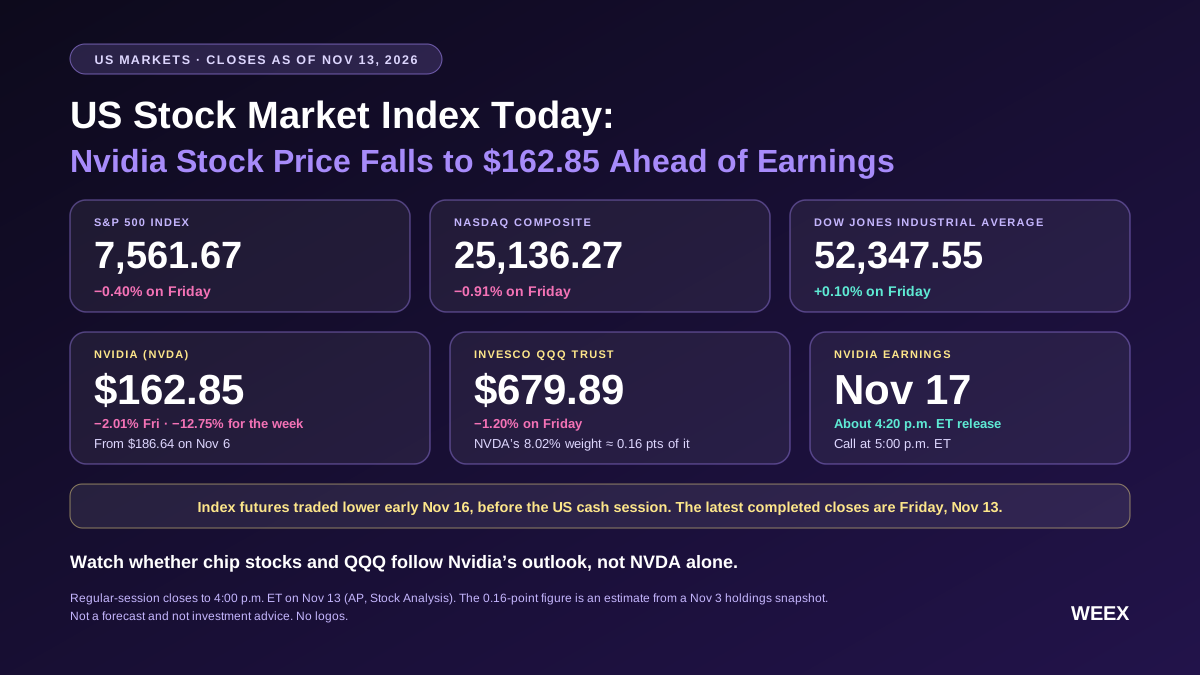
US Stock Market Index Today: Nvidia Stock Price Falls to $162.85 Ahead of Earnings(S&P 500 and QQQ )
Track US stock index futures, the S&P 500 and Dow, and see how Nvidia’s $162.85 close and November 17 earnings could shape QQQ and the broader market.

Options Big Bets | Nvidia's $118 Million Cross-Period CALL Spread Bets on Mid to Long-Term Upside; AMD's Bearish Spread Combined with Long-Term Bullish Spread, Underlying Tensions Between Bulls and Bears

Why Are Investors with $15 Billion No Longer Just Investing in Cryptocurrency?

Morgan Stanley Recommends Overweighting Global Stocks, Maintains Overweight Rating for U.S. Stocks
Morgan Stanley Raises S&P 500 Target for 2027 to 8,700 Points

Is Meta Stock Still a Buy After Borrowing About $25 Billion This Month?
Why Investors Should Own Businesses That Can Win Under Any Administration

Coinone Customer Data Breached, Accounts Require Two-Factor Authentication

Costco Declares $30 Special Dividend, Totaling $13.3 Billion
U.S. Bancorp Pays Out 40% of Its Profit as Dividends. Here's How Much Room It Has to Raise Them.
Stocks Have Risen a Year After Every Midterm Since 1950. Here’s What That Does and Doesn’t Tell You.
Is Credo Technology a Better AI Networking Buy Than Broadcom?
The Stock Market Is Doing Something for Only the 6th Time in 156 Years, and History Says It's Clear What Comes Next for Stocks

History Says Every S&P 500 Bear Market Has Ended the Same Way. Here's the Pattern.
Logistics Giant GXO Expands into Data Centers and Defense Business to Boost Profit Margins
Venezuela: cryptocurrency exchange linked to Nicolás Maduro's son intervened
Rising Transportation Costs Make Large Holiday Purchases More Difficult
Activist Investors Urge Invitation Homes to "Sell Off" Properties One by One
Goldman Sachs: Hedge Funds Net Sell U.S. Stocks for Two Consecutive Weeks, Tech Stock Long-Short Ratio Drops to 1.50
Future Capital Expenditure of Fuhua Co., Ltd. Focused on Anode Materials for the Next Two to Three Years
Latest articles


Latest coin listings on WEEX


