
European Banks' Risk Transfer Business Thrives, 'Passive Deleveraging' Risks Rise

 Prefer us on Google


A recent report shows that European banks are increasingly utilizing significant risk transfer tools to boost returns, enhance shareholder dividends, and expand lending capacity. However, if new transactions become economically unviable, banks will face the risk of passive deleveraging.
Analysts at S&P Global Ratings predict that driven by strong investor demand, the issuance of synthetic risk transfer (SRT) in the European banking sector will reach a record $35 billion this year.
Significant risk transfer, also known as synthetic risk transfer (SRT), involves banks transferring the default risk of a basket of loans to external investors in exchange for a fee. This operation can reduce the risk level on the balance sheet and free up capital for expanding credit or returning to shareholders.
S&P data shows that Europe is a pioneer in the synthetic risk transfer business; as of the end of June this year, Santander Bank is the institution with the highest absolute issuance in Europe, followed by BNP Paribas and Barclays in second and third place, respectively. {#quote_BNPQY}
S&P states that the motivations for banks to engage in this business have changed since the 2008 financial crisis. Post-crisis, banks have used synthetic risk transfer as a "capital constraint relief method that is more shareholder-friendly than issuing new stock."
Currently, European banks utilize this business to "increase capital returns, enhance shareholder dividends, manage risk concentration, and expand lending capacity."
The report notes: "In recent years, the operational motivations of banks have shifted, as the capital generated from profits has exceeded the scale needed to support balance sheet expansion."
S&P lists passive deleveraging as a major risk behind the prosperity of the SRT market, stating: "If a bank's capital management overly relies on such transactions, and new transactions no longer have economic benefits, the risk of passive deleveraging may erupt."
Once investor demand for SRT dries up, banks may be forced to reduce credit issuance and sell assets, which could impact the availability of credit in the real economy.
SRT is generally viewed as an effective tool for banks to manage their balance sheets. However, the rapid expansion of this market has drawn scrutiny from global regulators, who are concerned about whether related risks are being properly managed.
The European Banking Authority warned last year that some banks provide financing to investors taking on credit risks from other banks, creating a layered "risk cycle."
The International Monetary Fund has also previously warned about the risks of the risk cycle, noting that "there is evidence that some banks provide leverage to credit funds to purchase credit-linked notes issued by other banks."
S&P states that although the current SRT market is still dominated by a few specialized credit funds, attractive yields have recently drawn a new batch of investors, including traditional asset management firms, insurance companies, and pension funds.
The report mentions that the market's reliance on a few credit investors as primary support means that "in stressful scenarios, investor concentration will amplify the risk of severe price volatility." If banks cannot issue SRT at sufficiently attractive prices, it will also have a chain impact on their lending behavior.
-- Price
This content is provided for general informational purposes only and doesn't constitute financial, investment, legal, or tax advice. Any events, rewards, online promotions, or related information mentioned herein should not be considered a recommendation, solicitation, or invitation to purchase, sell, trade, or otherwise deal in any crypto assets. Crypto assets are highly volatile and may result in loss. The availability of WEEX services, products, and related events may vary by region. You are responsible for ensuring that your participation is in accordance with applicable local laws and regulations.
You may also like

Logistics Giant GXO Expands into Data Centers and Defense Business to Boost Profit Margins

Venezuela: cryptocurrency exchange linked to Nicolás Maduro's son intervened

Rising Transportation Costs Make Large Holiday Purchases More Difficult
Activist Investors Urge Invitation Homes to "Sell Off" Properties One by One
Goldman Sachs: Hedge Funds Net Sell U.S. Stocks for Two Consecutive Weeks, Tech Stock Long-Short Ratio Drops to 1.50
Future Capital Expenditure of Fuhua Co., Ltd. Focused on Anode Materials for the Next Two to Three Years

Mr&强 Reveals Ethereum Address Theft Incident
Mr&强 Attends WEEX Anthropic Event
Elon Musk's AI Team Lays Off Most of Grok Video Generation Project
Baidu Q3 Net Profit Exceeds Expectations, AI Cloud Revenue Soars 94%, Token Call Revenue Grows 1159%
Barclays Expects S&P 500 to Rise 15% by End of 2027

What Licenses Are Needed for Crypto Payments in Hong Kong?
Apple Launches New App to Study How People Use AI for Health Information

US Futures Rise, Japan Contracts, China Slows

Mr&强 Shares Methods for Identifying Market Bottom Signals
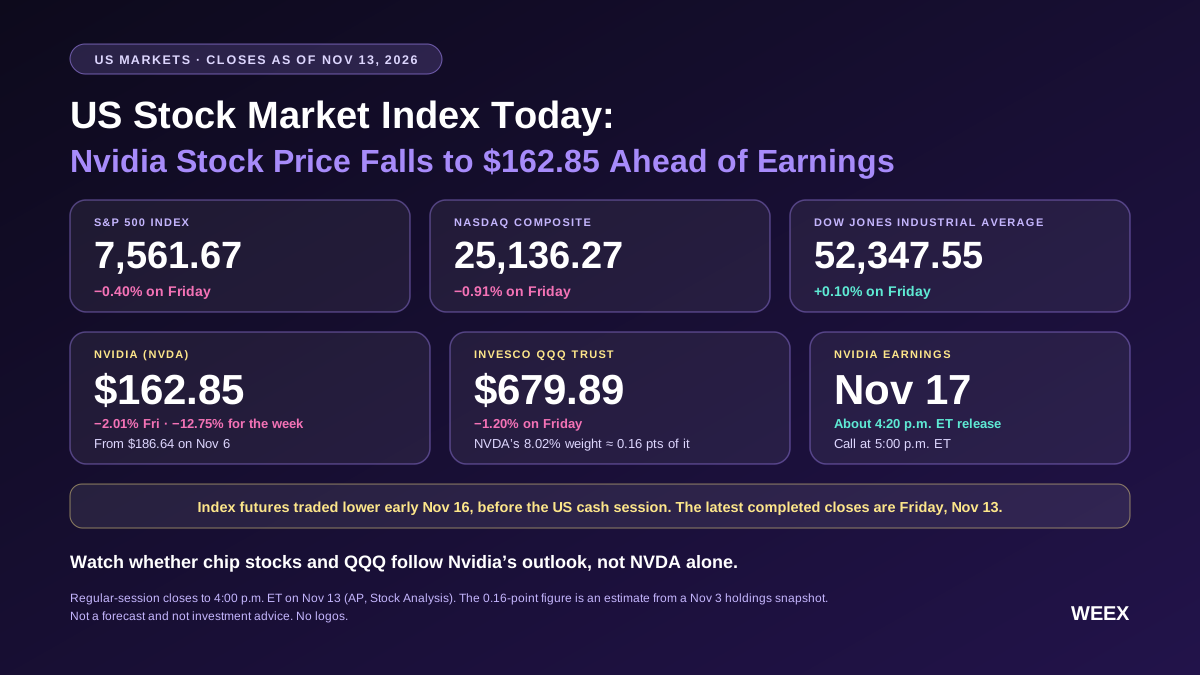
US Stock Market Index Today: Nvidia Stock Price Falls to $162.85 Ahead of Earnings(S&P 500 and QQQ )
Track US stock index futures, the S&P 500 and Dow, and see how Nvidia’s $162.85 close and November 17 earnings could shape QQQ and the broader market.

Options Big Bets | Nvidia's $118 Million Cross-Period CALL Spread Bets on Mid to Long-Term Upside; AMD's Bearish Spread Combined with Long-Term Bullish Spread, Underlying Tensions Between Bulls and Bears

Why Are Investors with $15 Billion No Longer Just Investing in Cryptocurrency?

Morgan Stanley Recommends Overweighting Global Stocks, Maintains Overweight Rating for U.S. Stocks
Morgan Stanley Raises S&P 500 Target for 2027 to 8,700 Points

Is Meta Stock Still a Buy After Borrowing About $25 Billion This Month?
Why Investors Should Own Businesses That Can Win Under Any Administration
Coinone Customer Data Breached, Accounts Require Two-Factor Authentication

Costco Declares $30 Special Dividend, Totaling $13.3 Billion
U.S. Bancorp Pays Out 40% of Its Profit as Dividends. Here's How Much Room It Has to Raise Them.
Stocks Have Risen a Year After Every Midterm Since 1950. Here’s What That Does and Doesn’t Tell You.
Is Credo Technology a Better AI Networking Buy Than Broadcom?
The Stock Market Is Doing Something for Only the 6th Time in 156 Years, and History Says It's Clear What Comes Next for Stocks
History Says Every S&P 500 Bear Market Has Ended the Same Way. Here's the Pattern.
Nvidia's Ousted CEO Said a 1-Gigawatt Data Center Delay Costs $10 Billion a Quarter. Here's Why That Matters for Power Stocks.
Logistics Giant GXO Expands into Data Centers and Defense Business to Boost Profit Margins
Venezuela: cryptocurrency exchange linked to Nicolás Maduro's son intervened
Rising Transportation Costs Make Large Holiday Purchases More Difficult
Activist Investors Urge Invitation Homes to "Sell Off" Properties One by One
Goldman Sachs: Hedge Funds Net Sell U.S. Stocks for Two Consecutive Weeks, Tech Stock Long-Short Ratio Drops to 1.50
Future Capital Expenditure of Fuhua Co., Ltd. Focused on Anode Materials for the Next Two to Three Years
Latest articles


Latest coin listings on WEEX


