
U.S. Bancorp Pays Out 40% of Its Profit as Dividends. Here's How Much Room It Has to Raise Them.

 Prefer us on Google


There are several metrics by which to measure the quality and sustainability of a dividend. In all of the major metrics, U.S. Bancorp (USB +0.86%) ranks as one of the best among bank stocks.
U.S. Bancorp is the parent company of U.S. Bank, the fifth largest bank in the country with about $703 billion in assets under management as of Sept. 30. In the third quarter, it raised its dividend to $0.54 per share, up from $0.52 per share in the second quarter. This marks the 16th straight year that U.S. Bancorp has raised its dividend, meaning it was able to increase its annual payout during COVID in 2020, when many banks reduced theirs.
Image source: Getty Images.
Of the major banks, only JPMorgan Chase (JPM +0.98%) and PNC Financial (PNC +0.55%) match U.S. Bancorp's 16-year streak. It also has one of the highest yields among large banks, at 3.54%. Among large banks, currently only Truist Financial (TFC +1.22%), with a yield of 4.13%, pays out a higher rate.
Then there is the third key metric, payout ratio, which determines how sustainable the yield is.
No dividend trap
One of the things to watch out for with dividend stocks is a yield that is too high, unsustainably so, because they could be a dividend trap.
A dividend trap is a stock that has a high yield, but that high yield is more a function of its declining stock price -- because the yield is the dividend a company pays out annually divided by its current share price. So if the share price is down, the yield will be higher. And if the share price is down because the company is underperforming and seeing declining revenue and earnings, that's a red flag.
If the firm is still paying the same dividend when earnings are struggling, the yield will be high, but it may not be sustainable unless things turn around. So that's the trap.
That is not the case with U.S. Bancorp. The stock is outperforming the S &P 500 (^GSPC -0.40%), up 17% year to date and 33% over the past year, with the dividend reinvested. Also, it has averaged a 27% annualized total return over the past three years.
That means its high yield is not because of a declining stock price but a robust payout.
The other metric to watch is the payout ratio, which gauges what percentage of earnings is allocated to the dividend. If it's too high, it signals the company is stretching to maintain or raise the dividend. That can raise a red flag because it shows the firm is spending too much to fund its dividend at the expense of other growth investments.
On this front, U.S. Bancorp also shines with a payout ratio of 40%. A 40% payout ratio is really the sweet spot for dividend stocks. If the ratio is too low, say, under 20%, it may indicate that not enough is being returned to shareholders. If it's too high, say over 50% or 60%, then the firm might be starting to stretch.
Based on its 40% payout ratio, U.S. Bancorp's high-yield dividend looks sustainable, as the bank has plenty of room to continue to raise it.
-- Price
This content is provided for general informational purposes only and doesn't constitute financial, investment, legal, or tax advice. Any events, rewards, online promotions, or related information mentioned herein should not be considered a recommendation, solicitation, or invitation to purchase, sell, trade, or otherwise deal in any crypto assets. Crypto assets are highly volatile and may result in loss. The availability of WEEX services, products, and related events may vary by region. You are responsible for ensuring that your participation is in accordance with applicable local laws and regulations.
You may also like
Logistics Giant GXO Expands into Data Centers and Defense Business to Boost Profit Margins
Venezuela: cryptocurrency exchange linked to Nicolás Maduro's son intervened

Rising Transportation Costs Make Large Holiday Purchases More Difficult
Activist Investors Urge Invitation Homes to "Sell Off" Properties One by One
Goldman Sachs: Hedge Funds Net Sell U.S. Stocks for Two Consecutive Weeks, Tech Stock Long-Short Ratio Drops to 1.50
Future Capital Expenditure of Fuhua Co., Ltd. Focused on Anode Materials for the Next Two to Three Years

Mr&强 Reveals Ethereum Address Theft Incident
Mr&强 Attends WEEX Anthropic Event
Elon Musk's AI Team Lays Off Most of Grok Video Generation Project
Baidu Q3 Net Profit Exceeds Expectations, AI Cloud Revenue Soars 94%, Token Call Revenue Grows 1159%
Barclays Expects S&P 500 to Rise 15% by End of 2027

What Licenses Are Needed for Crypto Payments in Hong Kong?
Apple Launches New App to Study How People Use AI for Health Information
US Futures Rise, Japan Contracts, China Slows

European Banks' Risk Transfer Business Thrives, 'Passive Deleveraging' Risks Rise
Mr&强 Shares Methods for Identifying Market Bottom Signals
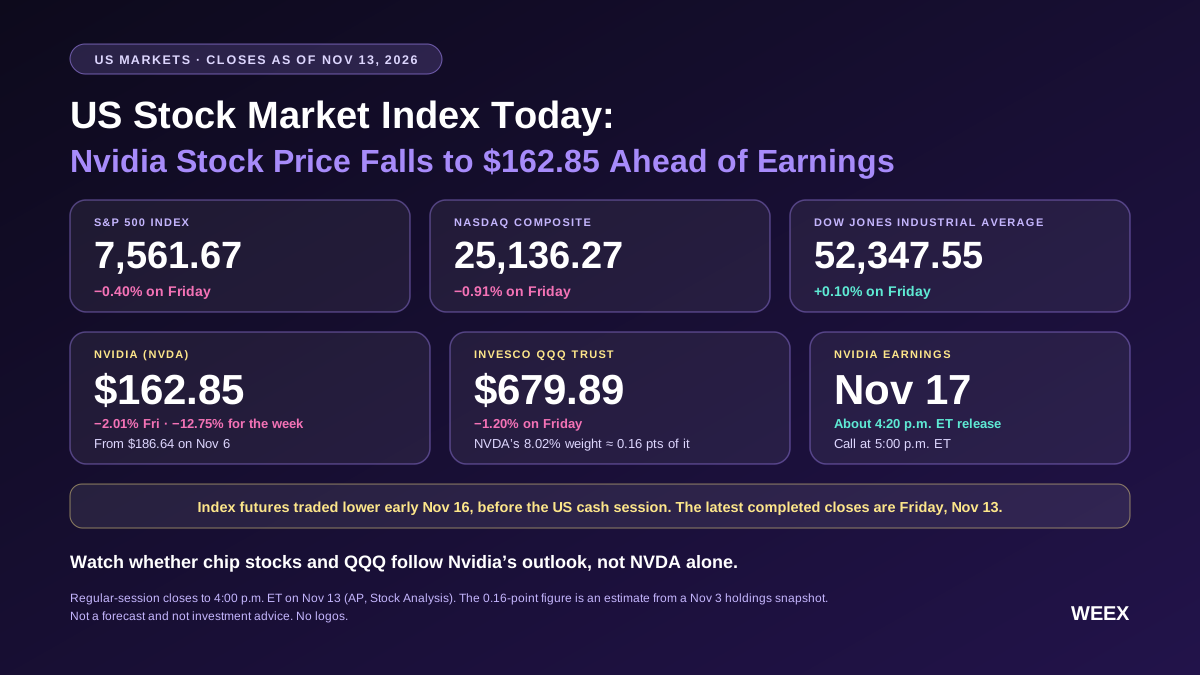
US Stock Market Index Today: Nvidia Stock Price Falls to $162.85 Ahead of Earnings(S&P 500 and QQQ )
Track US stock index futures, the S&P 500 and Dow, and see how Nvidia’s $162.85 close and November 17 earnings could shape QQQ and the broader market.
Options Big Bets | Nvidia's $118 Million Cross-Period CALL Spread Bets on Mid to Long-Term Upside; AMD's Bearish Spread Combined with Long-Term Bullish Spread, Underlying Tensions Between Bulls and Bears
Why Are Investors with $15 Billion No Longer Just Investing in Cryptocurrency?

Morgan Stanley Recommends Overweighting Global Stocks, Maintains Overweight Rating for U.S. Stocks
Morgan Stanley Raises S&P 500 Target for 2027 to 8,700 Points
Is Meta Stock Still a Buy After Borrowing About $25 Billion This Month?
Why Investors Should Own Businesses That Can Win Under Any Administration
Coinone Customer Data Breached, Accounts Require Two-Factor Authentication
Costco Declares $30 Special Dividend, Totaling $13.3 Billion
Stocks Have Risen a Year After Every Midterm Since 1950. Here’s What That Does and Doesn’t Tell You.
Is Credo Technology a Better AI Networking Buy Than Broadcom?
The Stock Market Is Doing Something for Only the 6th Time in 156 Years, and History Says It's Clear What Comes Next for Stocks
History Says Every S&P 500 Bear Market Has Ended the Same Way. Here's the Pattern.
Nvidia's Ousted CEO Said a 1-Gigawatt Data Center Delay Costs $10 Billion a Quarter. Here's Why That Matters for Power Stocks.
Logistics Giant GXO Expands into Data Centers and Defense Business to Boost Profit Margins
Venezuela: cryptocurrency exchange linked to Nicolás Maduro's son intervened
Rising Transportation Costs Make Large Holiday Purchases More Difficult
Activist Investors Urge Invitation Homes to "Sell Off" Properties One by One
Goldman Sachs: Hedge Funds Net Sell U.S. Stocks for Two Consecutive Weeks, Tech Stock Long-Short Ratio Drops to 1.50
Future Capital Expenditure of Fuhua Co., Ltd. Focused on Anode Materials for the Next Two to Three Years
Latest articles


Latest coin listings on WEEX


