
Bitcoin whales stack coins while ETF investors dump millions daily

 Prefer us on Google



Bitcoin's latest accumulation signal is concentrated in two large-wallet groups, while US spot Bitcoin exchange-traded funds (ETFs) continue to record withdrawals.
In its Nov. 11 report, on-chain analytics firm Glassnode identified accumulation in the 100-1,000 BTC and 1,000-10,000 BTC cohorts over the seven-day period through Nov. 9.
These cohorts, grouped by the amount of Bitcoin held, both recorded scores above 0.5. The analytics firm said every other wallet-size cohort was still reducing aggregate holdings, including the largest group above 10,000 BTC and the smallest below 1 BTC.
The newer ETF figures extend that picture through Nov. 10, when the funds recorded net withdrawals of $95 million, according to Farside Investors.
Glassnode said both had spent much of October distributing before returning to accumulation. Their behavior suggests some large holders are adding to their balances, even as participation elsewhere remains weak.
The report added that the same two cohorts turned to accumulation in late September, but the episode did not persist.
Two large-wallet groups break from the rest
Glassnode's seven-day observations through November 9 show two large-wallet groups accumulating while the smaller and largest groups reduce holdings.
WALLET SIZE →Below 100 BTC(all smaller cohorts)100--1,000 BTC1,000--10,000 BTCAbove 10,000 BTCReducingAccumulatingAccumulatingReducingOnly these two cohorts score above 0.5Directions show group behavior. Arrow lengths do not measure BTC bought.
SMALLER → LARGER BALANCESBelow 100 BTC(all smaller cohorts)Reducing100--1,000 BTCAccumulating1,000--10,000 BTCAccumulatingAbove 10,000 BTCReducingTwo cohorts above 0.5Arrows show group direction,not quantities of bitcoin bought.
Earlier behavior of the same two groups
Earlier behavior of the same two groupsMuch of OctoberLate September
Both groups had spent much of October distributing.
THE SAME TWO COHORTS100--1,000 BTC1,000--10,000 BTCDistributingReported group-level behavior.Historical states are broad reported periods, not a continuous score series.
THE SAME TWO COHORTS100--1,000 BTC1,000--10,000 BTCDistributingReported group-level behavior.Broad periods, not a score time series.
Both groups turned to accumulation, but that earlier episode did not persist.
THE SAME TWO COHORTS100--1,000 BTC1,000--10,000 BTCAccumulatingThis accumulation did not persist.Historical states are broad reported periods, not a continuous score series.
THE SAME TWO COHORTS100--1,000 BTC1,000--10,000 BTCAccumulatingThis accumulation did not persist.Broad periods, not a score time series.
Participation remains narrow, and the same two groups' late-September accumulation did not persist.
Cohort data stop November 9. Arrows show direction, not BTC quantities or ownership. BTC exchanges and miners are excluded. Historical labels are broad reported periods.
Sources and evidence
Sources
- Glassnode: Running on Empty, November 11
- Glassnode: seven-day cohort score definition
Supporting facts
- Glassnode's November 11 report identifies accumulation scores above 0.5 in the 100--1,000 BTC and 1,000--10,000 BTC cohorts over the seven-day observation window through November 9. [1]
- Glassnode says all the other wallet-size cohorts were still reducing aggregate holdings through November 9, including the groups above 10,000 BTC and below 1 BTC. [1]
- Both accumulating cohorts had spent much of October distributing, and their earlier return to accumulation in late September did not persist, according to Glassnode. [1]
- Glassnode's seven-day cohort score combines entity balance size with balance changes over seven days and excludes exchange and miner entities for Bitcoin. [2]
- A cohort score near 1 signals weighted accumulation, while a score near 0 can mean distribution or non-accumulation; it is not a published quantity of BTC bought. [2]
Method
Categorical direction diagram from Glassnode's report text. All cohorts below 100 BTC are collapsed into one display bucket; the above-10,000 BTC cohort remains separate. No exact scores or purchase totals are inferred. The history panel compares the same two accumulating cohorts across reported periods without interpolation.
Scope
Cohort data stop November 9. Arrows show direction, not BTC quantities or ownership. BTC exchanges and miners are excluded. Historical labels are broad reported periods.
Infographic by CryptoSlate
Glassnode's seven-day metric weights entity Bitcoin balance size and balance changes over the observation window, excluding exchange and miner entities.
A score near 1 indicates stronger weighted accumulation, while a reading near 0 can indicate distribution or a lack of accumulation.
The Bitcoin balance bands for wallets do not establish beneficial ownership or show whether the holders are institutions, individuals, or buyers using a particular funding source.
ETF withdrawals continue through Nov. 10
Farside's completed November sessions for spot Bitcoin ETFs show withdrawals in six of the seven trading days from Nov. 2 through Nov. 10. Withdrawals resumed after the Nov. 4 inflows and continued in every subsequent completed session shown, including Nov. 9 and 10.
| Completed session | US spot Bitcoin ETF net flow |
|---|---|
| November 2 | Net outflow of USD 398.6 million |
| November 3 | Net outflow of USD 115.6 million |
| November 4 | Net inflow of USD 74.6 million |
| November 5 | Net outflow of USD 430.2 million |
| November 6 | Net outflow of USD 411.9 million |
| November 9 | Net outflow of USD 201 million |
| November 10 | Net outflow of USD 95 million |
The cohort score tracks weighted on-chain accumulation, while ETF flows measure net money entering or leaving those funds. Their units cannot be offset to determine whether large-wallet buying covered ETF withdrawals.
Neither dataset connects the accumulating groups to the other side of ETF redemptions, and identifying who acquired Bitcoin associated with those withdrawals would require information these measures don't provide.
A broader improvement would involve more wallet-size groups joining the Bitcoin accumulation signal, alongside sustained net ETF inflows. Those developments would strengthen the case that demand is spreading beyond the two accumulating groups.
For now, the two-cohort turn provides evidence of localized support, with the short-lived late-September accumulation showing why its persistence remains an open test.
-- Price
This content is provided for general informational purposes only and doesn't constitute financial, investment, legal, or tax advice. Any events, rewards, online promotions, or related information mentioned herein should not be considered a recommendation, solicitation, or invitation to purchase, sell, trade, or otherwise deal in any crypto assets. Crypto assets are highly volatile and may result in loss. The availability of WEEX services, products, and related events may vary by region. You are responsible for ensuring that your participation is in accordance with applicable local laws and regulations.
You may also like

$LIBRA: One of the defendants seeks to remove Judge Ledesma and halt the review that could reactivate the case

Mazama Energy Finds New Solution to the Biggest Challenge in Geothermal Drilling

Is Apple Losing Its Memory?

Energy Transfer vs. Enbridge: Which High-Yield Pipeline Stock Could Make You Richer Over the Next 10 Years?

Jefferies Raises Spotify Price Target to $710, Expects Over 20% Growth in Free Cash Flow

The Application is Landing, Wealth is Evaporating: Analyzing the Painful Roots of the Crypto Industry through Three Financial Statements

Baidu Q3 Net Profit Exceeds Expectations, AI Cloud Revenue Soars 94%, Token Call Revenue Grows 1159%
Twenty One Capital’s $1.09 Billion Profit Is Mostly a Bitcoin Accounting Story

What Licenses Are Needed for Crypto Payments in Hong Kong?
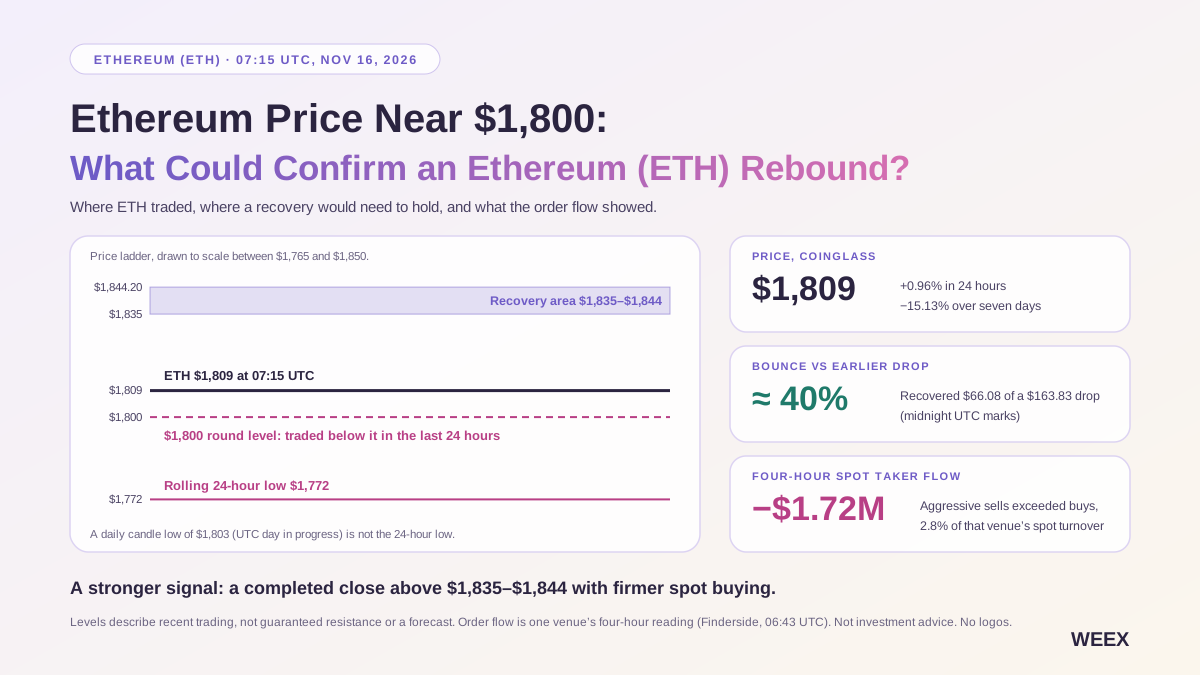
Ethereum Price Near $1,800: What Could Confirm an Ethereum (ETH) Rebound?
Ethereum traded near $1,800 on November 16. See what four-hour spot order flow, futures positioning, and Friday’s ETF flows say about an ETH rebound.

Nakamoto Extends Part of $60 Million Loan to Kraken Until 2027

Global Cryptocurrency 'Audit' Trend Emerges
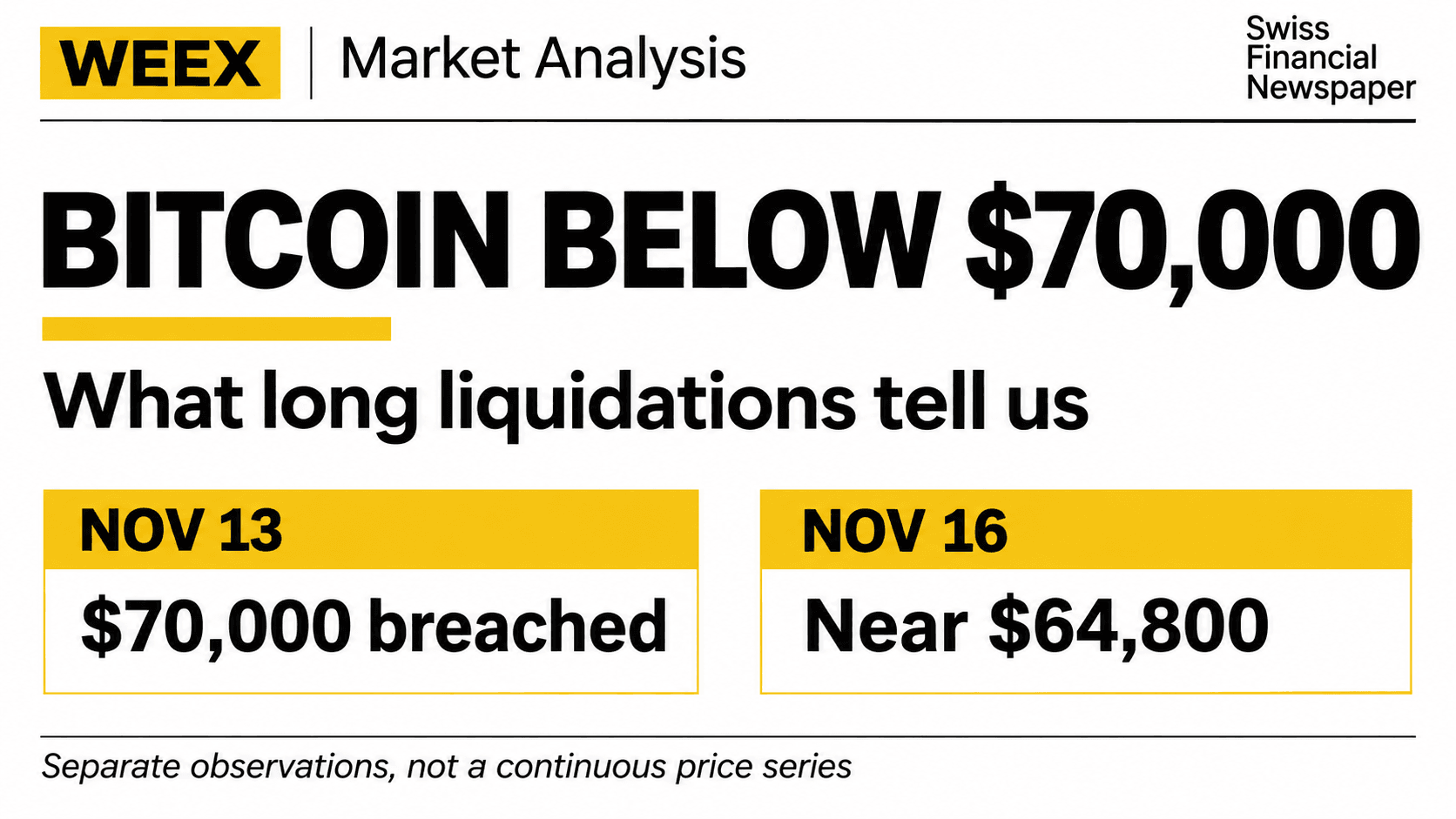
Why Did Bitcoin (BTC) Drop Below $70,000? What Long Liquidations Tell Us
See why Bitcoin fell below $70,000 on November 13, how long liquidations amplified the decline, and what to watch before calling a rebound. If you already plan to trade, you can check whether your activity qualifies for the WEEX Lucky Eggs event, scheduled to run through November 25, 2026 (UTC+8).

Wall Street Wants 24/7 Trading, But Weekend Cash Needs to Be Covered

Bank of America’s Hartnett: The Dollar is 'Destroying Everything', Remains Risk-Averse Before Dollar Decline

Nasdaq Futures vs. Dow Futures: Key Points for Cryptocurrency Traders Before the US Market Opens

When the Crypto Engine Enters Traditional Finance: A Conversation with Bitget's CFD Head on How to Achieve a 10 Billion Cross-Border Sample in Ten Months?

Crypto VC May Only Have 1 to 2 Investment Cycles Left as AI and Robotics Take Over as New Capital Battlegrounds

The Cryptocurrency Circle No Longer Exists

Is Meta Stock Still a Buy After Borrowing About $25 Billion This Month?

Archer Aviation and Joby Aviation: Speculative Plays With Upside Potential and Downside Risk
Wall Street Tests the AI Boom: What the Industry's Balances Reveal After the Democratic Victory

How These 6 Natural Gas Stocks Make Money

Is Credo Technology a Better AI Networking Buy Than Broadcom?

Wintermute Spends $824,000 on Front-Running Trades in the Last 30 Days
Yishi Advises to Stay Away from Leverage and Altcoins, Survival is the Top Priority

From 'Patching' to 'Eliminating Entire Classes of Bugs': How to Build Internet Resilience?

One Year of JPYC Stablecoin: First Gas-Free User is Quail Egg Merchant; Single Transaction Limit Set at 1 Million Yen
[Analysis] Two Barriers Preventing Bitcoin from Rising

Is CoreWeave Stock a Buy After Its Latest Earnings?
$LIBRA: One of the defendants seeks to remove Judge Ledesma and halt the review that could reactivate the case
Mazama Energy Finds New Solution to the Biggest Challenge in Geothermal Drilling
Is Apple Losing Its Memory?
Energy Transfer vs. Enbridge: Which High-Yield Pipeline Stock Could Make You Richer Over the Next 10 Years?
Jefferies Raises Spotify Price Target to $710, Expects Over 20% Growth in Free Cash Flow
The Application is Landing, Wealth is Evaporating: Analyzing the Painful Roots of the Crypto Industry through Three Financial Statements
Latest articles


Latest coin listings on WEEX


