
How Much Is Anthropic Really Worth?

 Prefer us on Google



Anthropic CEO Dario Amodei.
Investors are still digesting the news of NVIDIA CEO Jensen Huang's resignation and the implications for the AI industry; meanwhile, they are also pondering another difficult question: How much is Anthropic really worth?
If all goes according to plan, the market will provide an answer next week when the company goes public on NASDAQ. Anthropic has initially set its valuation range for the IPO at $1.25 trillion to $1.4 trillion, although several investors we spoke to expect the final pricing to be above this range. {#quote_.IXIC}
Samantha Lau, Chief Investment Officer of Janus Henderson Small Cap Growth, stated, "If the IPO pricing is above the preset range, it indicates strong underlying demand, which is crucial for driving investor participation."
This initial range is lower than the $1.5 trillion or even higher valuations previously expected by investment banks. Several investors mentioned that the lower limit of the range is directly suppressed by the financing news from OpenAI (OpenAI aims to raise $9 billion, with a cap of $11 billion). However, Anthropic's business scale has already surpassed that of OpenAI: it reported revenue of $17 billion in the third quarter, while OpenAI's revenue during the same period was $10 billion. From this perspective, Anthropic's current valuation range appears conservative.
One valuation approach: assuming Anthropic's annualized revenue approaches $100 billion by the end of the year (with an October figure of $81 billion) and that revenue doubles over the next two years. Taking an adjusted operating profit margin of 25% (higher than the 19% level in June), this revenue projection suggests that operating profit could reach approximately $50 billion by 2028. In other words, the current valuation range corresponds to an EBIT multiple of over 25 times for 2028.
John Belton, a portfolio manager at Gabelli Funds, is considering participating in Anthropic's IPO subscription. He said, "From an EBIT multiple of around 25 times, this valuation seems cheap compared to software stocks; slightly expensive compared to large tech giants. Overall, it seems reasonable. The key point of contention in this valuation range is not the multiple itself, but the core question: after achieving such a large revenue scale, can it maintain this growth rate?"
Morningstar analyst Ahmed Khan has given a valuation of $1.7 trillion. He predicts a compound annual growth rate of 47% for Anthropic's revenue over the next five years. In a research report dated November 11, Khan mentioned that even in his optimistic scenario (valuation of $3.4 trillion), if Anthropic's models develop to the point of self-training and continuous iteration, this optimistic valuation might still be conservative.
However, some investors pointed out that the valuation on Anthropic's first day of trading is not solely based on the company's short-term financial fundamentals.
Willy Lee, head of Neostellar Investment Company, said, "The core determinant of valuation is not entirely how much free cash flow this company can ultimately generate, but whether it can grow to the scale of Google or Microsoft, and how long it will take to do so." Neostellar manages an ETF that includes unlisted companies like OpenAI and Canva. Lee stated that Neostellar currently does not hold equity in Anthropic but invested in OpenAI over a year ago. {#quote_MSFT}
A key question: Will the turmoil in NVIDIA's management trigger significant volatility in the AI sector, thereby impacting Anthropic's IPO?
On one hand, NVIDIA's substantial investments have deeply supported the entire AI sector; if NVIDIA faces setbacks, it would not bode well for Anthropic's valuation. Gabelli's Belton pointed out that model vendors like Anthropic "benefit from the continuous output of various technological innovations from NVIDIA." "If NVIDIA undergoes a leadership change and the pace of technological iteration slows, the progress of cutting-edge model development and the efficiency of model deployment will inevitably be affected."
On the other hand, an investor from a large UK asset management firm (who is participating in Anthropic's roadshow and considering a subscription) suggested: Companies that can withstand this round of turmoil are those that are chip-neutral and not tied to a single chip manufacturer, and Anthropic has an advantage over OpenAI and Google in this regard.
This investor indicated that asset management firms wishing to participate in new IPOs almost always have to sell part of their holdings to free up funds. To allocate funds for Anthropic, they may need to reduce their positions in the AI infrastructure sector, namely semiconductor stocks. "Recent declines in semiconductors have already reflected this reallocation expectation."
Another issue weighing on Anthropic: a significant portion of its growth this year comes from its AI code assistant business; can it continue to expand rapidly and penetrate vertical industries beyond coding?
Neostellar's Lee said, "If you are optimistic about the long-term growth of AI, you need to confirm two things: Can Anthropic continue to grow the AI market beyond knowledge work? And can it capture the corresponding market share? Currently, it has not fully proven this, which is why many investors find it difficult to accept this valuation."
Ultimately, Anthropic's valuation largely depends on external conditions that it cannot control—these factors could hinder its growth or prevent it from obtaining sufficient scarce computing power to train and run models.
Janus Henderson's Samantha Lau said, "If I were a large-cap investor, I wouldn't be overly concerned about profitability; I would only care about financing, not just for Anthropic itself, but for the entire AI ecosystem's funding supply.",
-- Price
This content is provided for general informational purposes only and doesn't constitute financial, investment, legal, or tax advice. Any events, rewards, online promotions, or related information mentioned herein should not be considered a recommendation, solicitation, or invitation to purchase, sell, trade, or otherwise deal in any crypto assets. Crypto assets are highly volatile and may result in loss. The availability of WEEX services, products, and related events may vary by region. You are responsible for ensuring that your participation is in accordance with applicable local laws and regulations.
You may also like

$LIBRA: One of the defendants seeks to remove Judge Ledesma and halt the review that could reactivate the case
Mazama Energy Finds New Solution to the Biggest Challenge in Geothermal Drilling
Is Apple Losing Its Memory?

Energy Transfer vs. Enbridge: Which High-Yield Pipeline Stock Could Make You Richer Over the Next 10 Years?

Jefferies Raises Spotify Price Target to $710, Expects Over 20% Growth in Free Cash Flow

The Application is Landing, Wealth is Evaporating: Analyzing the Painful Roots of the Crypto Industry through Three Financial Statements

Baidu Q3 Net Profit Exceeds Expectations, AI Cloud Revenue Soars 94%, Token Call Revenue Grows 1159%
Twenty One Capital’s $1.09 Billion Profit Is Mostly a Bitcoin Accounting Story

What Licenses Are Needed for Crypto Payments in Hong Kong?
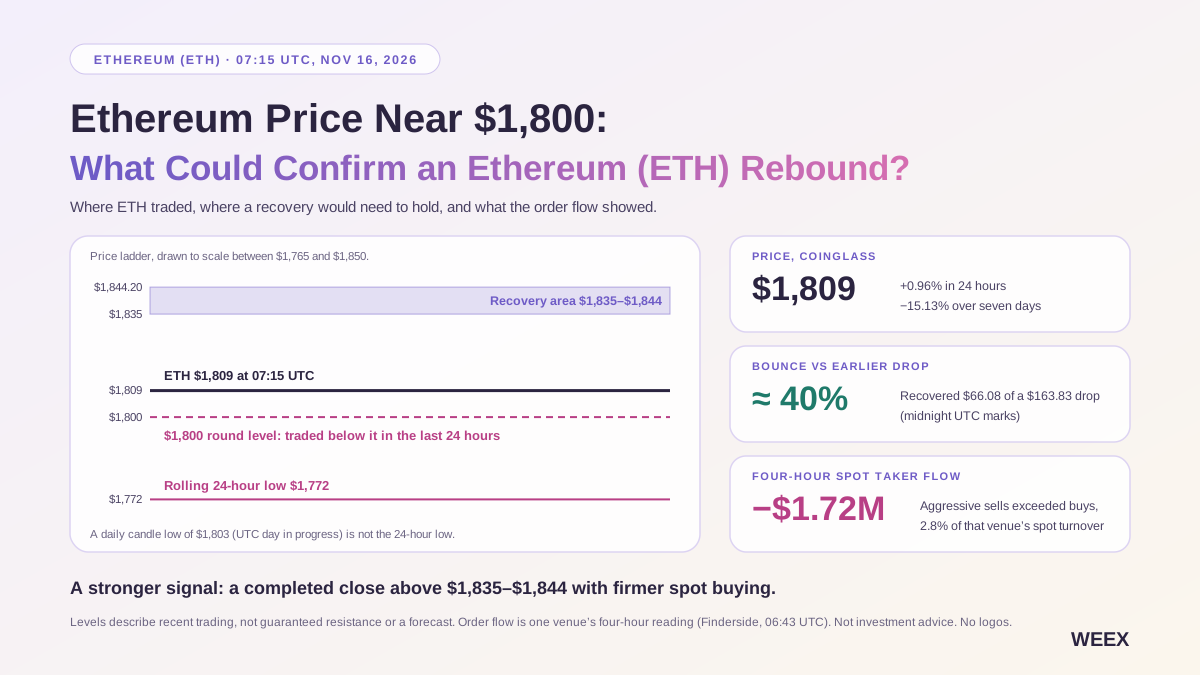
Ethereum Price Near $1,800: What Could Confirm an Ethereum (ETH) Rebound?
Ethereum traded near $1,800 on November 16. See what four-hour spot order flow, futures positioning, and Friday’s ETF flows say about an ETH rebound.

Nakamoto Extends Part of $60 Million Loan to Kraken Until 2027

Global Cryptocurrency 'Audit' Trend Emerges
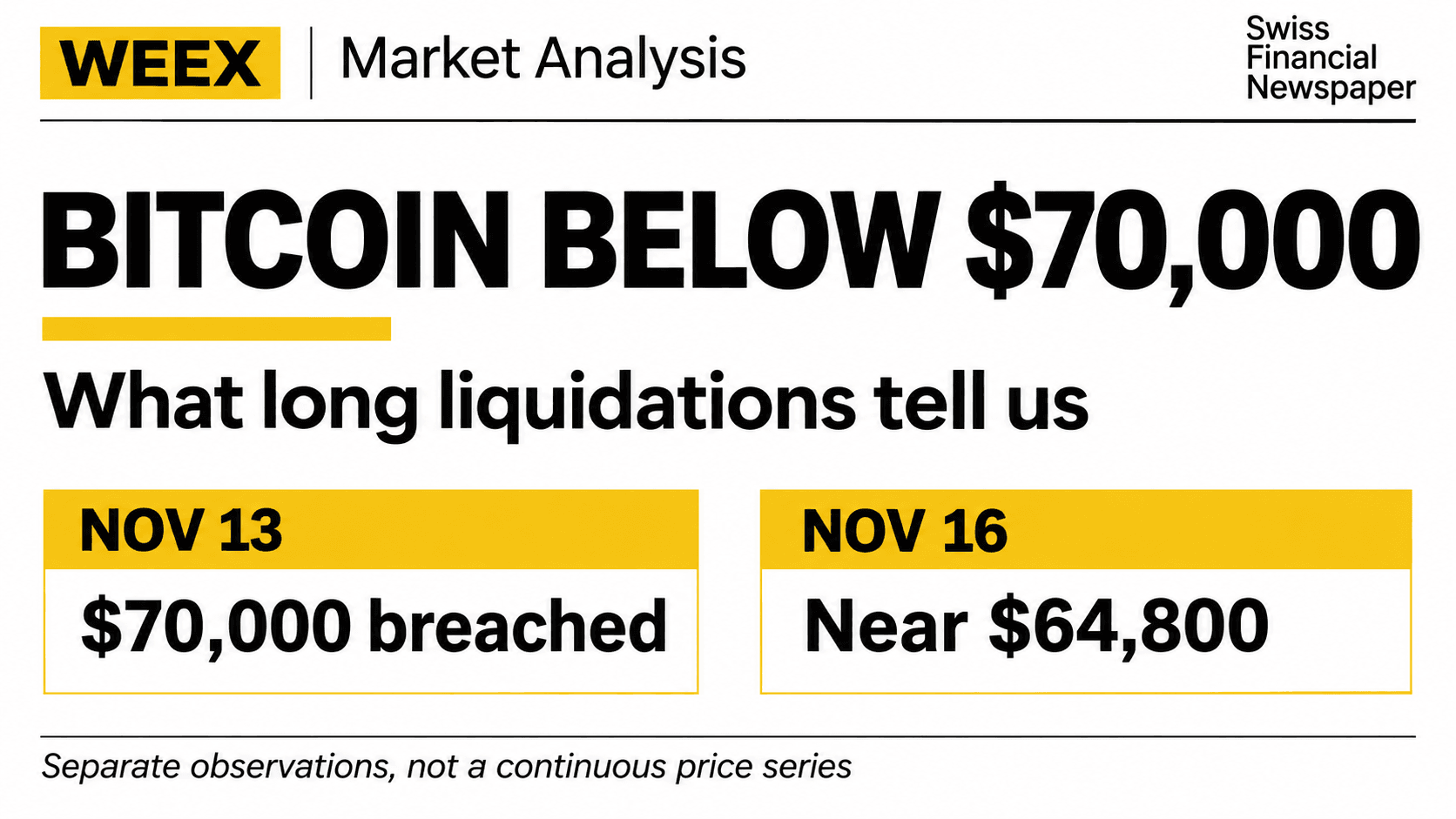
Why Did Bitcoin (BTC) Drop Below $70,000? What Long Liquidations Tell Us
See why Bitcoin fell below $70,000 on November 13, how long liquidations amplified the decline, and what to watch before calling a rebound. If you already plan to trade, you can check whether your activity qualifies for the WEEX Lucky Eggs event, scheduled to run through November 25, 2026 (UTC+8).

Wall Street Wants 24/7 Trading, But Weekend Cash Needs to Be Covered

Bank of America’s Hartnett: The Dollar is 'Destroying Everything', Remains Risk-Averse Before Dollar Decline

Nasdaq Futures vs. Dow Futures: Key Points for Cryptocurrency Traders Before the US Market Opens

When the Crypto Engine Enters Traditional Finance: A Conversation with Bitget's CFD Head on How to Achieve a 10 Billion Cross-Border Sample in Ten Months?

Crypto VC May Only Have 1 to 2 Investment Cycles Left as AI and Robotics Take Over as New Capital Battlegrounds

The Cryptocurrency Circle No Longer Exists

Is Meta Stock Still a Buy After Borrowing About $25 Billion This Month?

Archer Aviation and Joby Aviation: Speculative Plays With Upside Potential and Downside Risk
Wall Street Tests the AI Boom: What the Industry's Balances Reveal After the Democratic Victory

How These 6 Natural Gas Stocks Make Money

Is Credo Technology a Better AI Networking Buy Than Broadcom?
Wintermute Spends $824,000 on Front-Running Trades in the Last 30 Days
Yishi Advises to Stay Away from Leverage and Altcoins, Survival is the Top Priority

From 'Patching' to 'Eliminating Entire Classes of Bugs': How to Build Internet Resilience?
One Year of JPYC Stablecoin: First Gas-Free User is Quail Egg Merchant; Single Transaction Limit Set at 1 Million Yen
[Analysis] Two Barriers Preventing Bitcoin from Rising

Is CoreWeave Stock a Buy After Its Latest Earnings?
$LIBRA: One of the defendants seeks to remove Judge Ledesma and halt the review that could reactivate the case
Mazama Energy Finds New Solution to the Biggest Challenge in Geothermal Drilling
Is Apple Losing Its Memory?
Energy Transfer vs. Enbridge: Which High-Yield Pipeline Stock Could Make You Richer Over the Next 10 Years?
Jefferies Raises Spotify Price Target to $710, Expects Over 20% Growth in Free Cash Flow
The Application is Landing, Wealth is Evaporating: Analyzing the Painful Roots of the Crypto Industry through Three Financial Statements
Latest articles


Latest coin listings on WEEX


