
Nvidia's $105 Billion OpenAI Data Center Backing: Could It Push the IPO Toward a $1 Trillion Valuation? 2026

 Prefer us on Google
The Headline vs. The Fine Print
Nvidia's newly signed $105 billion commitment to OpenAI's Ohio data center campus is financial backing for a lease, not a direct equity investment, and that distinction matters enormously when evaluating what it actually does for OpenAI's path to a trillion-dollar IPO. The deal supports a 20-year lease on a massive compute campus rather than adding a single dollar to OpenAI's cap table or ownership structure. Our structural read is that this financing strengthens OpenAI's infrastructure story, which is the foundation any trillion-dollar valuation claim rests on, but it does not itself change what OpenAI is worth on paper, and conflating the two is the most common misreading of this announcement. Understanding exactly what Nvidia committed to, how it differs from its earlier equity stake, and what it does and does not say about valuation is essential before drawing conclusions about the IPO.
What Did Nvidia Actually Agree to Back in This Deal?
Nvidia is guaranteeing up to $105 billion in financing to support lease and power payments for a new data center campus in Pike County, Ohio, which OpenAI will lease for twenty years rather than own outright. The facility, built and operated by SoftBank-backed developer SB Energy, will support an initial 4.25 gigawatts of computing capacity with an option for an additional 3.75 gigawatts, all running exclusively on Nvidia chips.
Why the Guarantee Shrank From an Earlier $250 Billion Figure
The final $105 billion figure represents a significant reduction from the roughly $250 billion guarantee Nvidia had reportedly been considering earlier in the process, with reporting indicating the number was cut to under $120 billion before settling at $105 billion when the agreement was signed. Nvidia disclosed the final "aggregate payment obligation" cap in a securities filing tied to the announcement, and the scaling-down itself is informative: it suggests either the two companies negotiated a more conservative structure or that concerns about the sustainability of AI infrastructure financing influenced the final terms. Nvidia shares reportedly fell roughly 4.5% intraday when the larger $250 billion figure first surfaced in earlier reporting, indicating the market itself was uneasy with the scale of the original number.
How Is This Different From Nvidia's Earlier $100 Billion OpenAI Investment?
This Ohio financing deal is structurally distinct from Nvidia's separate, earlier commitment to invest up to $100 billion directly into OpenAI through non-voting shares, and treating the two as the same transaction misrepresents both. The earlier deal was a direct capital investment tied to deploying at least 10 gigawatts of Nvidia systems; the new deal is a credit guarantee tied to a single Ohio facility's lease obligations.
| Deal Feature | Original Equity Investment | New Ohio Financing Deal |
|---|---|---|
| Structure | Up to $100B via non-voting shares | Up to $105B lease and power payment guarantee |
| Cap table impact | Adds Nvidia as a capital participant | No direct equity stake created |
| Scope | 10GW of Nvidia systems broadly | Specific Pike County, Ohio campus, 4.25GW initial |
| Ownership of facility | Not applicable | Owned by SB Energy, leased to OpenAI |
Taken together, Nvidia's cumulative commitments across both the equity investment and the various financing and infrastructure arrangements could total as much as $600 billion, a scale that underscores how central Nvidia has become to OpenAI's compute buildout regardless of which specific instrument is used.
Why Are Analysts Raising Circular Financing Concerns Here?
Circular financing describes a company investing in a customer that then uses that capital, directly or indirectly, to purchase the investor's own products, and critics argue this can inflate reported demand without reflecting genuine independent revenue. Nvidia CEO Jensen Huang has explicitly pushed back on this characterization for the Ohio deal, stating that Nvidia is only backing defined portions of lease and power payments rather than covering OpenAI's full financial obligations, and emphasizing that OpenAI itself remains responsible for paying the lease.
Why This Distinction Matters for Valuation Analysis
Whether or not the circular financing critique is fair, its persistence in market commentary signals that sophisticated investors are scrutinizing the substance behind AI infrastructure spending rather than accepting headline dollar figures at face value. A trillion-dollar IPO valuation ultimately needs to be justified by durable, independently generated revenue rather than infrastructure spending that partly circulates back to the chip supplier funding it, which is precisely the tension this deal has reignited in investor commentary.
Does This Financing Actually Move OpenAI Closer to a $1 Trillion Valuation?
The financing strengthens the infrastructure case for OpenAI's revenue ambitions, but it does not directly alter OpenAI's valuation, since it is debt-like credit support rather than a primary funding round that reprices the company. The most recent primary-market data point remains OpenAI's roughly $852 billion valuation from an approximately $122 billion funding round involving SoftBank, Amazon, and Nvidia, which sits meaningfully below the $1 trillion target company leadership has publicly held to.
The Bull Case: Infrastructure as the Bottleneck to Growth
Proponents of the trillion-dollar case argue that compute capacity, not customer demand, has been the binding constraint on OpenAI's revenue growth, and securing 8 gigawatts of dedicated capacity directly supports the company's internally projected path toward roughly $280 billion in annual revenue by 2030. Under this view, every major compute commitment, including this Ohio deal, is a necessary building block for hitting the revenue scale that would make a trillion-dollar valuation defensible on fundamentals rather than narrative alone.
The Bear Case: A Valuation Gap That Financing Alone Cannot Close
Skeptics point out that OpenAI's own leadership has treated $1 trillion as a negotiating floor, with reports describing any valuation below that level as a "non-starter" internally, which is a stance rather than a confirmed outcome. The company is also reportedly facing a substantial net loss in 2026, with estimates for the figure varying by source but consistently landing in the tens of billions of dollars, driven heavily by the same infrastructure buildout this Nvidia deal supports. That combination, aggressive spending funded partly through guarantees from its own key supplier, a primary valuation still hundreds of billions below the IPO target, and a widely reported possibility that the listing itself could slip from late 2026 into 2027, suggests this specific financing deal is necessary infrastructure groundwork rather than a valuation catalyst in its own right.
What Does the SpaceX IPO Comparison Tell Us About Realistic Outcomes?
SpaceX's June 2026 public listing, which priced at roughly $1.77 trillion and briefly pushed the company's market value past $2 trillion, reset the scale of what "largest IPO ever" now means and gives OpenAI's own trillion-dollar target useful public-market context. That outcome demonstrates public investors are currently willing to pay historic premiums for category-defining technology companies, which supports the bull case for OpenAI, but SpaceX also had audited revenue figures and an operating history that OpenAI's prospectus will need to match in credibility.
What Prediction Markets Currently Imply
Prediction markets tracking OpenAI's IPO timing show real uncertainty rather than consensus confidence: one platform recently priced a 2026 listing at roughly a coin-flip probability, while another showed a higher probability for an IPO announcement specifically by March 2027. That spread across prediction markets is itself a useful signal, indicating that informed traders see meaningful execution risk in both the timing and the ultimate valuation OpenAI will achieve, regardless of how much infrastructure backing continues to arrive from partners like Nvidia.
Investors tracking this story are best served watching for the actual S-1 prospectus disclosures, particularly audited revenue and loss figures, rather than treating individual infrastructure financing announcements as valuation confirmations on their own. Distinguishing between debt-like backing that enables future growth and the primary-market events that actually reprice the company remains the most reliable way to evaluate how close OpenAI truly is to its trillion-dollar target.
Frequently Asked Questions About Nvidia's OpenAI Data Center Deal and IPO Valuation
1. Is Nvidia's $105 billion commitment a direct investment in OpenAI
No, this specific $105 billion figure is a financing guarantee covering portions of lease and power payments for a leased data center campus, not a direct equity investment in OpenAI.
Nvidia's separate, earlier commitment of up to $100 billion through non-voting shares is the actual direct equity investment, and the two deals should not be treated as the same transaction despite both involving Nvidia and OpenAI.
2. Does this data center deal automatically raise OpenAI's valuation toward $1 trillion
No, financing guarantees do not directly reprice a company the way a primary funding round does, since they represent credit support rather than new capital exchanged for equity ownership.
OpenAI's most recent primary-market valuation remains below the $1 trillion target, and reaching that figure would require either a new funding round or the IPO itself to establish that specific price.
3. What is circular financing, and does it apply to this Nvidia OpenAI deal
Circular financing refers to a company investing in or financially supporting a customer that then uses those funds, directly or indirectly, to purchase products from the original investor, which can create an appearance of demand that is partly self-generated.
Nvidia's leadership has publicly disputed that characterization for this specific deal, noting that OpenAI remains responsible for paying its own lease while Nvidia only backs defined portions of the payment obligations.
4. When is OpenAI actually expected to go public
Reports have described a potential listing window in late 2026, though other reporting suggests the timeline could slip into 2027, and OpenAI's leadership has not confirmed a fixed date.
Prediction markets tracking this outcome currently show meaningful uncertainty rather than strong consensus, reflecting genuine unresolved questions about both timing and final valuation.
5. How does the SpaceX IPO affect expectations for OpenAI's potential valuation
SpaceX's 2026 public listing at roughly $1.77 trillion demonstrated that public markets will pay historic premiums for category-defining technology companies, which strengthens the plausibility case for OpenAI's own trillion-dollar target.
However, SpaceX's listing came with audited revenue and an established operating history, meaning OpenAI's own prospectus disclosures, rather than the SpaceX comparison alone, will ultimately determine how public investors price its shares.
This content is provided for general informational purposes only and doesn't constitute financial, investment, legal, or tax advice. Any events, rewards, online promotions, or related information mentioned herein should not be considered a recommendation, solicitation, or invitation to purchase, sell, trade, or otherwise deal in any crypto assets. Crypto assets are highly volatile and may result in loss. The availability of WEEX services, products, and related events may vary by region. You are responsible for ensuring that your participation is in accordance with applicable local laws and regulations.
You may also like
What Is Pearl (PRL) Crypto and How Does Its Mining Work?
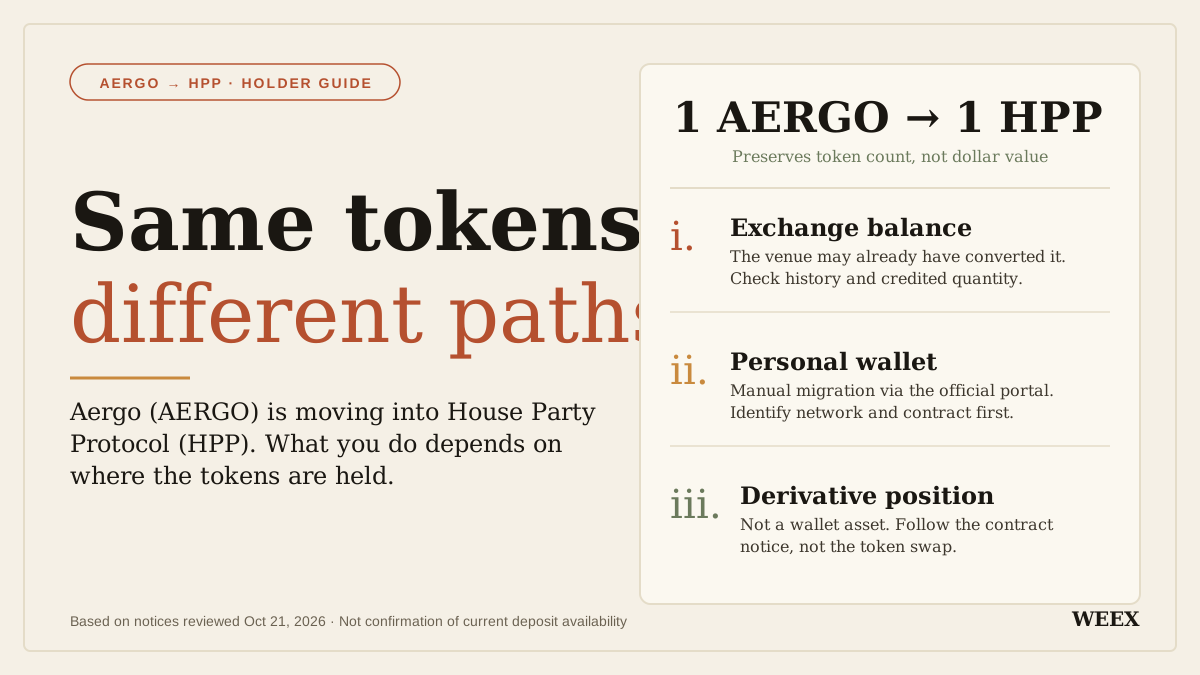
What Happened to Aergo (AERGO) Crypto? Token Migration and What Holders Should Do
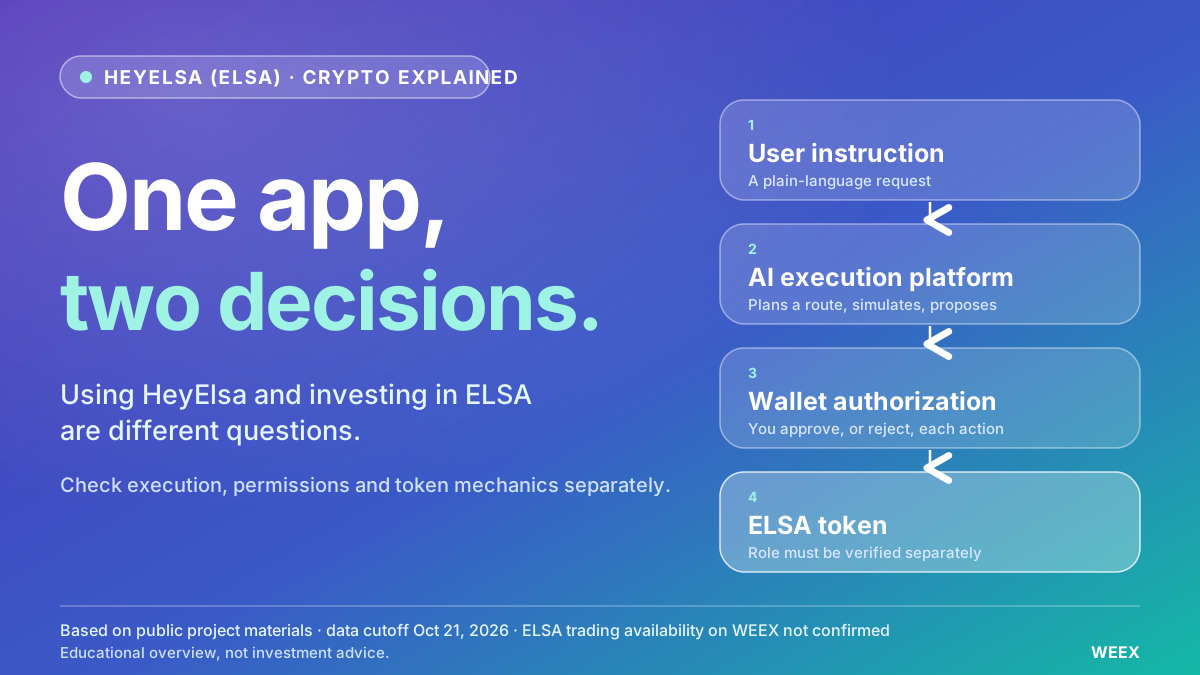
What Is HeyElsa (ELSA) Crypto and How Does It Work?
Stake ETH or Hold USDT on WEEX? The Price Move That Decides It
How Transparent Is a Crypto Exchange? Checking Proof of Reserves and Protection Funds
Token Unlocks This Week: How to Read AKE, ZRO and XPL Releases

World ID for Banks: What the New Suite Means for WLD Holders
Solana Alpenglow Upgrade: What Changes When Finality Hits 150ms
How to Use the WEEX Trust Center: Check Reserves, Protection Fund and Official Contacts
INJ Community BuyBack: What the $247K October Pool Really Means
What Is Leverage Trading in Crypto? A Beginner’s Guide With Simple Examples
What Is Crypto Margin Trading? How It Works, How It Differs From Futures and What Can Go Wrong
Crypto Leverage Trading Explained: How Perpetual Futures, Margin and Liquidation Work
Best Crypto Leverage Trading Platform: Things to Compare Before You Choose an Exchange
Nvidia Stock This Week: Why NVDA Fell Then Bounced and What AI Funding Worries Mean for Chip Stocks
Is My Pre-4.26.4 Qubic Wallet Unsafe? Recovery After the Network Restart
WXT Staking When Supply Shrinks: What Burns Add to Your Yield
Are Tokenized Stocks Backed by Real Shares? What Holders Own
ETH Funding Rate Today: 0.0087% per 8h as Ether Longs Re-Lever
Bitcoin Margin Trading: BTC Liquidation Math at 3x, 10x and 25x
Crypto Leverage Trading Platform: 6 Checks Before You Deposit
What Is Margin Trading? A $1,000 Example at 3x and 10x Leverage

The 17 October 2026 DBR Unlock: Six Allocations and deBridge's Vesting Schedule
Fake Crypto Payments: What to Check Before Handing Over Goods
What Is Leverage in Trading? How Leverage Ratios Like 5x and 10x Work and What They Do to Your Risk
What Is Leverage Trading? A Beginner’s Guide to Margin, Liquidation and Funding Fees
Is RSI a Good Indicator? How the Relative Strength Index Works, Its Limits and How Traders Use It
CXMT Stock Explained: What Is ChangXin Memory, Why It Fell on October 19 and What to Watch Next

Why Is CoreWeave (CRWV) Stock Falling? Debt, Bond Yields and What Analysts Say
KOSPI Whipsaw Explained: Samsung, SK Hynix and the AI Spending Doubts Behind the Swing
What Is Pearl (PRL) Crypto and How Does Its Mining Work?
What Happened to Aergo (AERGO) Crypto? Token Migration and What Holders Should Do
What Is HeyElsa (ELSA) Crypto and How Does It Work?
Stake ETH or Hold USDT on WEEX? The Price Move That Decides It
How Transparent Is a Crypto Exchange? Checking Proof of Reserves and Protection Funds
Token Unlocks This Week: How to Read AKE, ZRO and XPL Releases


