
MSTR Stock Trades Below Its Bitcoin. Here's the Catch

 Prefer us on Google


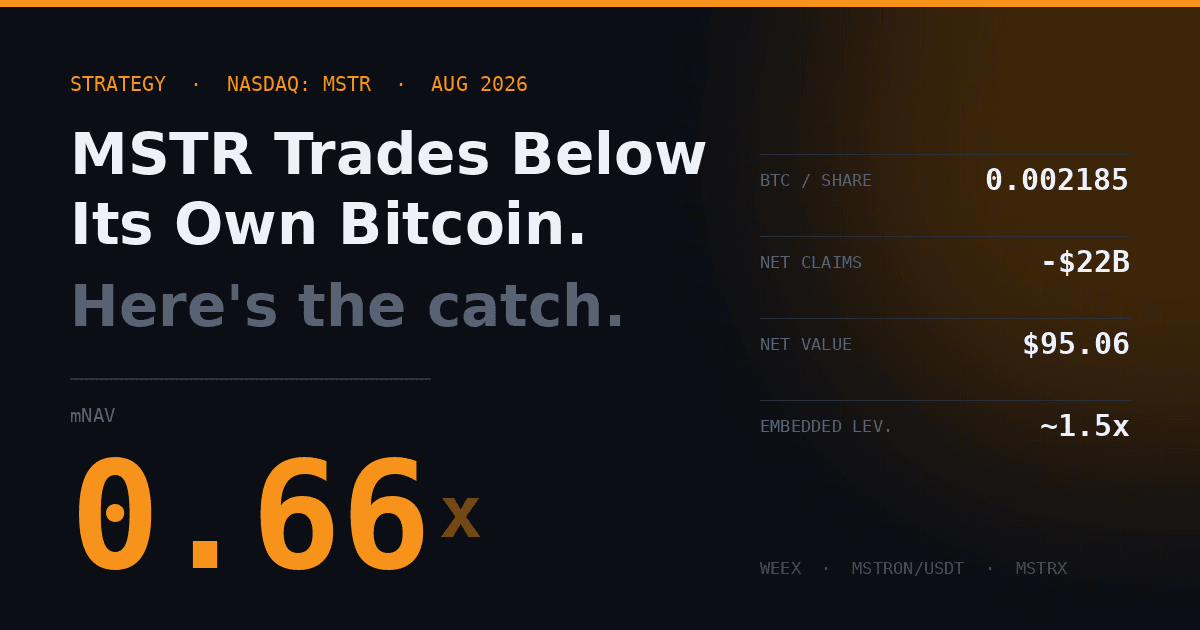
MSTR stock changed hands around $95 on August 18, 2026, after closing at $97.68 the day before. Strategy Inc. (Nasdaq: MSTR) holds 840,447 BTC — about 4% of all bitcoin that will ever exist — and yet the market values the whole company at roughly two-thirds of what those coins are worth on a gross basis. On paper that looks like buying bitcoin at a 34% discount.
It isn't, and the reason is the $22 billion of claims sitting in front of common shareholders. This piece works through the actual per-share math with dated numbers, explains what the 0.66x mNAV headline leaves out, and covers the October index decision that is the single biggest swing factor for MSTR stock between now and year-end.
Why MSTR stock fell from $473 to $95
Two things broke at once.
The first is bitcoin. BTC traded at $64,262 on WEEX on August 18, 2026 — down roughly 48% from its all-time high of $124,457 set on August 14, 2025. Strategy's average purchase price across the whole stack is $75,385 per coin. The company's bitcoin position is roughly 15% underwater, an unrealized loss in the neighborhood of $9.4 billion.
The second is the reflexive loop that made MSTR work in the first place. Strategy's model was to issue equity above net asset value, buy bitcoin with the proceeds, raise bitcoin-per-share, and repeat. That loop only runs while the stock trades at a premium. It doesn't run at a discount — issuing shares below NAV destroys bitcoin-per-share instead of creating it.
So the buying stopped. Saylor confirmed in early August that Strategy had paused regular bitcoin purchases for seven weeks; the last reported buy was 520 BTC for $35 million during the week of June 15–21. What replaced it is more telling: Strategy has been a net seller in 2026, offloading 6,916 BTC year-to-date, including 3,588 BTC for $216 million in early July explicitly to fund preferred dividends, and 1,690 BTC for $108.6 million during August 3–9. The company that spent five years promising it would never sell is now selling to service its own capital stack. Strategy is not alone here — more than a dozen digital asset treasury companies have slipped below 1.0x mNAV since late 2025, but Strategy is the one whose obligations are measured in billions.
What MSTR's 0.66x mNAV actually means
mNAV is the ratio of a company's market value to the market value of its crypto. Below 1.0x, the stock is worth less than the coins. Strategy's readings as of mid-August 2026:
| Metric | Value | As of |
|---|---|---|
| BTC held | 840,447 BTC | Aug 10, 2026 |
| BTC market value | $54.4B | Aug 18, 2026 |
| Average cost per BTC | $75,385 | Aug 9, 2026 |
| Market cap | $35.9B | Aug 18, 2026 |
| Enterprise value | $54.3B | Aug 18, 2026 |
| mNAV (basic) | 0.66x | Aug 18, 2026 |
| mNAV (enterprise value) | 1.00x | Aug 18, 2026 |
| Debt outstanding | $6.75B | Aug 9, 2026 |
| Preferred stock | $15.24B | Aug 9, 2026 |
| BTC per basic share | 0.002185 | Aug 18, 2026 |
Sources: BitcoinTreasuries.net, Strategy 8-K and FWP filings, WEEX BTC price page.
Look at the two mNAV lines. Basic mNAV of 0.66x compares market cap to gross bitcoin and ignores everything owed. Enterprise-value mNAV of 1.00x includes the debt and preferred — and it says the market is pricing Strategy's bitcoin at exactly par.
The per-share arithmetic makes the point concrete. Strategy carries 0.002185 BTC per basic share, implying roughly 385 million shares. At $64,262 per coin, that is $140 of gross bitcoin per share. Now subtract the claims: $6.75B of debt and $15.24B of preferred, offset by a $4.65B USD reserve, works out to about $45 per share of net obligations. Gross $140 minus $45 leaves roughly $95 of net bitcoin value per share — within a dollar of where MSTR stock actually trades.
The discount is not a discount. It is leverage, priced correctly. Anyone buying MSTR expecting to pick up bitcoin at 66 cents is buying the residual claim after $22 billion of senior paper, and the market has already done that subtraction.
MSTR stock vs bitcoin: what the leverage table looks like
Because the claims are fixed in dollars and the assets are not, MSTR's net value per share moves faster than bitcoin in both directions. Holding the capital structure constant at its August 2026 shape:
| BTC price | Gross BTC per share | Net BTC value per share | Change vs today |
|---|---|---|---|
| $40,000 | $87 | $42 | −56% |
| $50,000 | $109 | $64 | −33% |
| $64,262 (Aug 18, 2026) | $140 | $95 | — |
| $75,385 (Strategy's cost basis) | $165 | $120 | +26% |
| $100,000 | $218 | $173 | +82% |
| $124,457 (BTC all-time high) | $272 | $227 | +138% |
Calculated from 840,447 BTC, ~385M basic shares, $6.75B debt, $15.24B preferred, $4.65B USD reserve. Static model — it assumes no further issuance, buybacks, or coin sales, all of which are happening.
A 22% fall in bitcoin from here takes about 33% off net value per share; a 55% rally adds about 82%. That is roughly 1.5x embedded leverage, and it is the actual product being sold. Run the same line to zero and net value per share hits nothing somewhere around a $20,600 bitcoin — far-fetched, but it is the number that defines the floor, and no quote page will show it to you.
The static caveat matters more than usual right now. Strategy's preferred securities — STRK, STRF, STRD, and the 12%-coupon STRC — carry an estimated $1.5 billion annual dividend load. Software revenue does not cover that. So the cash comes from issuing more stock, which dilutes bitcoin-per-share, or from selling coins, which shrinks the numerator. Both quietly erode the top row of that table over time.
-- Price
Is MSTR stock still a bitcoin proxy?
It is a bitcoin proxy with a financing business bolted on, and in 2026 the financing business is doing the driving.
Consider what a holder actually owns: levered bitcoin exposure, a small software company, an obligation to fund $1.5 billion a year of dividends before common shareholders see anything, and the option value of Saylor's ability to keep tapping capital markets. When the stock traded at 2x NAV, that last item was worth a great deal — the ATM machine was accretive. At 0.66x basic mNAV, it is worth much less, and Strategy raising $653.1 million through MSTR share sales during August 3–9 while simultaneously selling bitcoin tells you the machine is now running to service the stack rather than grow it.
Sell-side coverage has not caught up. Consensus price targets still cluster around $264, roughly 180% above spot — targets set against a premium-mNAV business model that no longer exists. Treat those numbers as an artifact of slow revision, not as a signal.
The more useful framing: if you want bitcoin exposure, spot bitcoin gives you it without the preferred stack. If you want leverage, MSTR gives you roughly 1.5x with equity-market hours, single-issuer credit risk, and a dilution mechanism you don't control. Those are different products, and conflating them is where most of the pain in this name has come from.
The MSCI decision is MSTR's biggest near-term catalyst
MSCI has proposed a screen that would remove companies whose core business assets make up less than 50% of total assets from its Global Investable Market Indexes. When MSCI ran the test against May 2026 data, Strategy failed outright, alongside Metaplanet and uranium holder Yellow Cake. Exclusion could take effect as early as the November 2026 index review.
The dates that matter: feedback closes September 30, 2026, and MSCI's final decision lands by October 16, 2026. Estimated passive outflows if Strategy is deleted run to roughly $2.8 billion, and prediction markets have put deletion odds near 73%. Strategy's public response — that MSCI should measure markets rather than dictate corporate balance sheets — is a reasonable argument and not a hedge against forced selling.
MSCI shelved a narrower crypto-treasury exclusion in January 2026, so a reprieve is possible. But this is a scheduled, binary, calendarized event in a stock that already lacks a premium to cushion it. Position sizing around October 16 is a more practical concern for MSTR holders right now than any 2027 price target.
How to trade MSTR exposure around the clock
MSTR stock trades on Nasdaq during US market hours. Bitcoin does not stop, and Strategy's value is now almost entirely a bitcoin function — which means the gap risk sits in the overnight and weekend windows when BTC moves and MSTR cannot reprice.
Tokenized MSTR instruments exist to close that window, and they carry their own frictions worth understanding before using them:
| Instrument | Price | Market size | Note (as of Aug 19, 2026) |
|---|---|---|---|
| MSTR (Nasdaq) | ~$95.04 | $35.9B market cap | US hours, real shares, voting rights |
| MSTRON/USDT on WEEX | $92.73 | $17.83M token market cap, 192,320 circulating | Ondo-issued, listed on WEEX since Feb 6, 2026 |
| MSTRX (xStock) | $92.97 | $44.30M cap, $6.58M 24h volume | Backed-issued; not listed on WEEX |
Two things stand out in that table. First, both tokenized versions were trading about 2.2–2.4% below the Nasdaq close — a real tracking gap that widens when the underlying is closed and liquidity is thin. Second, the token float is tiny relative to the equity: $17.8 million of MSTRON against a $35.9 billion company. That is not a market where size can move without slippage.
The practical rules, then: check the token's premium or discount to the last Nasdaq print before you size anything, keep orders small enough that the book absorbs them, and remember these tokens give economic exposure only — no voting rights, and issuer and redemption mechanics you should read before committing capital. If your actual view is on bitcoin's spot price rather than on Strategy's capital structure, trading BTC directly removes every one of these frictions.
What matters most for MSTR stock right now
Rank the variables and the picture gets simple. Bitcoin's price is the dominant term — it sets 100% of the asset side. The MSCI vote on October 16 is the near-term event with a known date and a knowable size. The preferred dividend load is the slow leak, forcing either dilution or coin sales every quarter it isn't covered by operations.
What is not a variable worth much weight: the 0.66x basic mNAV headline. Strip out the $22 billion of senior claims and MSTR stock is priced at roughly par against its net bitcoin — no bargain, no premium, just leverage that cuts symmetrically. MSTR stock is a levered bet on bitcoin wrapped in a capital structure that charges rent, and understanding both halves is the whole job.
Traders who want the bitcoin view without the balance sheet can trade BTC directly on WEEX. Those who want the leverage should size for the fact that it works in both directions.
FAQ
1. Why is MSTR stock down so much in 2026?
Bitcoin fell about 48% from its August 2025 high to $64,262 on August 18, 2026, putting Strategy's stack — bought at an average $75,385 — underwater. On top of that, the premium-to-NAV that funded accretive share issuance disappeared, so the flywheel that drove the stock from 2020 to 2024 stopped turning.
2. What is MSTR's mNAV and why are there different numbers?
Basic mNAV (0.66x as of August 18, 2026) compares market cap to gross bitcoin value and ignores liabilities. Enterprise-value mNAV (1.00x) includes the $6.75B of debt and $15.24B of preferred. The second number is the one that reflects what common shareholders actually own.
3. Does MSTR stock still track bitcoin one-for-one?
No. Because the debt and preferred claims are fixed in dollars, MSTR's net value per share moves roughly 1.5x bitcoin in both directions. That amplification is the point of the structure and also its main risk.
4. Has Strategy sold any of its bitcoin?
Yes. Strategy sold 6,916 BTC during 2026 through mid-August, including 3,588 BTC for $216 million in July disclosed as funding for preferred dividends, and 1,690 BTC for $108.6 million during August 3–9.
5. What happens if MSCI removes MSTR from its indexes?
Estimated passive outflows are around $2.8 billion. The final decision is due by October 16, 2026, with any exclusion taking effect as early as the November 2026 review. Forced index selling into a stock with no NAV premium is the specific mechanism to watch.
6. Can I get MSTR exposure without a US brokerage account?
Tokenized versions such as MSTRON, listed on WEEX since February 6, 2026, offer economic exposure to MSTR without a traditional broker. They trade at a small discount or premium to the Nasdaq price, carry no voting rights, and have far thinner liquidity than the underlying equity.
7. Is MSTR stock better than buying bitcoin directly?
They are different instruments. Spot bitcoin gives clean, unlevered exposure with no issuer credit risk. MSTR adds roughly 1.5x leverage plus dilution risk, preferred dividend obligations, index-inclusion risk, and equity-market hours. Which is appropriate depends entirely on whether you want the leverage and can tolerate the extra failure modes.
Risk Warning
Crypto assets and crypto-linked equities are highly volatile and can result in partial or total loss of capital. MSTR stock carries risks that spot bitcoin does not: roughly 1.5x embedded leverage from its debt and preferred stack, an estimated $1.5 billion annual preferred dividend load that may be funded through share issuance or bitcoin sales, single-issuer credit and solvency risk, and a pending MSCI index decision due by October 16, 2026 that could trigger an estimated $2.8 billion of passive selling. Tokenized MSTR products add further layers — issuer and custody risk, redemption restrictions, thin secondary liquidity, tracking error against the Nasdaq price, and no shareholder voting rights. All prices, holdings, and ratios in this article are dated as shown and change continuously. Nothing here is investment advice; verify current figures before acting and only risk capital you can afford to lose.
This content is provided for general informational purposes only and doesn't constitute financial, investment, legal, or tax advice. Any events, rewards, online promotions, or related information mentioned herein should not be considered a recommendation, solicitation, or invitation to purchase, sell, trade, or otherwise deal in any crypto assets. Crypto assets are highly volatile and may result in loss. The availability of WEEX services, products, and related events may vary by region. You are responsible for ensuring that your participation is in accordance with applicable local laws and regulations.
You may also like

XSolut Company: What Is the Team Behind XST Coin and What Do They Actually Disclose

Stock Market News Today: Why Bonds Are Setting the Tape

How to Earn WXT Rewards with WEEX Trade to Earn S6 Event

How to Earn WXT Rewards with WEEX Trade to Earn S6 Futures Event

Roblox Stock Price Prediction 2026-2027: Can RBLX Recover After Falling From $142 to $38
Roblox Stock Is Down 68% in the Past Year: What Age Verification and Sands Capital's Exit Actually Signal

Pakistan Stock Exchange Performance in 2026: What Is Driving the KSE 100 to Record Highs

The XSolut (XST) Contract Address: How to Identify the Real XST Token on Solana 2026
Nvidia's $105 Billion OpenAI Data Center Backing: Could It Push the IPO Toward a $1 Trillion Valuation? 2026
How Do Pre-IPO Perpetual Futures Allow On-Chain Exposure to OpenAI Stock? 2026

Can XST Crypto Reach $0.10? XSolut Price Prediction 2026
Is XST Crypto a Long-Term Opportunity or Short-Term Hype?
USDT vs BTC Settlement for Crypto Broker Partners: Which Currency Is Better for Your Business
Master Account vs Sub-Account: What the Difference Means for Crypto Broker Partners

Crypto Broker vs Stock Broker: What Is the Difference and Which Do You Need
Is OPAI.PVT OpenAI's Real Stock Symbol? What Investors Need to Know Before the IPO 2026
Meta Stock Price Is Down 30% From Its 52 Week High: Is META a Buy After the Child Safety Trial Drop
Meta Stock Falls as 29 States Begin Federal Child Safety Trial: What the "Big Tobacco Moment" Warning Actually Means
What Is NIULAI Crypto? Why the Token and the Film Are Two Completely Different Things
Google Stock and the 199% EPS Beat: What Earning $9.11 Against a $3.04 Estimate Actually Reveals
Adobe Stock Jumps After BlackRock Raises Stake to Over 10%: What an $8.4 Billion Bet Actually Signals
Is OPAI.PVT OpenAI's Real Stock Symbol? What Investors Need to Know Before the IPO 2026
CoreWeave Stock (CRWV): The Debt Math Behind the AI Trade — and How to Trade It 24/7
Buy Crypto With JazzCash and Easypaisa, Now Live on WEEX
Before Swapping XSolut (XST): How to Check Liquidity, Price Impact, and Failed-Trade Risk 2026

Is Niulai Coin a Good Investment? What the Film Story Cannot Tell You About NIULAI Risk
Niulai Coin Price Prediction: What Happens to Meme Tokens After a Viral Peak on BNB Chain
SK Hynix Stock Price Has 43% Upside According to Wall Street: What the $245 Consensus Target Actually Requires
Tesla Stock Price Is Down 30% in 2026: What the Q2 Earnings Miss and 1.4% Operating Margin Actually Signal
MSFT Stock Price Prediction 2026-2027: What the $569 Analyst Consensus Target Actually Requires
XSolut Company: What Is the Team Behind XST Coin and What Do They Actually Disclose
Stock Market News Today: Why Bonds Are Setting the Tape
How to Earn WXT Rewards with WEEX Trade to Earn S6 Event
How to Earn WXT Rewards with WEEX Trade to Earn S6 Futures Event
Roblox Stock Price Prediction 2026-2027: Can RBLX Recover After Falling From $142 to $38
Roblox Stock Is Down 68% in the Past Year: What Age Verification and Sands Capital's Exit Actually Signal
Contents
Popular coins
Latest articles


