
Fixed-Rate Lending Unused? It's the Existing Products That Can't Solve Mismatched Terms

 Prefer us on Google



Fixed rates lock in prices, while early repayment terms determine actual costs.
Written by: Stephen
Fixed rates determine the financing price in the contract, while early repayment terms decide whether this certainty can extend to shorter borrowing periods. If loans only allow repayment at face value or exit at market prices, borrowers cannot automatically obtain an alternative settlement method under the contract, which is to pay interest only for the actual time funds are used and settle the loan.
For borrowers financing LP positions, arbitrage strategies, or short-term market opportunities, the window of potentially profitable strategies may be far shorter than the loan's maturity. Another mismatch occurs when interest rate environments change. Borrowers lock in financing at high rates, and even if cheaper funding opportunities arise during that period, they must first bear the costs of exiting existing financing.
This creates a counterintuitive demand structure for fixed-rate financing. Leverage demand is often strongest when rates are highest, making locking in financing for the entire term least attractive; conversely, when it is suitable to lock in rates, borrowing demand tends to be weaker. The product is most attractive when there is the least demand.
In this structure, the economic consequences of mismatched terms are still borne by the borrower: the term may be too long for the strategy or too long for the interest rate environment.
The Cost of Early Exit Depends on the Repayment Method
When repaying at face value, the amount due does not automatically decrease as the actual borrowing time shortens. Suppose a borrower receives 100,000 USDC and needs to repay 100,600 USDC after 30 days. Ignoring fees and slippage, the financing cost is 600 USDC. If the strategy ends on day 7, the borrower still needs to pay the full 100,600 USDC upon direct repayment. According to the same simple interest calculation, the interest for 7 days is only 140 USDC, and the remaining 460 USDC is the cost of financing for the unused 23 days.
Another way is to buy the corresponding units in the market to offset the debt. Market repurchases can reduce this cost and may even be more cost-effective than paying interest only for the actual borrowing time at the original rate. However, the outcome depends on the price and liquidity at the time of exit, which cannot be determined at the time the loan is initiated.
Under otherwise identical conditions, a decline in market yields will increase the value of the remaining fixed-rate debt, making repurchases more expensive; an increase in yields may have the opposite effect. Borrowers wishing to refinance at lower rates may find the costs of exiting existing financing increasing. The original contract rate remains unchanged; what changes is the exit cost.
More Pools ≠ Aggregated Liquidity
If the market is divided by loan assets, acceptable collateral, risk parameters, and maturity dates, time itself becomes a boundary between markets. Allowing one market to accept multiple collateral assets can reduce some fragmentation.
Standardizing maturity dates can concentrate trading activity, but when borrowers' needs fall outside these dates, they still bear the burden of term differences. Increasing maturity dates expands the optional range but also increases the number of independent debts, each of which requires pricing and executable liquidity.
Multi-market quotes can alleviate some burdens. Shared funding budgets allow the same capital to support multiple quotes without needing to pre-allocate to each market; providing funds at execution can enhance capital efficiency. A rebalancing mechanism can also support atomic extensions between different terms, but extensions still require executable financing conditions on the other end.
These mechanisms are often referred to as “aggregation.” However, each additional market, maturity date, or set of collateral further divides the same supply of funds and order flow into smaller pools, which are then reconnected by the quoting layer.
To measure aggregation, one must see how much existing liquidity a borrowing demand can actually reach. If the market can only match counterparties with identical assets, amounts, and maturity dates, then no matter how many markets participate in quoting, it remains structurally fragmented.
If a market can only match counterparties with “the same asset, the same amount, and the same maturity date,” then regardless of how many different venues quote to this market, it is still structurally fragmented.
This boundary exists because debts inherently carry terms. If there is no longer a requirement for terms to match, allowing loans of any term to serve a shorter-term financing need means that the same pool of funds can reach previously unmatched demands without first slicing liquidity by maturity date.
Liquidity aggregation can reduce the cost of servicing multiple markets but cannot solve the borrower's term mismatch. Matching more existing liquidity and increasing more quoting venues are two different issues.
Cost Ceiling: Making Previously Unquantifiable Demand Measurable
Under floating rates, the cost of funds is essentially a random variable. For strategies with bounded returns, whether arbitrage, basis trading, market making, or financing a known cash flow, it is challenging to pre-calculate financing costs without a clear ceiling. When the strategy itself has a narrow profit margin, the rational outcome may be not to borrow at all.
Without early repayment rights that charge interest based on actual borrowing time, fixed rates only provide known full-term costs. Borrowers still find it difficult to judge in advance whether the strategy's spread can cover the actual costs of ending financing early. The low activity level in the fixed-rate market may not necessarily mean there is no demand; it may also be that product terms exclude some demand.
Clear early repayment rights allow borrowers to settle interest based on actual borrowing time according to pre-agreed rules, while the loan itself still has a fixed rate and a clear maturity date. Thus, the interest cost of funds has a ceiling, at most paying interest at the fixed rate for the actual time used; if cheaper financing is obtained during this period, costs may also decrease. With this ceiling, strategies with bounded returns can be pre-calculated, and borrowers can assess whether financing is appropriate before entering into transactions.
Constant Finance is currently testing its lending design on the testnet, which revolves around this point: fixed terms, early repayment based on actual borrowing time, and built-in refinancing mechanisms. The goal is to clarify the method of interest calculation before borrowers enter positions. As for whether alternative financing can be obtained, it still depends on the available funds and the financing conditions acceptable to the borrower at that time.
-- Price
Core Comparison: Total Financing Cost During Actual Borrowing Period
This flexibility does not come without cost.
Early repayment means lenders lose future interest income while also bearing reinvestment risk, especially when market interest rates have already fallen. Therefore, lenders need to price this early repayment right, which in Constant Finance manifests as higher quoted interest rates.
Whether this flexibility is worth it should ultimately be assessed based on the total financing cost borne by the borrower during the actual use of funds, rather than merely comparing quoted rates.
Thus, the truly meaningful competitive standard is the complete financing outcome, including the initiation of financing, actual use period, and final settlement.
Fixed rates solve an important uncertainty in financing costs. However, under the repayment structure discussed in this article, borrowers still bear the consequences of term mismatches: paying the full face value amount or exiting at market prices.
Infrastructure can become more sophisticated, but it will not eliminate this limitation. When predictable contractual obligations come at the expense of financing terms that match actual demand, for such borrowers, a lending market remains incomplete.
This content is provided for general informational purposes only and doesn't constitute financial, investment, legal, or tax advice. Any events, rewards, online promotions, or related information mentioned herein should not be considered a recommendation, solicitation, or invitation to purchase, sell, trade, or otherwise deal in any crypto assets. Crypto assets are highly volatile and may result in loss. The availability of WEEX services, products, and related events may vary by region. You are responsible for ensuring that your participation is in accordance with applicable local laws and regulations.
You may also like

$LIBRA: One of the defendants seeks to remove Judge Ledesma and halt the review that could reactivate the case

Mazama Energy Finds New Solution to the Biggest Challenge in Geothermal Drilling

Is Apple Losing Its Memory?

Energy Transfer vs. Enbridge: Which High-Yield Pipeline Stock Could Make You Richer Over the Next 10 Years?

Jefferies Raises Spotify Price Target to $710, Expects Over 20% Growth in Free Cash Flow

The Application is Landing, Wealth is Evaporating: Analyzing the Painful Roots of the Crypto Industry through Three Financial Statements

Baidu Q3 Net Profit Exceeds Expectations, AI Cloud Revenue Soars 94%, Token Call Revenue Grows 1159%
Twenty One Capital’s $1.09 Billion Profit Is Mostly a Bitcoin Accounting Story

What Licenses Are Needed for Crypto Payments in Hong Kong?
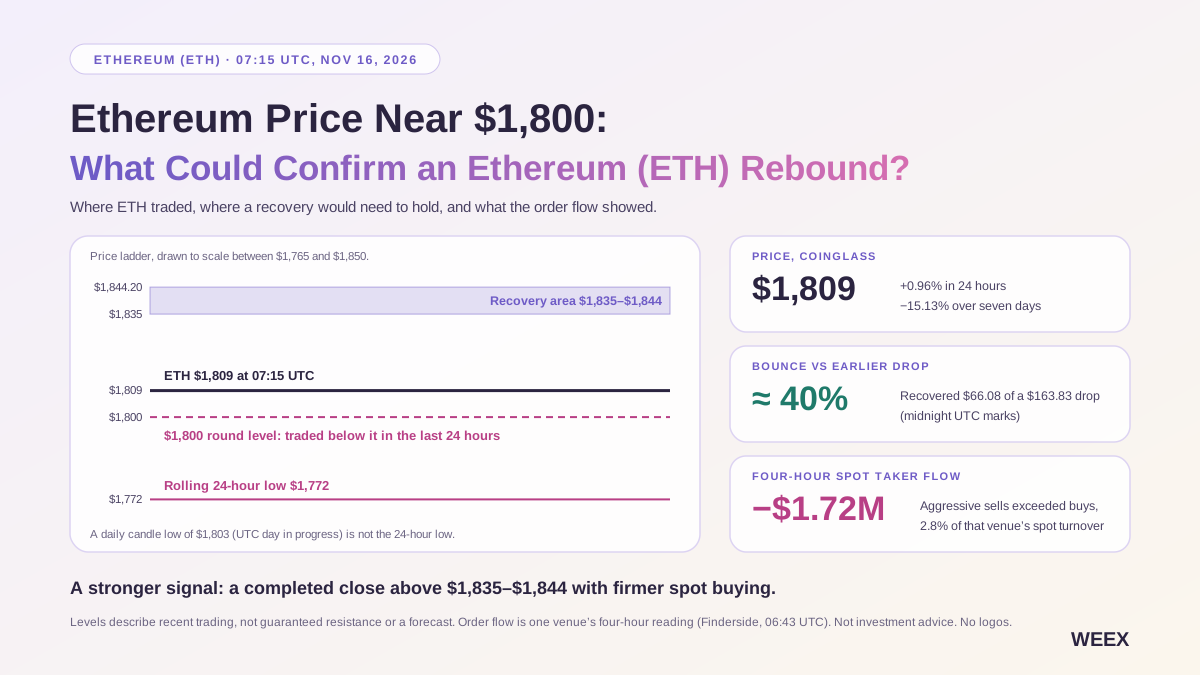
Ethereum Price Near $1,800: What Could Confirm an Ethereum (ETH) Rebound?
Ethereum traded near $1,800 on November 16. See what four-hour spot order flow, futures positioning, and Friday’s ETF flows say about an ETH rebound.

Nakamoto Extends Part of $60 Million Loan to Kraken Until 2027

Global Cryptocurrency 'Audit' Trend Emerges
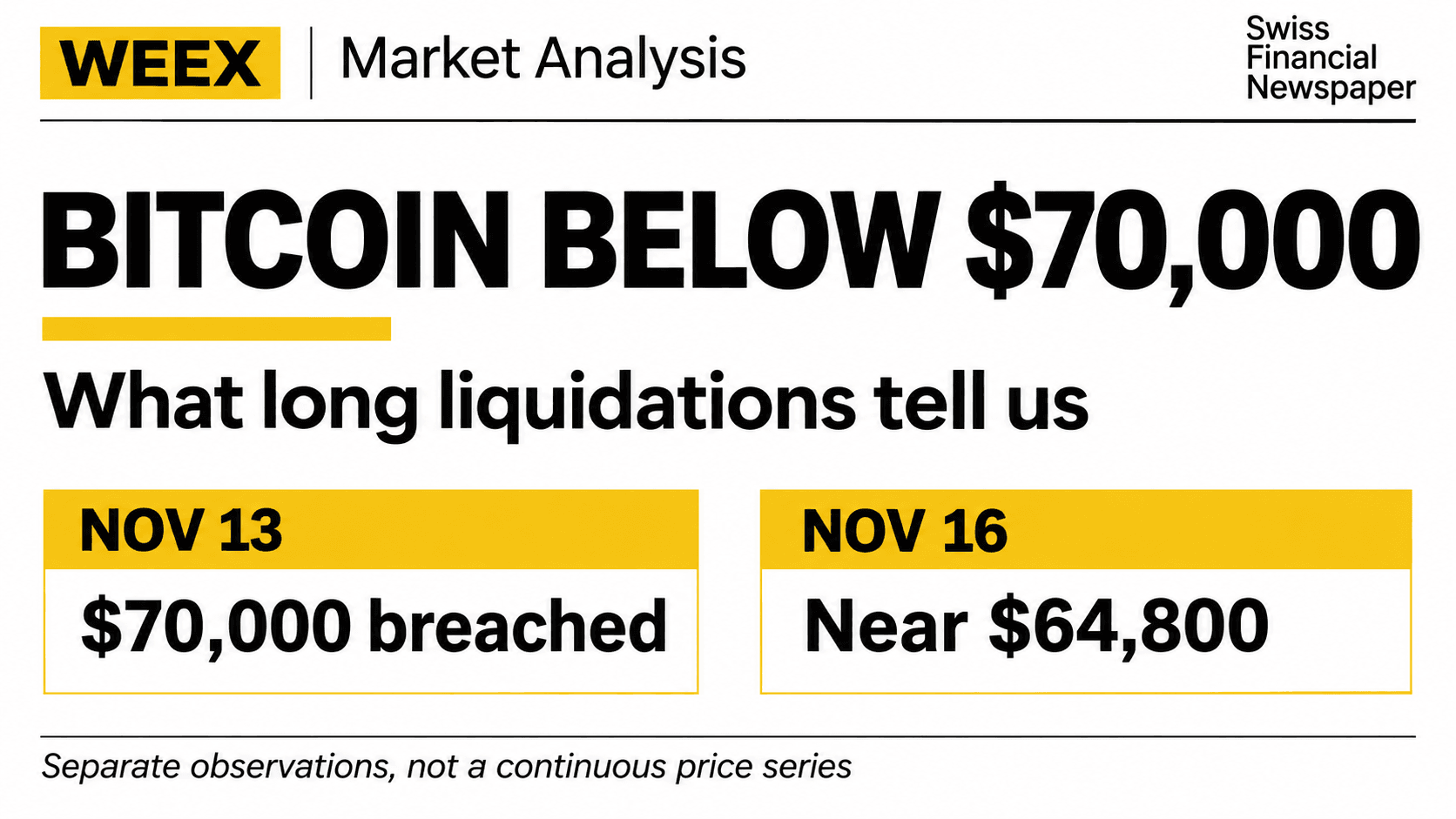
Why Did Bitcoin (BTC) Drop Below $70,000? What Long Liquidations Tell Us
See why Bitcoin fell below $70,000 on November 13, how long liquidations amplified the decline, and what to watch before calling a rebound. If you already plan to trade, you can check whether your activity qualifies for the WEEX Lucky Eggs event, scheduled to run through November 25, 2026 (UTC+8).

Wall Street Wants 24/7 Trading, But Weekend Cash Needs to Be Covered

Bank of America’s Hartnett: The Dollar is 'Destroying Everything', Remains Risk-Averse Before Dollar Decline

Nasdaq Futures vs. Dow Futures: Key Points for Cryptocurrency Traders Before the US Market Opens

When the Crypto Engine Enters Traditional Finance: A Conversation with Bitget's CFD Head on How to Achieve a 10 Billion Cross-Border Sample in Ten Months?

Crypto VC May Only Have 1 to 2 Investment Cycles Left as AI and Robotics Take Over as New Capital Battlegrounds

The Cryptocurrency Circle No Longer Exists

Is Meta Stock Still a Buy After Borrowing About $25 Billion This Month?

Archer Aviation and Joby Aviation: Speculative Plays With Upside Potential and Downside Risk
Wall Street Tests the AI Boom: What the Industry's Balances Reveal After the Democratic Victory

How These 6 Natural Gas Stocks Make Money

Is Credo Technology a Better AI Networking Buy Than Broadcom?

Wintermute Spends $824,000 on Front-Running Trades in the Last 30 Days
Yishi Advises to Stay Away from Leverage and Altcoins, Survival is the Top Priority

From 'Patching' to 'Eliminating Entire Classes of Bugs': How to Build Internet Resilience?

One Year of JPYC Stablecoin: First Gas-Free User is Quail Egg Merchant; Single Transaction Limit Set at 1 Million Yen
[Analysis] Two Barriers Preventing Bitcoin from Rising

Is CoreWeave Stock a Buy After Its Latest Earnings?
$LIBRA: One of the defendants seeks to remove Judge Ledesma and halt the review that could reactivate the case
Mazama Energy Finds New Solution to the Biggest Challenge in Geothermal Drilling
Is Apple Losing Its Memory?
Energy Transfer vs. Enbridge: Which High-Yield Pipeline Stock Could Make You Richer Over the Next 10 Years?
Jefferies Raises Spotify Price Target to $710, Expects Over 20% Growth in Free Cash Flow
The Application is Landing, Wealth is Evaporating: Analyzing the Painful Roots of the Crypto Industry through Three Financial Statements
Latest articles


Latest coin listings on WEEX


