
Interpretation of FATF Report on Scam Compound Funds: Virtual Assets Become Core Money Laundering Channels

 Prefer us on Google



The report analyzes the operational mechanisms and complete funding chains of scam compounds based on nearly 120 cases from over 60 jurisdictions, identifying virtual assets as a core money laundering channel.
Written by: Beosin
On November 5, the Financial Action Task Force (FATF) released the report "Combating End-to-End Illicit Financial Flows Linked to Scam Compounds." The report analyzes the operational mechanisms and complete funding chains of scam compounds based on nearly 120 cases from over 60 jurisdictions, identifying virtual assets as a core money laundering channel.
In this article, Beosin will interpret the core content of the report to help readers quickly understand the complete criminal patterns and funding flows of scam compounds, as well as the authoritative action guidelines provided by FATF for national regulators, financial institutions, and virtual asset service providers to combat scam compounds.
I. Scam Compounds Have Become a Global Organized Crime Network
The report points out that fraud causes economic losses of about $500 billion annually worldwide, with scam compound-related crimes resulting in losses of hundreds of billions of dollars each year. Victims are spread across more than 100 jurisdictions, with identified individuals in Southeast Asian compounds coming from at least 80 jurisdictions. It is estimated that 120,000 people in Myanmar alone are forced to engage in online scams, making it a significant threat with a high priority in the global anti-money laundering field. In the report, FATF clearly states that the criminal patterns of scam compounds have undergone significant changes:
(1) Decentralization of Criminal Forms
Under law enforcement pressure, large closed compounds are gradually disbanding, shifting to apartments, hotels, office buildings, small decentralized scam cells, and even casinos, rental houses, cafes, and vehicles; operations are spreading to Africa, Central Asia, Europe, and multiple countries in Latin America.
(2) Formation of a "Crime-as-a-Service" Industry
The entire criminal chain is highly outsourced and fragmented, with different specialized gangs handling recruitment, victim diversion, scam execution, fund collection, money laundering, and profit reinvestment, without needing to concentrate all operations in the same physical location.
The physical boundaries of the compounds do not coincide with the boundaries of the criminal organizations. A compound may be shared by multiple gangs, with several independent scam lines operating simultaneously in one building, each funding group only responsible for collecting payments for its own line; often, those arrested in a raid are operational personnel and grassroots managers, while the actual controllers of the funding chain may have never entered the compound.
(3) Interwoven Multiple Crimes
Scam compounds are not limited to telecom fraud; they are intertwined with human trafficking, forced labor, corruption, bribery, and underground money laundering, creating dual victims: those coerced into scams and the ordinary people globally who are scammed, posing a threat far beyond mere property loss.
(4) AI Amplifies Criminal Capabilities
The report mentions the impact of AI large models, deep forgery, and intelligent agent AI on scams: AI-generated content, deep forgery, and automation technologies are reducing the operational costs of scam networks, helping them scale up and accelerate, while making it increasingly difficult for victims to recognize scams.
II. Seven-Stage Model of Illicit Fund Flows
The most important core concept of the report is that law enforcement cannot focus solely on dismantling physical scam sites; the emphasis should be on disrupting the funding chains, shared infrastructures, and behind-the-scenes control networks that sustain criminal operations. To this end, FATF proposes a seven-stage closed-loop funding model to analyze the funding flows of scam compounds, where funds are used both to build criminal infrastructures and to receive scam proceeds, with laundered profits reinvested to expand criminal operations.
Stage 1: Building Operational Sites and Supporting Infrastructure
Criminal groups use funds to lease/build sites, acquire communication equipment, purchase SIM cards and domain names, register shell front companies, bribe protection networks, procure mule accounts, and virtual asset wallets, establishing a complete set of soft and hard infrastructure for criminal operations. A large number of black market services are settled directly using virtual assets.
Stage 2: Recruitment of Personnel and Victims
Two parallel victim acquisition channels: one is through false recruitment to lure people across borders, with trafficked individuals coerced into scams; the other is through social platforms, false advertisements, and imitation investment platforms, targeting victims in over 100 jurisdictions worldwide. Many scam warning signals appear before fund transfers occur (such as false advertisements, recruitment, malicious domains), but are often not communicated to financial institutions in real-time.
Stage 3: Scam Execution and Profit Extraction
Primarily involving investment scams and emotional manipulation, supplemented by impersonation scams and refund/unfreezing secondary harvesting of victims. In some scenarios, blockchain authorization scams induce victims to directly authorize the transfer of on-chain assets.
Stage 4: Fund Collection and Initial Placement (Payment Window)
Victim funds are transferred into mule personal accounts, shell company accounts, and virtual asset wallets. The report reveals a key risk fact: victims typically take an average of 20 hours to realize they have been scammed, but the proceeds can be initially transferred within 2-5 minutes (some cases around 2 minutes, generally stated as 3 to 5 minutes). This "payment window" is the golden time for asset preservation and the easiest window to miss intervention. The forms of funds include bank transfers, instant payments, cash, virtual assets, precious metals, gift cards, and various other forms.
Stage 5: Layered Obfuscation and Fund Concealment
Proceeds are obfuscated through multi-layer mule networks, underground money houses, offshore VASPs, P2P/OTC over-the-counter trading, DeFi cross-chain bridges, mixers, and on-chain multi-address jumps. This part is the core link where virtual assets are used for money laundering.
Stage 6: Cashing Out and Asset Consolidation
Washed funds are converted into fiat currency through OTC, underground money houses, and cash cross-border smuggling; large amounts of money flow into real estate, luxury cars, corporate equity, and luxury goods to achieve asset realization and legalize criminal profits. Many scenarios involve "on-chain obfuscation and off-chain cashing out," and relying solely on on-chain analysis cannot restore the complete evidence chain. The cross-border transfer phase pushes funds into the international financial system through shell companies, offshore holdings, and proxy directors.
Stage 7: Profit Extraction and Reinvestment Expansion
Some funds are personal illegal gains for criminals, while the remaining funds flow back to pay for sites, bribes, recruit new personnel, procure scam tools, expand compounds, invest in real estate casinos, or other legitimate businesses, completing the closed loop and continuously expanding the criminal territory.
III. Virtual Assets Become Core Channels for Money Laundering
The report points out that the illegal funds generated by scam compounds exhibit characteristics of "high velocity, multi-layered mixing, and transnational dispersion." Among them, virtual assets and their service providers (VASPs) are exploited by criminal groups in various stages:
(1) Rapid Fund Collection
Scammers use mule networks to quickly transfer fiat funds deposited by victims into bank accounts, and within minutes, exchange them for virtual assets through P2P transactions or OTC brokers, swiftly cutting off the fiat tracking chain. Some large scam compounds even set up dedicated OTC exchange counters within the compound to achieve on-site exchanges from illegal fiat to virtual assets.
(2) Multi-layer Mixing and Money Laundering Links
- Stablecoins: USDT on the TRON network, with its high liquidity, price stability, and low transaction costs, has become the preferred tool for money laundering in Southeast Asia and globally. There are also black market guarantee markets like U-merchant on Telegram and Xinbi Guarantee that bypass KYC, facilitating a full range of criminal services and processing hundreds of billions in equivalent funds.
- Decentralized Money Laundering Tools: When funds flow on-chain, criminals use DeFi cross-chain bridges, mixers, chain-hopping, and crypto ATMs to deeply conceal the flow of illegal funds.
(3) Proprietary On-chain Financial Infrastructure
The report also discloses extreme cases where criminal groups attempt to establish proprietary crypto infrastructures to counter regulatory freezes: for example, the Huione Group developed its own proprietary stablecoin, blockchain, and wallet ecosystem (such as H-Pay) to escape the severance and freezing of assets by law enforcement agencies and issuers.
-- Price
IV. Six Core Challenges and Strategic Principles
The second part of the report systematically outlines the real obstacles faced by national regulators, FIUs, law enforcement agencies, financial institutions, and virtual asset service providers, and the third part provides six strategic principles for combating illicit financial flows linked to scam compounds.
Six Core Challenges:
(1) Serious Mismatch Between Fund Transfer Speed and Intervention Speed
Scam funds can flow across accounts, wallets, and countries within minutes, but the processes for victims to report, institutions to submit suspicious transaction reports (STRs), financial intelligence agencies to analyze, and cross-border judicial assistance are lengthy. 24-72 hours is the golden window for asset preservation, and beyond that, the probability of recovery drops sharply. Additionally, many transactions are initiated by victims who have been deceived into authorizing transfers, making the transaction messages appear completely normal, making it difficult for financial institutions and VASPs to identify scam proceeds based solely on transaction data.
(2) Fragmented Information and Difficulty in Intelligence Integration
Scam-related clues are scattered across banks, VASPs, social platforms, telecom operators, anti-fraud centers, and civilian victim reports. Each party only sees a small piece of the criminal chain. Early scam advertisements and false recruitment signals are held by internet platforms and have not yet resulted in financial transactions, making it difficult to communicate with financial risk control; the legal channels for information sharing between public and private sectors vary by country, and differences in privacy protection rules hinder the flow of risk signals; in cross-border scenarios, different countries have inconsistent classifications of cases, making it impossible to automatically associate similar cases.
(3) High Opacity of Beneficial Ownership
Shell companies, proxies, and multi-layer offshore structures conceal the actual controllers behind the scenes. Even if a batch of mule accounts is frozen, the true masterminds can continuously activate new puppet accounts; if a single service provider is shut down, the black market can quickly switch to alternative channels. Many politically exposed persons (PEPs) and their associated enterprises are used to cover up the funds of scam compounds.
(4) Multiple Barriers to Investigation and Evidence Collection
Existing barriers include: the need to synchronize and integrate evidence from financial investigations, human trafficking, cybercrime, and corruption across multiple fields, which is difficult to coordinate among many departments; a large amount of electronic evidence is stored abroad, encrypted communication is common, and the processes for preserving, verifying, and transferring electronic evidence across borders are cumbersome; many trafficked individuals are easily labeled as suspects, overlooking their victim status and losing key intelligence sources.
(5) Real Barriers to Cross-border Cooperation
Scam crimes inherently have cross-regional characteristics: victims, dens, money laundering transit points, and asset storage locations are distributed across different countries or regions. Traditional judicial assistance processes are lengthy and cannot keep up with rapid fund flows. Formal judicial procedures are suitable for evidence collection and enforcement measures but cannot meet the rapid interception needs of the golden window. Some scam dens are located in areas with weak governance and corrupt protection networks, further hindering cooperation.
(6) Shortcomings in Victim Reporting Systems and Asset Recovery Mechanisms
As many as 70% of victims do not report, due to shame, fear of accountability, or the belief that losses cannot be recovered, leading to significant underreporting; at the same time, it is necessary to distinguish between two types of victims: ordinary people scammed online and trafficked individuals coerced into scams. Existing systems often overlook the protection of the latter, and there is a general lack of mature mechanisms for returning frozen assets to corresponding victims after confiscation, making it impossible to implement compensation after asset confiscation.
The six strategic principles proposed by FATF serve as top-level guidance for all countries to carry out their work. These principles require law enforcement agencies to pursue the ability to continuously combat the entire criminal ecosystem, rather than focusing on superficial, single-point indicators such as arrest numbers and frozen accounts:
(1) Target the overall criminal ecosystem, not just physical scam compounds. Focus on dismantling leadership, recruitment networks, shared financial and digital infrastructures, and specialized money laundering service providers; prioritize targeting key dependency nodes that are difficult to quickly replace.
(2) Cut off illicit fund flows end-to-end, considering both upstream and downstream interventions. Upstream: combat the establishment of sites needed for crime, personnel recruitment, advertisements, domain names, and black market procurement; downstream: intercept payments, mule networks, asset tracking and freezing, confiscation and return.
(3) Establish cross-departmental and cross-national intelligence networks. No single agency can see the complete criminal chain; establish public-private collaborative channels to timely relay scam signals to capable intervention agencies.
(4) Prioritize speed in cross-border scenarios, safeguarding intervention windows. Establish pre-agreed rapid response mechanisms to complete interceptions before funds dissipate; informal FIUs, rapid law enforcement channels, and formal judicial assistance should complement each other.
(5) Be victim-centered. Protect both scam victims and those trafficked and coerced into scams, implementing non-punitive protection principles; victim intelligence should be used for investigations but should not reduce victims to mere intelligence tools.
(6) Continuously adapt and measure effectiveness by actual results. Crime will relocate, rename, and switch service providers; distinguish between "short-term dismantling" and truly "degrading criminal capabilities"; evaluation metrics should focus on actual recovery of losses and victim protection, rather than merely counting arrests and frozen accounts.
Conclusion
Scam compound crimes integrate multiple challenges of financial crime, human trafficking, corruption, and cybercrime. This FATF report provides a detailed analysis of the criminal ecology of scam compounds, the real governance dilemmas, and an examination of the links used for money laundering through virtual assets, offering practical guidance for combating illicit financial flows linked to scam compounds, aiming to sever the entire illegal funding chain supporting criminal operations, facilitate cross-industry and cross-border intelligence pathways, and establish a governance system oriented towards actual victim protection and degradation of the criminal ecosystem.
Report link: https://www.fatf-gafi.org/content/dam/fatf-gafi/reports/combating-illicit-financial-flows-linked-to-scam-compounds-fatf-2026.pdf.coredownload.pdf
This content is provided for general informational purposes only and doesn't constitute financial, investment, legal, or tax advice. Any events, rewards, online promotions, or related information mentioned herein should not be considered a recommendation, solicitation, or invitation to purchase, sell, trade, or otherwise deal in any crypto assets. Crypto assets are highly volatile and may result in loss. The availability of WEEX services, products, and related events may vary by region. You are responsible for ensuring that your participation is in accordance with applicable local laws and regulations.
You may also like

$LIBRA: One of the defendants seeks to remove Judge Ledesma and halt the review that could reactivate the case

Mazama Energy Finds New Solution to the Biggest Challenge in Geothermal Drilling

Is Apple Losing Its Memory?

Energy Transfer vs. Enbridge: Which High-Yield Pipeline Stock Could Make You Richer Over the Next 10 Years?

Jefferies Raises Spotify Price Target to $710, Expects Over 20% Growth in Free Cash Flow

The Application is Landing, Wealth is Evaporating: Analyzing the Painful Roots of the Crypto Industry through Three Financial Statements

Baidu Q3 Net Profit Exceeds Expectations, AI Cloud Revenue Soars 94%, Token Call Revenue Grows 1159%
Twenty One Capital’s $1.09 Billion Profit Is Mostly a Bitcoin Accounting Story

What Licenses Are Needed for Crypto Payments in Hong Kong?
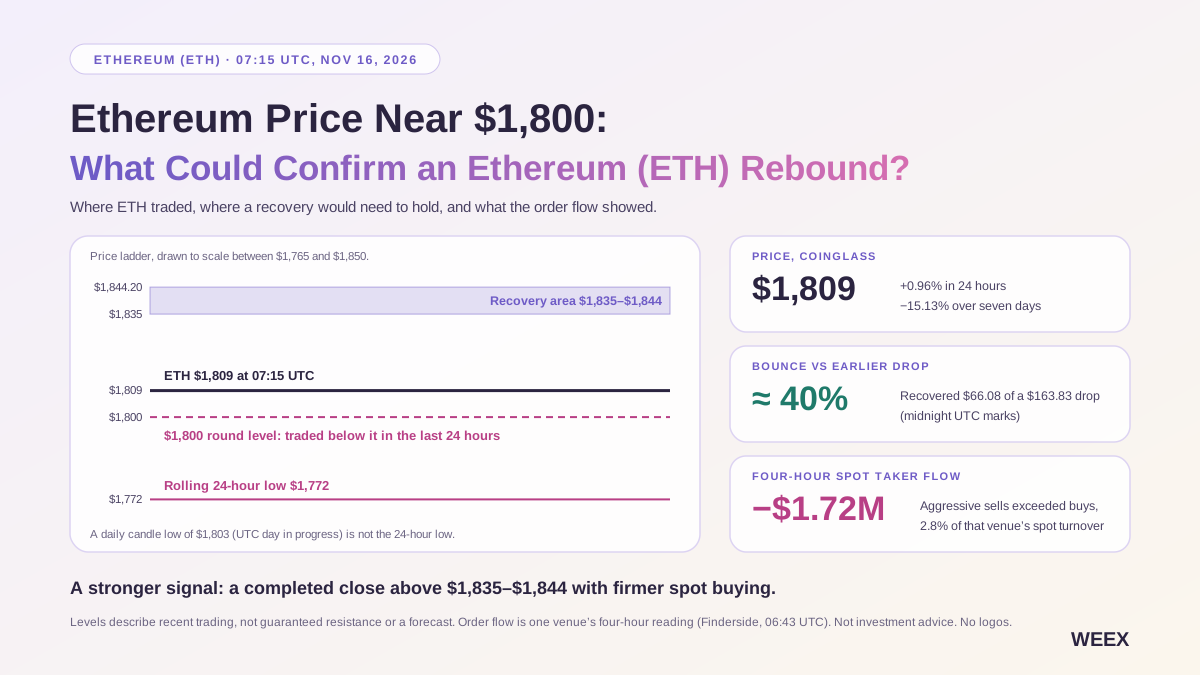
Ethereum Price Near $1,800: What Could Confirm an Ethereum (ETH) Rebound?
Ethereum traded near $1,800 on November 16. See what four-hour spot order flow, futures positioning, and Friday’s ETF flows say about an ETH rebound.

Nakamoto Extends Part of $60 Million Loan to Kraken Until 2027

Global Cryptocurrency 'Audit' Trend Emerges
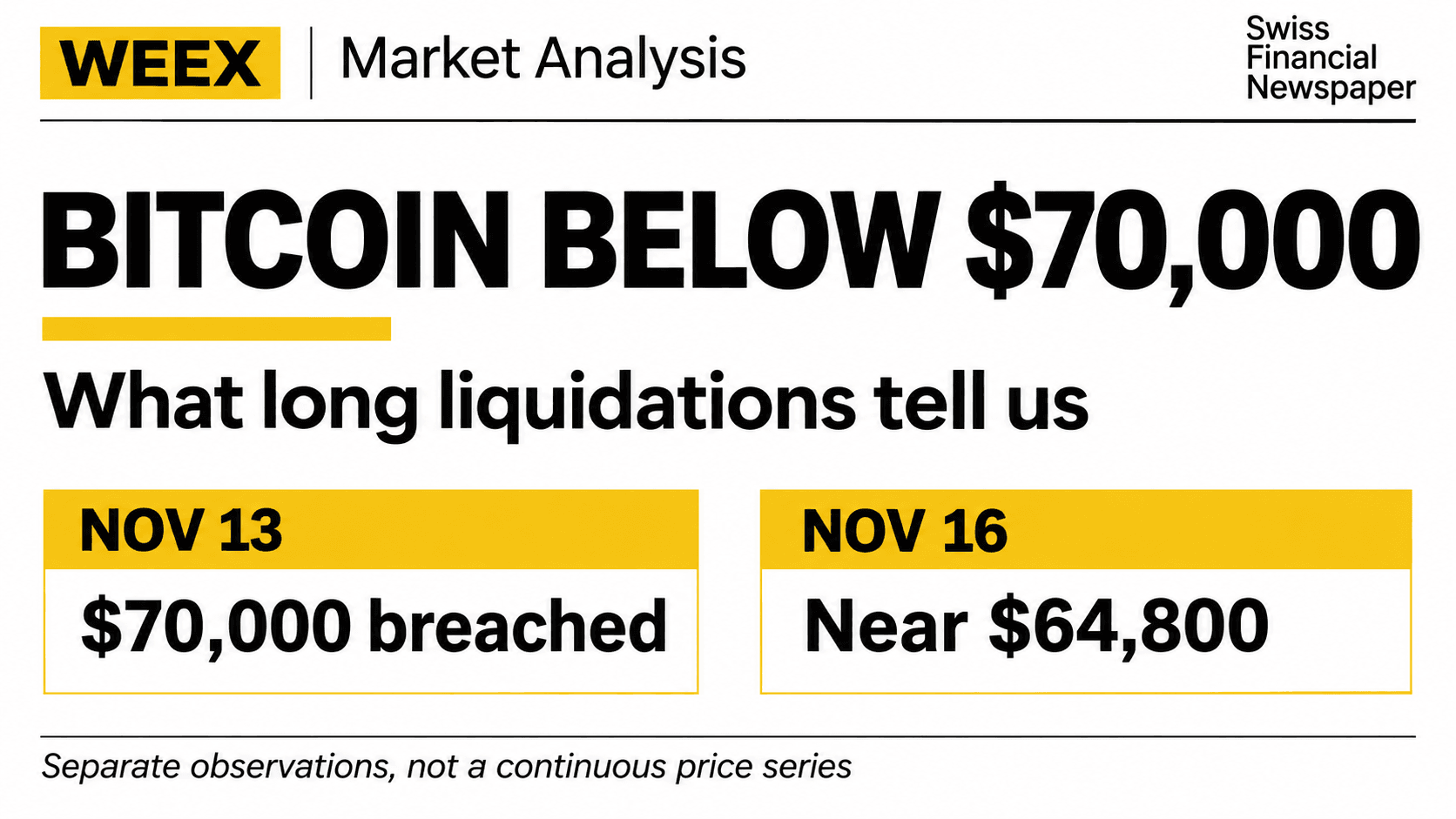
Why Did Bitcoin (BTC) Drop Below $70,000? What Long Liquidations Tell Us
See why Bitcoin fell below $70,000 on November 13, how long liquidations amplified the decline, and what to watch before calling a rebound. If you already plan to trade, you can check whether your activity qualifies for the WEEX Lucky Eggs event, scheduled to run through November 25, 2026 (UTC+8).

Wall Street Wants 24/7 Trading, But Weekend Cash Needs to Be Covered

Bank of America’s Hartnett: The Dollar is 'Destroying Everything', Remains Risk-Averse Before Dollar Decline

Nasdaq Futures vs. Dow Futures: Key Points for Cryptocurrency Traders Before the US Market Opens

When the Crypto Engine Enters Traditional Finance: A Conversation with Bitget's CFD Head on How to Achieve a 10 Billion Cross-Border Sample in Ten Months?

Crypto VC May Only Have 1 to 2 Investment Cycles Left as AI and Robotics Take Over as New Capital Battlegrounds

The Cryptocurrency Circle No Longer Exists

Is Meta Stock Still a Buy After Borrowing About $25 Billion This Month?

Archer Aviation and Joby Aviation: Speculative Plays With Upside Potential and Downside Risk
Wall Street Tests the AI Boom: What the Industry's Balances Reveal After the Democratic Victory

How These 6 Natural Gas Stocks Make Money

Is Credo Technology a Better AI Networking Buy Than Broadcom?

Wintermute Spends $824,000 on Front-Running Trades in the Last 30 Days
Yishi Advises to Stay Away from Leverage and Altcoins, Survival is the Top Priority

From 'Patching' to 'Eliminating Entire Classes of Bugs': How to Build Internet Resilience?

One Year of JPYC Stablecoin: First Gas-Free User is Quail Egg Merchant; Single Transaction Limit Set at 1 Million Yen
[Analysis] Two Barriers Preventing Bitcoin from Rising

Is CoreWeave Stock a Buy After Its Latest Earnings?
$LIBRA: One of the defendants seeks to remove Judge Ledesma and halt the review that could reactivate the case
Mazama Energy Finds New Solution to the Biggest Challenge in Geothermal Drilling
Is Apple Losing Its Memory?
Energy Transfer vs. Enbridge: Which High-Yield Pipeline Stock Could Make You Richer Over the Next 10 Years?
Jefferies Raises Spotify Price Target to $710, Expects Over 20% Growth in Free Cash Flow
The Application is Landing, Wealth is Evaporating: Analyzing the Painful Roots of the Crypto Industry through Three Financial Statements
Latest articles


Latest coin listings on WEEX


