
Why Is Monad (MON) Crypto Trending Today? Privacy Update Expectations and the November Token Unlock

 Prefer us on Google


Monad (MON) is trending because the network’s Open conference in Singapore has focused attention on the ecosystem’s next phase, including expectations around privacy-oriented infrastructure and financial-market applications. The more material, measurable event is still ahead: a large MON token unlock is scheduled for November 24, 2026. These are different catalysts. Privacy expectations can change sentiment quickly; the unlock changes the supply framework that traders will need to assess over the following weeks.
The important editorial point is that a privacy narrative should not be allowed to hide a supply event. Monad has real ecosystem growth, including reported transaction activity, DeFi liquidity, and live applications. But a market can be simultaneously excited about a product direction and cautious about a future cliff unlock. The better MON analysis is not “bullish or bearish”; it is whether usage and liquidity can absorb the additional supply without turning attention into vesting sell pressure.
What Is Making Monad (MON) Trend Today?
Monad’s October 6 Open conference in Singapore has placed the network in front of builders, institutions, and crypto-market participants during a major industry-event window. Monad’s official website presents the network as infrastructure for payments, tokenization, capital markets, and DeFi, while highlighting more than 9 million active wallets, approximately $1 billion in DeFi TVL, and more than 143 live applications at the data cutoff.
The network’s messaging makes the present interest understandable. Monad is positioning itself as an EVM-compatible Layer 1 for high-throughput financial applications, with a stated 300-millisecond block time, 600-millisecond finality, and near-zero transaction costs. These claims matter because they define the project’s intended competitive edge: applications can use Ethereum-compatible tooling without accepting Ethereum’s traditional cost and throughput constraints.
However, the phrase “privacy update” requires precision. Market discussions and event expectations may focus on privacy-oriented developments, encrypted mempools, or confidential transaction infrastructure. Yet an expectation is not the same thing as a confirmed protocol-wide release. At the time of writing, the official sources reviewed confirm the Open event and ecosystem direction, but do not provide enough primary-source detail to treat a specific privacy feature as already launched.
The Short Version
| Question | Evidence-Based Answer |
|---|---|
| Why is Monad (MON) trending? | The October 6 Open event, network-growth narrative, and expectations around future infrastructure updates have concentrated attention on Monad. |
| Has a privacy update been confirmed? | Privacy-oriented expectations are visible in current market discussion, but readers should distinguish them from a named, deployed feature confirmed in official technical documentation. |
| What is the next major token event? | A major MON cliff unlock is scheduled for November 24, 2026. |
| Why does the unlock matter? | It may substantially increase available supply relative to today’s circulating float and can create vesting sell pressure. |
| Is MON available on WEEX? | Yes. MON/USDT perpetual futures are listed on WEEX, subject to live market status and regional eligibility. |
Monad (MON) Privacy Expectations Need a Higher Proof Standard
Privacy is a meaningful theme for high-performance public blockchains. Institutions, trading firms, and users often want the settlement benefits of a public blockchain without exposing every order, strategy, wallet relationship, or business workflow to the entire market.
That is why encrypted mempools, private order flow, confidential-computing approaches, and selective disclosure frameworks can be important. They may reduce certain forms of transaction exploitation, improve user experience, or make more financial activity suitable for public-chain settlement.
But privacy is also a term that is easy to over-market. A network can announce research, host a developer discussion, tease a feature, or describe a future roadmap without shipping a production-ready implementation. Traders should ask three questions before treating a privacy theme as a durable MON catalyst:
- What exact feature has been announced or deployed?
- Which user problem does it solve—MEV, transaction confidentiality, institutional compliance, or something else?
- Does it create new on-chain activity, fees, or demand for MON?
A privacy feature becomes economically relevant only when it changes how people use the network. Until then, it is a narrative input rather than proof of value capture.
-- Price
Why Monad (MON) Has a Credible Product Narrative
Monad’s case is stronger than a simple event-driven token story because the project is already presenting measurable ecosystem activity. Its official website reports approximately 910 million transactions, more than 9 million active wallets, more than 143 applications, and around $1 billion in DeFi TVL.
These figures should still be interpreted carefully. High transaction counts do not automatically mean high-quality economic activity, and a large wallet number does not reveal retention, user concentration, or transaction value. Yet the combination of applications, DeFi liquidity, and ecosystem integrations is more useful than a pure technical white-paper claim.
Monad’s product thesis has three connected parts.
First, it aims to preserve Ethereum compatibility. Developers can use familiar Solidity-based contracts, wallets, and tooling rather than rebuilding for a wholly separate execution environment.
Second, it competes on performance. Fast blocks and low transaction costs are intended to make trading, payments, consumer applications, and tokenized-asset settlement more practical.
Third, it is increasingly positioning itself around financial infrastructure rather than only speculative activity. Official materials highlight stablecoins, tokenization, lending, liquidity, and capital-market applications.
The weakness in the bullish case is not that Monad lacks a product narrative. The weakness is that markets can price in years of future adoption before the economic consequences are visible. That is why the November unlock is central to the current setup.
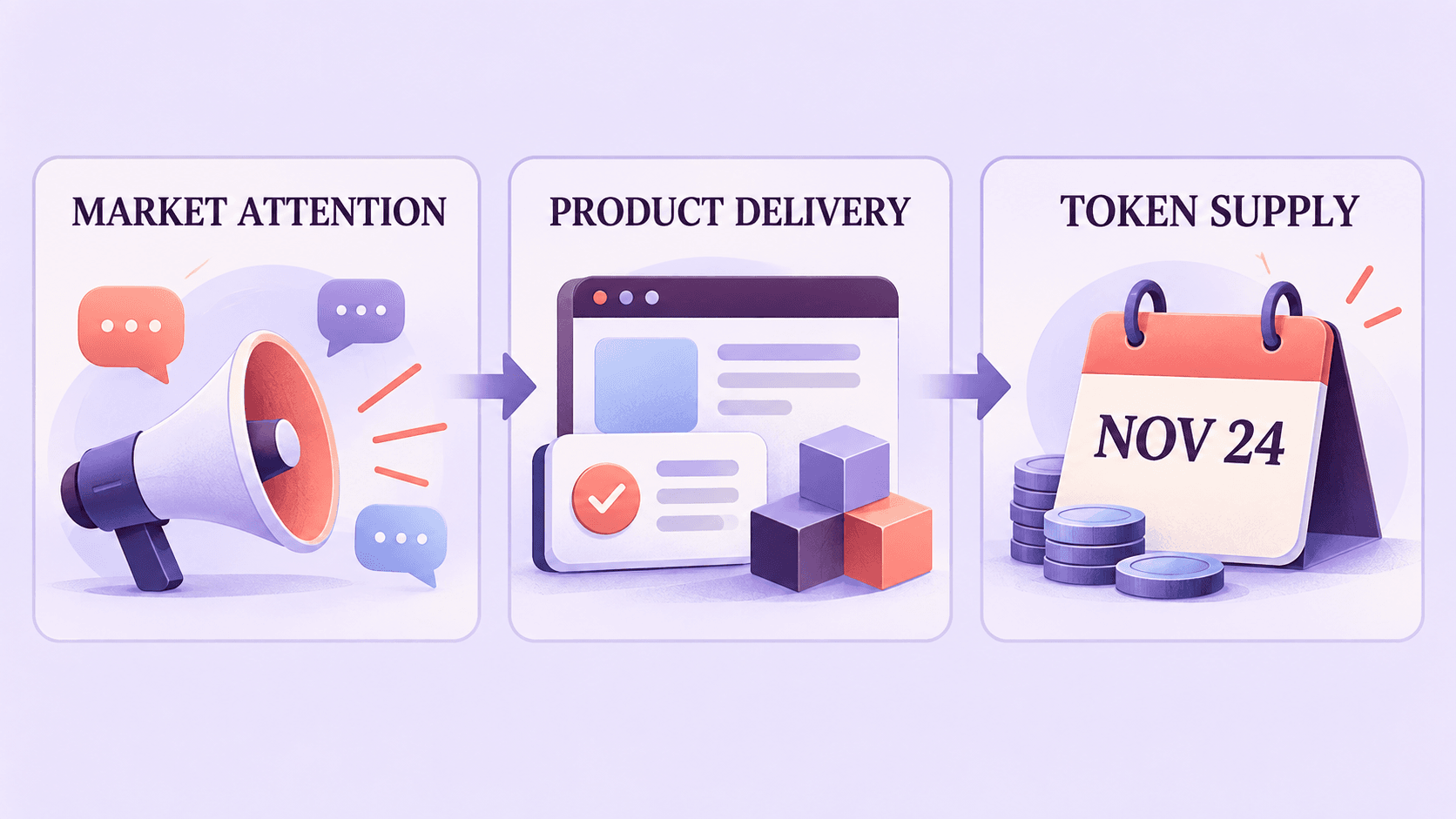
Monad (MON) Token Unlock: What Happens on November 24, 2026?
Third-party token-unlock trackers show a large MON cliff unlock scheduled for November 24, 2026. DefiLlama’s unlock page indicated that the event could release roughly 16.8% of total supply, including allocations connected to the team, investors, and Category Labs Treasury. The precise token quantity and USD value can vary with methodology and live prices, so readers should check the live unlock tracker close to the event.
The critical point is scale. The scheduled event is large relative to MON’s current circulating supply. That makes it different from a routine linear emission that markets can absorb gradually over many months.
| Supply Measure | Why It Matters for MON |
|---|---|
| Total supply | Shows the maximum base token amount referenced by the project’s initial tokenomics |
| Circulating ratio | Shows how much of that supply is already available to trade |
| Fully diluted valuation | Shows what MON’s valuation would imply if all scheduled supply were valued at the current token price |
| Cliff unlock | Releases a large allocation at a specific date instead of spreading it evenly |
| Vesting sell pressure | Describes the risk that newly unlocked holders decide to sell, hedge, diversify, or transfer tokens |
Monad’s official tokenomics overview states that initially locked tokens are expected to become fully unlocked by the fourth anniversary of public mainnet launch, in Q4 2029. The November 2026 event therefore sits within a multi-year release schedule, not a one-off anomaly.
A large unlock does not guarantee a price decline. Some recipients may retain tokens, stake, allocate them to ecosystem development, or avoid selling into weak liquidity. But it changes the burden of proof for buyers. The market needs enough organic demand, trading depth, staking demand, and application growth to absorb a larger available float.
The Difference Between a Cliff Unlock and Token Emissions
A cliff unlock and token emissions are often grouped together, but they affect markets differently.
A cliff unlock releases a meaningful amount at one known moment after a lockup period. Because the event is concentrated, it can influence positioning, hedging behavior, and liquidity conditions before the actual release date.
Token emissions are recurring additions to supply, such as validator rewards. Monad’s ecosystem documentation describes block rewards alongside fee-burning mechanics, meaning the long-term supply picture depends on both new issuance and transaction activity.
This distinction matters because traders may focus heavily on November 24 while ignoring the network’s longer-term economic design. A healthy token economy is not one with zero issuance; it is one where issuance, token utility, fee use, staking incentives, and demand are aligned well enough that network growth can support the system.
For MON, the relevant comparison is not simply “more tokens versus fewer tokens.” It is whether financial activity on Monad becomes large and durable enough to create demand for blockspace, staking, and ecosystem liquidity at a pace that offsets dilution concerns.
What the Market Should Watch Between Open and November 24
The period between the Open conference and the unlock date is more useful as an evidence window than as a countdown. Traders should look for product delivery that can be verified after the event, rather than relying only on social-media attention.
| Evidence to Watch | What Would Strengthen the Case | What Would Weaken the Case |
|---|---|---|
| Privacy roadmap | A named product, technical documentation, testnet, or mainnet deployment | Broad language without a concrete release path |
| DeFi activity | Sustained TVL, borrowing, trading, and stablecoin liquidity | Short-lived incentive-driven deposits |
| Application usage | Growth in recurring users and transaction value | Transaction volume that rises without retention |
| Liquidity | Deep spot and perpetual order books before the unlock | Thin liquidity that magnifies directional moves |
| Unlock preparation | Clear recipient behavior and transparent ecosystem plans | Unclear allocation use and abrupt market transfers |
This is where the article’s main distinction matters: product expectations can generate interest, while supply mechanics determine how fragile that interest may be.
How to Trade Monad (MON) on WEEX Futures
WEEX has a verified MON/USDT perpetual futures market. The contract page should always be checked immediately before trading because market status, leverage limits, funding, and availability can change.
To access MON/USDT perpetual futures, log in to WEEX, open the MON/USDT futures page, review the contract status and current funding information, then choose margin mode, leverage, order type, and position size. The contract page retrieved for this article displayed a circuit-breaker notice indicating that opening and closing positions could be disabled temporarily while only order cancellation remained available. That makes a live status check essential rather than optional.
No active MON-specific fee campaign or fee discount was independently verified at the data cutoff. General trading charges should be checked on the official WEEX fee schedule before placing an order.
For this setup, the practical use of a perpetual market is not only directional speculation. It can also help sophisticated traders observe funding, liquidity, and positioning around the November event. But a futures contract does not remove unlock risk; leverage can amplify it.
Monad (MON) Timeline: Event Attention Versus Supply Risk
The current MON discussion has two different clocks.
The first is the immediate event clock: Open took place in Singapore on October 6, 2026, bringing attention to Monad’s ecosystem, institutional positioning, and future infrastructure themes.
The second is the supply clock: the November 24 unlock is a defined token event that market participants can model. The closer it gets, the more the market may focus on expected recipient behavior, liquidity depth, and whether price strength is supported by real demand.
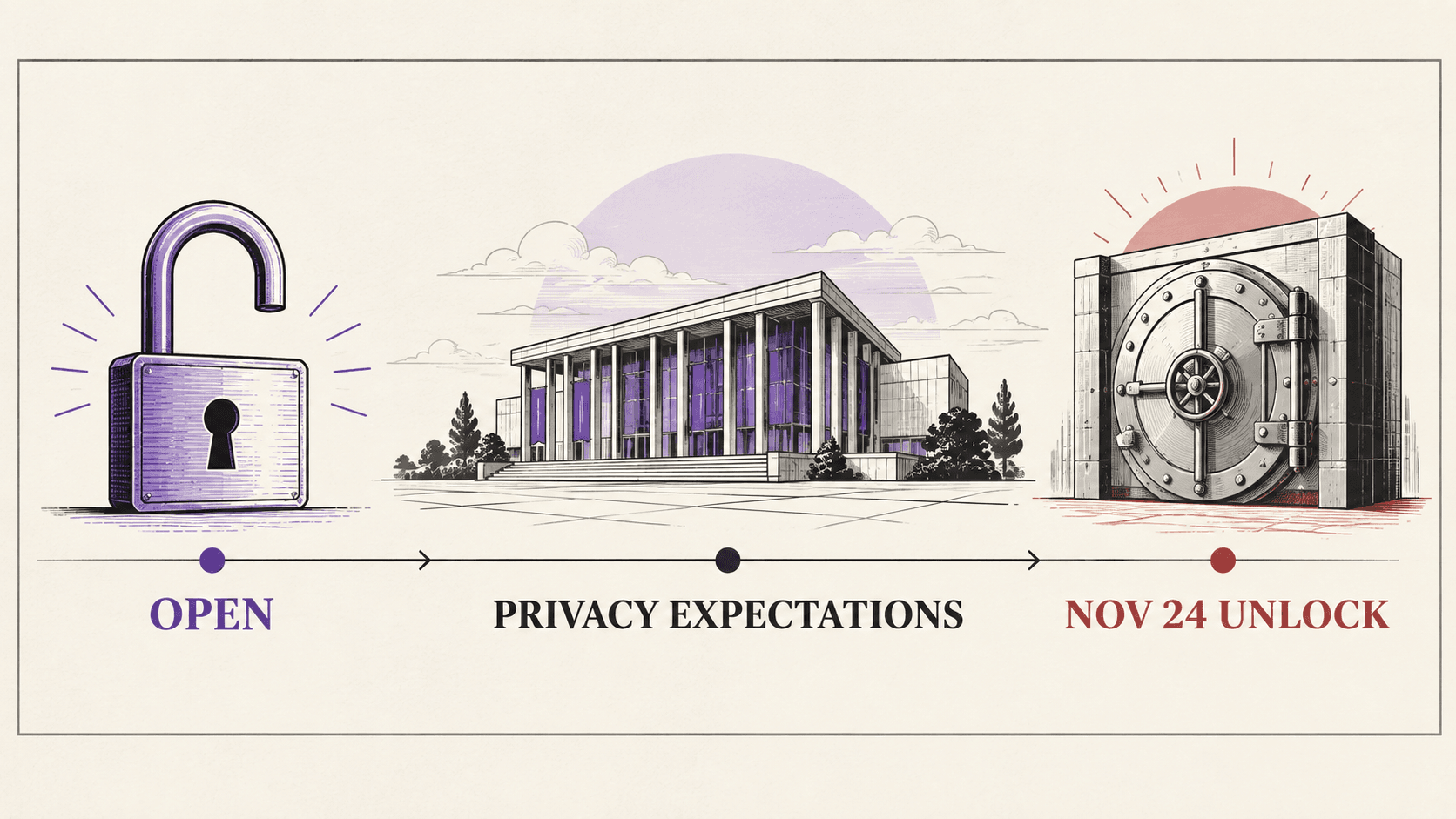
A common mistake would be to collapse these clocks into one bullish narrative. A stronger interpretation is that Open may raise attention, while the weeks after it test whether Monad can convert attention into verifiable product delivery and sustained network demand before additional supply becomes available.
Our View: Monad Needs Delivery More Than Another Narrative
Monad has enough visible ecosystem activity to deserve serious attention. It is not only a token with a future-performance promise; it has applications, liquidity, transaction throughput, and a financial-infrastructure strategy that can be evaluated over time.
But the November unlock creates a useful discipline for the market. The right question is not whether a privacy theme sounds compelling. It is whether Monad can turn that theme into deployed products, persistent users, and enough on-chain economic activity to make the extra supply easier to absorb. If the evidence improves, the token’s long-term case becomes stronger. If the story stays ahead of delivery, the unlock will matter more than the conference narrative.
FAQ
1. Why Is Monad (MON) Crypto Trending Today?
Monad (MON) is trending around its October 6 Open conference, expanding ecosystem narrative, and market expectations for future infrastructure developments. The November 24 token unlock is also drawing attention because it is a significant supply event.
2. Has Monad (MON) Launched a New Privacy Feature?
At the data cutoff, privacy-oriented expectations were part of the market discussion, but the official sources reviewed did not provide enough detail to describe a specific network-wide privacy product as fully launched. Readers should distinguish a confirmed technical release from event-driven expectation.
3. When Is the Next Monad (MON) Token Unlock?
Current token-unlock trackers list November 24, 2026, as the next major MON unlock date. The exact amount, recipient breakdown, and USD value should be rechecked close to the event because live tracker estimates and token prices can change.
4. Why Can a Monad (MON) Cliff Unlock Create Selling Pressure?
A cliff unlock can make a large amount of previously locked supply available at one time. Some holders may stake or retain tokens, but others may sell, hedge, or diversify. The potential effect depends on actual recipient behavior and market liquidity, not the unlock headline alone.
5. Can You Trade Monad (MON) on WEEX?
Yes. MON/USDT perpetual futures are available on WEEX. Traders should open the live contract page, confirm that trading is enabled, review funding and contract conditions, then set risk parameters before submitting an order.
Sources
- Monad, Official Network Overview and Ecosystem Statistics, accessed October 6, 2026.
- Monad, MON Tokenomics: Supply, Allocation, and Release Schedule, published November 10, 2025.
- DefiLlama, Monad Token Unlocks and Vesting Schedule, accessed October 6, 2026.
- WEEX, MON/USDT Perpetual Futures, accessed October 6, 2026.
- WEEX, MON/USDT Perpetual Contract Listing, published December 3, 2025.
This content is provided for general informational purposes only and doesn't constitute financial, investment, legal, or tax advice. Any events, rewards, online promotions, or related information mentioned herein should not be considered a recommendation, solicitation, or invitation to purchase, sell, trade, or otherwise deal in any crypto assets. Crypto assets are highly volatile and may result in loss. The availability of WEEX services, products, and related events may vary by region. You are responsible for ensuring that your participation is in accordance with applicable local laws and regulations.
You may also like

Crypto Transactions in Indonesia Rise 12.87%, Number of Members Reaches 23.21 Million - Fintech World

Gathering of Users of OAM-Pay Phoenix Due to Delayed Withdrawals

Parataxis Ethereum drops Korea merger over delisting risk

Monad's Outlook on the Korean Virtual Asset Market in 2030 – Tiger Research

Rialo eyes South Korea as institutions look to move financial services onchain

CFTC Introduces New Regulations for the Cryptocurrency Market

Polymarket V2 could change how users bet on events

Transparency Act Stalls, But Bankers Continue Crypto Deals

AI Investment Also Favors the 'Winner Takes All'... Top 1% of Companies Spend 600 Times More Than Median Companies

Why France's Debt Crisis is a Problem: Political Paralysis and Market Anxiety

FinCEN Withdraws Regulations on Wallets and Mixers, CFTC Proposes Leverage Oversight

The Cryptocurrency Law Has Been in Effect for a Month. What Has Changed?
Is Bitcoin Anonymous and What Are the Legal Implications? What Does Blockchain Say About Your Transactions?

The Crypto Landscape Continues to Shed Leaves: 6 More Projects and Platforms Shut Down

19.4% of Solana Block Production Comes from Amsterdam

36.9 Million Fake ZANO and 1.8 Trillion fUSD Stablecoins Flood On-Chain! Zano Team Decides to Roll Back Blockchain by About One Month Due to Inability to Distinguish Fake Coins

American Association of Independent Bankers Sues Office of the Comptroller of the Currency

Crypto: For Hyperliquid's Co-founder, 24/7 Trading Is Not the Advantage of Onchain Markets
US Opens New Path for Investment Funds to Enter Crypto, Bitcoin May Attract More Institutional Interest - Fintech World

Bitcoin’s $113,000 case strengthens as US regulators push 9 crypto actions
LIBRA lawsuit dismissed as court rejects claims against Meteora and Chow

Why Would a Public Blockchain Stop? Understanding Blockchain Consensus from Cosmos's 25-Hour Downtime

Global Bond Sell-off Signals ‘Anomaly’... US Rates Drop but France and Italy Surge - WSJ

Crypto Banks in Belarus Transition from Legal Model to Practical Launch

What is Concrete (CT) TGE? Can Institutional DeFi Drive More Gains?

Trump Calls for Jerome Powell's 'Forced' Resignation After Fed Inspector General Report

Bitcoin Cash: The History of Its Emergence, BCH Technology, Risks and Opportunities for Investors

Philippine Central Bank Limits Fiat Deposit Channels for Coins.ph

Lloyds uses USDC to settle $750,000 with Visa in under an hour

US court denies claims to 127,271 seized Bitcoin by fraud victims
Crypto Transactions in Indonesia Rise 12.87%, Number of Members Reaches 23.21 Million - Fintech World
Gathering of Users of OAM-Pay Phoenix Due to Delayed Withdrawals
Parataxis Ethereum drops Korea merger over delisting risk
Monad's Outlook on the Korean Virtual Asset Market in 2030 – Tiger Research
Rialo eyes South Korea as institutions look to move financial services onchain
CFTC Introduces New Regulations for the Cryptocurrency Market


