
Merck Stock Rose 12.7% on Vaccine Data That Has No Numbers Yet

 Prefer us on Google
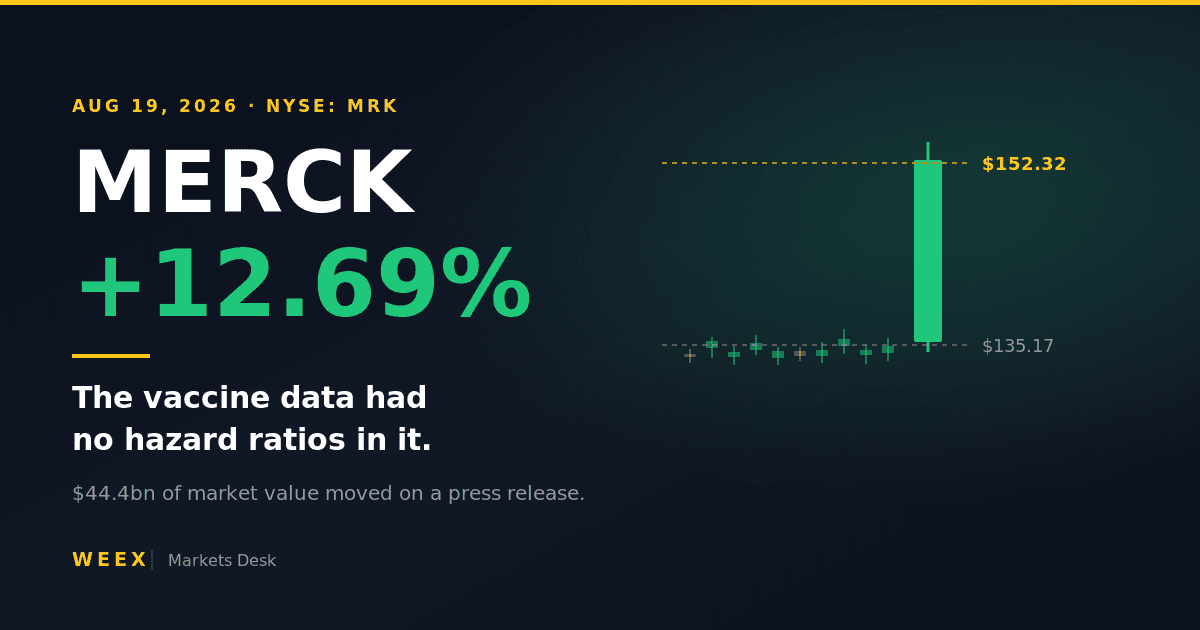
If you were awake in Asia on Wednesday, you watched Merck stock reprice without being able to touch it. Merck (NYSE: MRK) closed August 19, 2026 at $152.32, up 12.69% from a $135.17 prior close, touching an intraday record near $153.12 and adding roughly $44.4 billion of market value in a single session. The trigger was a joint Merck–Moderna announcement that their personalized mRNA cancer vaccine hit its endpoints in a Phase 3 melanoma trial.
Here is the part most coverage buried: the companies did not release a single effect size. No hazard ratio, no survival curve, no magnitude on either endpoint. A $44 billion repricing happened on a press release that said, in substance, "it worked."
That is not a reason to fade the move. It is a reason to know exactly what you are holding.
Why Merck stock jumped 12.69% on August 19
The INTerpath-001 trial enrolled 1,137 patients with completely resected stage IIB–IV cutaneous melanoma, randomising them to intismeran autogene (formerly V940 / mRNA-4157) plus Keytruda, or Keytruda alone. It met its primary endpoint of recurrence-free survival and the key secondary endpoint of distant metastasis-free survival. No new safety signal was reported.
This is the first randomised Phase 3 win for an individualised neoantigen vaccine — a class that has spent a decade being described as promising. Moderna president Stephen Hoge called the improvement statistically significant and clinically meaningful. The companies said they are in discussions with regulators; a launch is plausible in 2027, with pricing unset.
Moderna, which splits collaboration profits with Merck 50/50, did the arithmetic the market cared about: MRNA closed +176.97% at $174.38 on roughly 185 million shares, about 1,800% above its three-month average volume. When the junior partner triples and the senior partner adds 13%, the market is telling you the readout revalued Moderna's entire existence and revalued one line item in Merck's.
What intismeran autogene actually proved — and what it didn't
The honest summary is that Phase 3 confirmed direction, not size.
| Evidence | Phase 3 (Aug 2026) | Phase 2b (prior, 5-year data) |
|---|---|---|
| Population | 1,137 patients, stage IIB–IV | 157 patients, stage III–IV |
| Recurrence endpoint | Met; magnitude undisclosed | 49% lower recurrence-or-death risk |
| Distant metastasis | Met; magnitude undisclosed | 59% lower distant-metastasis-or-death risk |
| Overall survival | Not disclosed | Encouraging trend, exploratory only |
| Safety | No new signal reported | Long-term follow-up available |
The Phase 2b numbers are why the tape reacted as if the Phase 3 delivered a 40-plus percent risk reduction. It may have. It may also have delivered something statistically real and commercially modest. Until the curves are presented at a medical conference, the market is extrapolating a 157-patient result onto a 1,137-patient one.
There is a second, less-discussed hurdle. Every dose of this product is manufactured for one patient from that patient's tumour sequencing. Regulators will have to assess turnaround time, batch consistency and manufacturing scale — questions that do not exist for an off-the-shelf drug and that have no precedent at this scale.
The $44.4 billion question: what the tape is really pricing
Run the melanoma opportunity on its own and the move stops making sense. Barclays has forecast roughly $3 billion in annual melanoma sales by 2035; other published work values the melanoma programme near $2.5 billion. Wednesday's gain in Merck stock was a multiple of both.
| Yardstick | Estimate | Merck's $44.4bn one-day gain vs it |
|---|---|---|
| Melanoma programme value | ~$2.5 billion | 17.8× |
| 2035 melanoma annual sales | ~$3.0 billion | 14.8× |
| Pre-rally average analyst target | $136.04 | Price closed 11.2% above it |
| Highest analyst target on the Street | $155.00 | Price closed within 1.8% of it |
So the market did not buy a melanoma drug. It bought a platform option on Keytruda's succession problem.
That framing is the whole trade. Keytruda produced $8.37 billion of sales in Q2 2026 — 50.4% of Merck's $16.61 billion total — and loses key patent protection from 2028. Merck's central strategic risk is a cliff under half its revenue base. A vaccine that only works in combination with Keytruda does something no cost-cutting or bolt-on acquisition can: it gives physicians a clinical reason to keep prescribing pembrolizumab into the biosimilar era, and it opens combination trials across other tumour types. Merck and Moderna are already running the platform in non-small-cell lung cancer.
The better reading, then, is that Wednesday repriced the probability that Keytruda's cliff becomes a slope. That probability is genuinely higher than it was on Tuesday. Whether it is 17 times higher is what the next data release decides.
-- Price
Why Eli Lilly and the rest of pharma rallied on someone else's data
The sector move was broad, and it was not equally earned. Ranked by how much of each move is actually about this trial:
| Stock | Aug 19, 2026 move | How much is about INTerpath-001 |
|---|---|---|
| Moderna (MRNA) | +176.97% to $174.38 | Almost all of it — 50% of the economics, and the platform is the company |
| Merck (MRK) | +12.69% to $152.32 (record) | Most of it — 50% profit split plus Keytruda lifecycle extension |
| BioNTech (BNTX) | ~+22% | Partly — genuine read-across to its own mRNA oncology pipeline |
| Novavax (NVAX) | ~+7% | Little — vaccine-platform sympathy with no neoantigen programme at stake |
| Eli Lilly (LLY) | ~+5.3%, market cap ~$1.21tn | Almost none — sector beta layered on its own post-earnings run in obesity drugs |
Eli Lilly hit an intraday record near $1,292.65 and became the first pharmaceutical company to carry a market capitalisation above $1.2 trillion. That is a real milestone, but it is an incretin story, not an mRNA one. Traders treating LLY as a derivative of the Merck news are trading correlation, not cause — and correlation-driven legs are the first to unwind when the theme cools.
How to trade Merck stock exposure when the NYSE is closed
This is the practical gap the news coverage skips. The announcement landed Wednesday morning US time. For most of Asia and Europe, the entire 12.69% move in Merck stock happened inside a session they had no brokerage access to, and the next US open carries gap risk in both directions.
Tokenized US equities and stock perpetuals exist specifically for that window. Two things to be clear about before using them:
- A tokenized stock gives you price exposure, not equity. No shareholder vote, and dividend treatment depends entirely on the issuer's model. If your thesis is a decade-long hold in a dividend-paying pharma name, a brokerage share is the cleaner instrument. If your thesis is "this gaps again when the full curves are presented," the token or the perp is the tool that is actually open. WEEX's tokenized stock explainer walks through the backed-issuer, CFD and licensed-broker models — the model, not the ticker, is where the counterparty risk sits.
- On WEEX TradFi, stocks, gold, silver and oil trade against USDT from a single account with no separate sub-account, tokenized stocks support up to 100× leverage, and only USDT is accepted as margin (as of August 20, 2026). Funding on perpetual contracts settles on a recurring cycle, so a leveraged position held across a quiet weekend pays carry for exposure that is barely moving. You fund it by depositing or buying USDT and transferring it in.
What traders usually miss here: the danger in a post-catalyst pharma name is not direction, it is the weekend. Traditional markets close; the perpetual does not. Liquidity thins, spreads widen, and a headline out of a Sunday medical conference can move the mark against a leveraged position at the exact hour the order book is emptiest. Size the position for the thinnest hour you will hold it through, not the busiest.
What can unwind the Merck stock rally
Three specific things, in descending order of likelihood:
- The full data underwhelms. A hazard ratio materially weaker than the Phase 2b read would compress the platform premium fast. This is the single largest risk and it resolves on a known schedule — the next major oncology conference.
- Manufacturing and pricing reality. Individualised vaccines are slow and expensive to produce. If turnaround times or cost of goods look unattractive, the addressable market shrinks regardless of efficacy.
- Consensus catches up and stops. Merck stock closed above the Street's average target and within 1.8% of the highest one. Upside from here requires analysts to raise numbers, not merely to agree with the price. Estimate revisions now matter more than the existing consensus does.
The bull case does not need melanoma to be enormous. It needs the platform to read across to a tumour type with real volume — lung, most obviously. Until then, Merck stock is trading on a press release, at a record high, with the actual numbers still unpublished. That is a legitimate position to hold. It is a bad position to hold at 100× leverage.
FAQ
1. Why did Merck stock go up on August 19, 2026?
Merck and Moderna announced that their personalized mRNA cancer vaccine, intismeran autogene, met its primary endpoint of recurrence-free survival and a key secondary endpoint in a Phase 3 melanoma trial when combined with Keytruda. Merck stock closed at $152.32, up 12.69%, a record.
2. How much did Merck stock actually gain in market value?
About $44.4 billion in one session, based on the price change across roughly 2.47 billion shares outstanding. That is close to 18 times one published valuation of the melanoma programme itself, which is why the move is read as a platform bet rather than a single-drug bet.
3. Why did Moderna rise so much more than Merck?
The two companies split collaboration profits equally, but Moderna is a far smaller company with the mRNA platform as its central asset. The same absolute profit stream is transformational for Moderna and incremental for Merck. MRNA closed up 176.97%; MRK closed up 12.69%.
4. Does this fix Merck's Keytruda patent cliff?
Not by itself. Keytruda was 50.4% of Merck's Q2 2026 sales and loses key protection from 2028. A vaccine used in combination with Keytruda can extend the franchise's clinical relevance, but the melanoma indication alone is forecast at roughly $3 billion of annual sales by 2035 — meaningful, not a replacement.
5. Did Eli Lilly stock rise because of the cancer vaccine?
Only indirectly. LLY rose about 5.3% to a record, crossing $1.2 trillion in market capitalisation, but it has no exposure to the trial. That move was sector sentiment layered on its own momentum in obesity and diabetes drugs.
6. Can I trade Merck stock exposure outside US market hours?
Yes, through tokenized stock products and stock perpetual contracts, which trade around the clock on crypto venues including WEEX TradFi. These track the share price without conveying equity, voting rights or a direct dividend claim, and leveraged versions carry funding costs and liquidation risk.
7. What should I watch next on Merck stock?
The detailed Phase 3 results — hazard ratios, survival curves and full safety data — plus any regulatory timetable and pricing commentary. Read-through data from the non-small-cell lung cancer programme is the bigger long-term catalyst.
Risk Warning
Equities, tokenized stocks and stock derivatives are volatile and can result in partial or total loss of capital. Merck stock closed at a record on August 19, 2026 on a clinical announcement that did not include effect sizes, survival data or detailed safety results; a weaker full presentation, an unfavourable regulatory response, or unattractive manufacturing economics could unwind part or all of that premium. Positions taken above the Street's average price target depend on analyst estimates rising rather than on the current consensus. Tokenized versions of the stock add further layers: you may hold only price exposure rather than real equity, you carry the issuer's or exchange's counterparty and reserve risk, weekend and holiday liquidity in stock perpetuals is thinner than in regular market hours, and leverage of up to 100× can trigger liquidation on a gap that a cash position would have absorbed. Funding charges accrue on perpetual positions held across settlement windows. Regulatory treatment of tokenized US equities is still evolving and product availability varies by region and can change without notice. Confirm the live pair, its backing model and order-book depth before trading, and never commit funds you cannot afford to lose. This article is information, not investment advice.
This content is provided for general informational purposes only and doesn't constitute financial, investment, legal, or tax advice. Any events, rewards, online promotions, or related information mentioned herein should not be considered a recommendation, solicitation, or invitation to purchase, sell, trade, or otherwise deal in any crypto assets. Crypto assets are highly volatile and may result in loss. The availability of WEEX services, products, and related events may vary by region. You are responsible for ensuring that your participation is in accordance with applicable local laws and regulations.
You may also like
Should I Buy PONS Coin? Sep 2026 Price Prediction & Guide

Micron Stock (MU): Price, Outlook and How to Buy

SanDisk Stock (SNDK): Price, Outlook and How to Buy
Bybit Japan Service Termination: The Complete Timeline and What Happens on July 22, 2026

MU Stock Price Crosses $1,000 for the First Time Since July: What the Psychological Milestone Actually Signals
SNDK Stock Gets a JPMorgan Upgrade to Overweight: What the $2,250 Target Actually Requires
Musk's SpaceX Stake: 48.4% Equity vs 82.4% Voting Power

Nvidia Stock Is Closed 81% of the Week. Your Risk Isn't.

Is NBIS Stock a Buy After Falling From Its All Time High? What the $37 Billion RPO Actually Implies

What Is XST Coin? A $54M Valuation on $760,000 of Liquidity
Tencent Stock (0700): Where the Shares Actually Trade, and What Each Venue Owes You
Lenovo Stock (0992): The German Subsidiary, the Pension Liability and the Segments That Report
Is OpenAI Publicly Traded? The Foundation That Controls It, and the Ticker That Isn't Theirs

Is HIMS Stock a Buy After the Earnings Selloff? What the Full-Year Guidance Raise Actually Implies
Intel Stock Is Up Over 170% in 2026: What the AI Foundry Turnaround Actually Required
SPCX Stock Closes Above Its $135 IPO Price for the First Time in Weeks: What the Recovery Actually Signals
Is PROM Coin Safe? What Can and Cannot Be Verified About Prom
PROM on 12 August 2026: What Upbit Added and What the Price Did
RKLB Stock Q2 2026: What Record Revenue and the $397 Million Space Force Contract Actually Mean
SPCX Stock Price Rebounds 16% From Its All Time Low: Is the Worst Finally Over for SpaceX

Gold Forum: Where the Polish Discussion Actually Happens — and the Question It Argues About Most
Is Nvidia Stock Price a Buy Before August 26 Earnings? What the SpaceX Deal and 46% Upside Imply
Is AMD Stock a Buy After Falling 9% on Record Earnings? What the Setup Actually Looks Like
SK Hynix Stock Is Down 35% in July: Is the Worst Finally Over?
SpaceX Stock Price Prediction 2026-2027: Can SPCX Reach $200 After the First Earnings Beat?
AMD Stock Falls 9% After Data Center Revenue Doubles: What the Disconnect Means
AMD Stock Is Down 18% From Its Peak Into Earnings: Is the Setup Attractive or Risky?
PLTR Stock Jumps 15% After Q2 Earnings: What 93% Revenue Growth and 149% Commercial Surge Actually Mean
Is Samsung Stock a Buy After Falling 30% From Its All Time High? What the July Selloff Left Behind
What Is Broker Trading? A Beginner's Guide to Trading Through a Broker
Should I Buy PONS Coin? Sep 2026 Price Prediction & Guide
Micron Stock (MU): Price, Outlook and How to Buy
SanDisk Stock (SNDK): Price, Outlook and How to Buy
Bybit Japan Service Termination: The Complete Timeline and What Happens on July 22, 2026
MU Stock Price Crosses $1,000 for the First Time Since July: What the Psychological Milestone Actually Signals
SNDK Stock Gets a JPMorgan Upgrade to Overweight: What the $2,250 Target Actually Requires


