
World ID for Banks: What the New Suite Means for WLD Holders

 Prefer us on Google

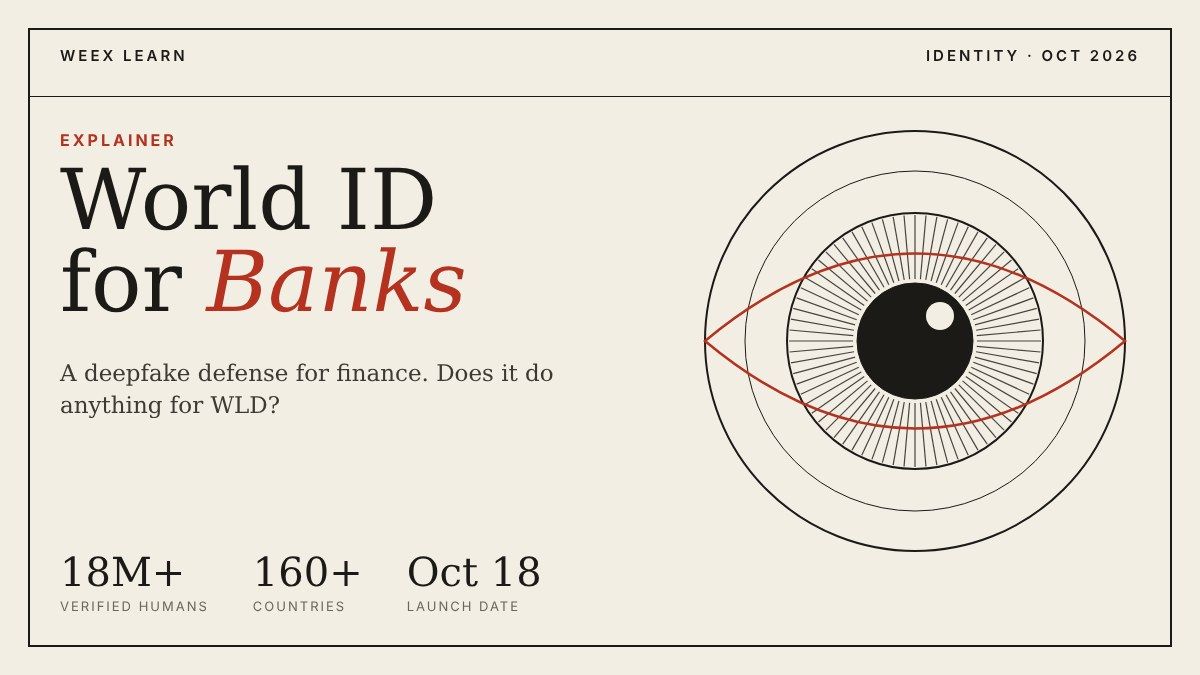
World ID for banks is a bundle of identity-verification tools that World, the project formerly known as Worldcoin, launched on October 18, 2026, to help financial firms prove they are dealing with real humans rather than deepfakes or rogue AI agents. WLD rallied about 10% in the days that followed. This guide explains what the suite actually contains, which firms are involved, and the part most coverage glosses over: why a useful product for banks does not automatically mean more demand for the WLD token.
What Is the World ID Suite for Banks?
World's co-founder Alex Blania unveiled the suite at the Money20/20 conference. It is the company's first product packaged for a specific industry, but it is built from three tools that already existed:
- World ID app. An identity wallet that stores credentials World calls "Proofs" and lets a person present them when asked.
- World ID for Zoom. Lets people on a video call confirm the other participant is a verified human. After a limited beta that began in April 2026, it is now generally available, and Orb-verified participants show a small badge.
- World ID for Agents (AgentKit). Lets a verified person delegate their Proofs to an AI agent, so a platform can check that a bot is acting on behalf of a real, verified human. A World executive compared it to a power of attorney.
The pitch to banks is fraud defense. World cited a Deloitte forecast that AI-enabled fraud losses in the United States could reach $40 billion by 2027, up from an estimated $12.3 billion in 2023. Impersonation on video calls and automated account abuse are exactly the attacks those numbers describe.
How World ID Verification Works
Every World ID starts with the Orb, an iris-scanning device. A person visits an Orb, gets scanned once, and receives a Proof of Human credential tied to their phone. World says the Orb does not build a central database of iris scans and that its code is open source.
Scale is the selling point. World says more than 18 million people now hold a Proof of Human, spread across more than 160 countries. That is a large verified population by crypto standards, but small next to the customer base of a single big retail bank, which is one reason the bank product leans on use cases like verifying staff on calls and policing AI agents rather than replacing standard customer onboarding.
Which Firms Are Using World ID for Banks?
This is where the headline outruns the detail. The named design partners are OpenExchange, Bain Capital, VanEck Funds, Outtake and Pantera Capital. Design partners help shape a product; they are not the same as paying customers.
As of the launch coverage, no bank was named as a user, and World did not disclose pricing. VanEck was the only finance firm named among the April Zoom beta testers. So "World ID for banks" is today a product aimed at banks, with investment and fintech firms helping test it, rather than a product banks have adopted.
Regulatory history is the other thing a bank's compliance team will weigh. Authorities have halted or restricted World's operations or iris-data collection in Kenya (2023), Spain and Portugal (2024) and Indonesia (May 2025). None of that blocks the new suite, but biometric data is the kind of topic that slows procurement at regulated institutions.
-- Price
Does World ID for Banks Increase Demand for WLD?
Probably not directly, at least not yet, and that is the most important point for WLD holders.
World has not said that banks pay for the suite in WLD, and pricing has not been published at all. A bank using World ID for Zoom to check a caller is using World's identity network; it is not necessarily buying, holding or spending the token. Adoption of World ID and demand for WLD are related, because a bigger network makes the ecosystem more valuable, but the link is indirect and hard to measure.
Meanwhile the supply side is concrete:
- Daily unlocks. WLD is among the tokens with ongoing linear releases, estimated at roughly $5.7 million per day during the week of October 19, 2026, based on unlock-tracker data republished by KuCoin. That is steady new supply the market has to absorb.
- Locked sale tokens. The World Foundation raised $52.5 million in July 2026 through a WLD sale with a one-year lockup, so those tokens are not expected to reach the market until around mid-2027.
Put plainly, the bank suite is a credible step for World's identity business. For the token, a product announcement with no named bank customer and no disclosed pricing is a sentiment catalyst, while unlocks are a mechanical one.
How WLD Is Trading After the Bank Suite Launch
The rally showed up clearly on WEEX. As of October 21, 2026 at about 03:00 UTC:
- WLD/USDT spot: about $0.589, up roughly 10.5% over 24 hours, with a range of $0.530 to $0.596 and 24h volume near 3.15 million USDT.
- WLDUSDT perpetual: about $0.588, up about 9.2%, with 24h volume near 30.6 million USDT.
- Funding rate: about +0.0095% per interval, meaning longs were paying shorts.
The detail worth noticing is the ratio. Perpetual volume was close to ten times spot volume, and funding had turned positive. That pattern usually means the move is being driven by leveraged traders rather than by steady spot buying. Two days earlier, WLD was still trading near $0.49, below the $0.50 level it had struggled to reclaim for weeks. Leverage-led breakouts can extend, but they also unwind quickly when funding gets expensive or the news fades.
If you want to hold WLD without leverage, the WLD/USDT spot market is the straightforward route. If you trade the WLDUSDT perpetual, size positions for the fact that WLD moved more than 12% between its daily low and high this week, and watch funding: a rising positive rate is the cost of staying long in a crowded trade.
The Bottom Line on World ID for Banks
World ID for banks gives World a clear story to tell regulated finance: deepfake calls and AI agents are real fraud problems, and a network of more than 18 million verified humans is a real asset. What it does not yet give WLD holders is evidence of paying bank customers, a pricing model, or any direct requirement to use the token.
Watch three things from here. First, whether any bank is named as a live user. Second, whether World discloses how the suite is priced and whether WLD has a role. Third, whether WLD can hold above $0.50 once leveraged traders take profit, given the steady daily unlocks underneath the price.
FAQ
1. What is World ID for banks?
It is a suite World launched on October 18, 2026 that bundles the World ID app, World ID for Zoom and World ID for Agents, aimed at helping financial firms detect deepfakes and verify that AI agents act for real people.
2. Do banks need WLD to use World ID?
World has not said so. Pricing for the bank suite has not been disclosed, and no requirement to pay in or hold WLD has been announced.
3. Which banks are using World ID?
None were named at launch. The named design partners are OpenExchange, Bain Capital, VanEck Funds, Outtake and Pantera Capital.
4. Why did WLD go up after the announcement?
The launch gave traders a fresh catalyst, and WLD rose about 10% in 24 hours. WEEX data showed perpetual volume near ten times spot and positive funding, which points to leveraged buying driving much of the move.
5. How many people have a World ID?
World says more than 18 million people across more than 160 countries hold a Proof of Human credential.
This content is provided for general informational purposes only and doesn't constitute financial, investment, legal, or tax advice. Any events, rewards, online promotions, or related information mentioned herein should not be considered a recommendation, solicitation, or invitation to purchase, sell, trade, or otherwise deal in any crypto assets. Crypto assets are highly volatile and may result in loss. The availability of WEEX services, products, and related events may vary by region. You are responsible for ensuring that your participation is in accordance with applicable local laws and regulations.
You may also like
BTC Funding Rate and Open Interest: What Each One Measures and How to Read Them Together
What Is Pearl (PRL) Crypto and How Does Its Mining Work?
What Happened to Aergo (AERGO) Crypto? Token Migration and What Holders Should Do
What Is HeyElsa (ELSA) Crypto and How Does It Work?
Stake ETH or Hold USDT on WEEX? The Price Move That Decides It
How Transparent Is a Crypto Exchange? Checking Proof of Reserves and Protection Funds
Token Unlocks This Week: How to Read AKE, ZRO and XPL Releases
Solana Alpenglow Upgrade: What Changes When Finality Hits 150ms
How to Use the WEEX Trust Center: Check Reserves, Protection Fund and Official Contacts
INJ Community BuyBack: What the $247K October Pool Really Means
What Is Leverage Trading in Crypto? A Beginner’s Guide With Simple Examples
What Is Crypto Margin Trading? How It Works, How It Differs From Futures and What Can Go Wrong
Crypto Leverage Trading Explained: How Perpetual Futures, Margin and Liquidation Work
Best Crypto Leverage Trading Platform: Things to Compare Before You Choose an Exchange
Nvidia Stock This Week: Why NVDA Fell Then Bounced and What AI Funding Worries Mean for Chip Stocks
Is My Pre-4.26.4 Qubic Wallet Unsafe? Recovery After the Network Restart

WXT Staking When Supply Shrinks: What Burns Add to Your Yield
Are Tokenized Stocks Backed by Real Shares? What Holders Own
ETH Funding Rate Today: 0.0087% per 8h as Ether Longs Re-Lever
Bitcoin Margin Trading: BTC Liquidation Math at 3x, 10x and 25x
Crypto Leverage Trading Platform: 6 Checks Before You Deposit
What Is Margin Trading? A $1,000 Example at 3x and 10x Leverage

The 17 October 2026 DBR Unlock: Six Allocations and deBridge's Vesting Schedule
Fake Crypto Payments: What to Check Before Handing Over Goods
What Is Leverage in Trading? How Leverage Ratios Like 5x and 10x Work and What They Do to Your Risk
What Is Leverage Trading? A Beginner’s Guide to Margin, Liquidation and Funding Fees
Is RSI a Good Indicator? How the Relative Strength Index Works, Its Limits and How Traders Use It
CXMT Stock Explained: What Is ChangXin Memory, Why It Fell on October 19 and What to Watch Next
Why Is CoreWeave (CRWV) Stock Falling? Debt, Bond Yields and What Analysts Say
KOSPI Whipsaw Explained: Samsung, SK Hynix and the AI Spending Doubts Behind the Swing
BTC Funding Rate and Open Interest: What Each One Measures and How to Read Them Together
What Is Pearl (PRL) Crypto and How Does Its Mining Work?
What Happened to Aergo (AERGO) Crypto? Token Migration and What Holders Should Do
What Is HeyElsa (ELSA) Crypto and How Does It Work?
Stake ETH or Hold USDT on WEEX? The Price Move That Decides It
How Transparent Is a Crypto Exchange? Checking Proof of Reserves and Protection Funds


