
Token Unlocks This Week: How to Read AKE, ZRO and XPL Releases

 Prefer us on Google


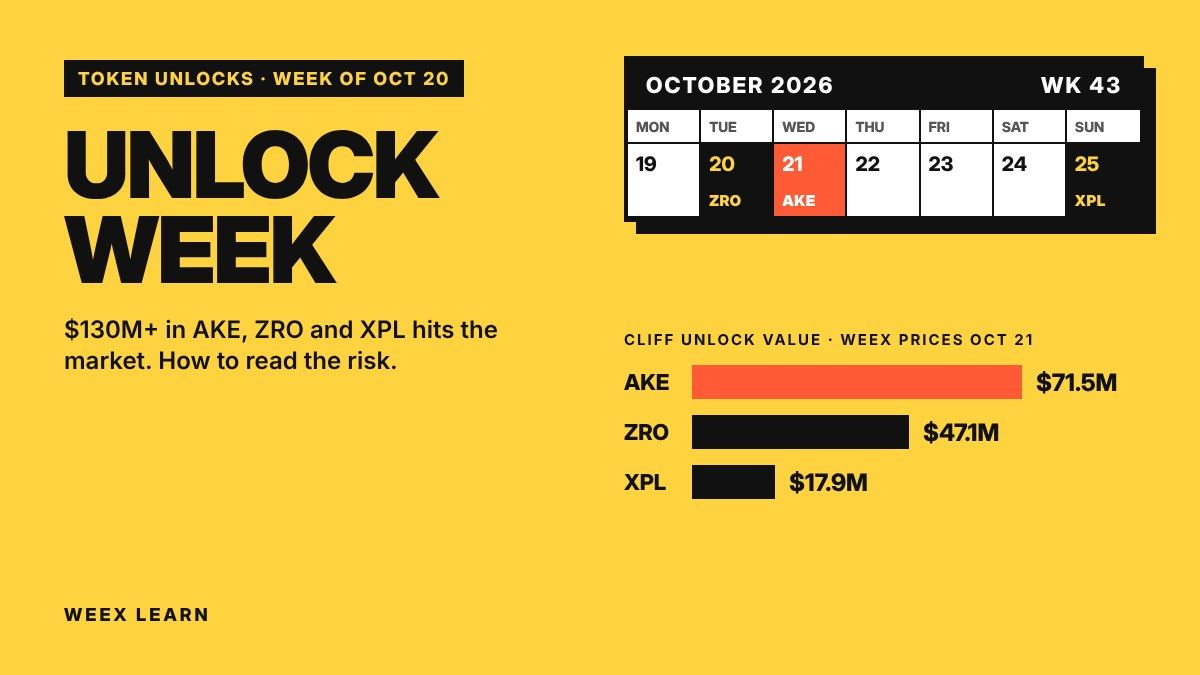
Token unlocks this week put more than $130 million of previously locked AKE, ZRO and XPL into the hands of investors, teams and ecosystem funds between October 20 and October 25, 2026. An unlock does not mean those tokens will be sold, but it does change who can sell. This guide uses the three largest cliff unlocks of the week to show a simple four-question method for judging any unlock, so you can tell a routine release from a real supply risk.
What Is a Token Unlock?
Most crypto projects do not release their entire supply at launch. Tokens allocated to the team, early investors, advisors and ecosystem funds are locked and released over time under a vesting schedule. A token unlock is the moment a batch of those tokens becomes transferable.
Unlocks come in two shapes:
- Cliff unlocks release a large batch on a single date. These are the ones that make headlines, because a lot of new supply arrives at once.
- Linear unlocks drip out continuously, often daily. They are less dramatic but can add up to more supply over a month than a single cliff.
For scale, unlock trackers put scheduled releases across the whole market at more than $793 million for the week of October 19, 2026, most of it linear. Cliff unlocks alone came to about $124 million over seven days, according to Tokenomist data cited in weekly roundups. The three tokens below account for the bulk of that cliff figure.
This Week's Biggest Unlocks: AKE, ZRO and XPL
All dollar values below are recalculated at WEEX prices as of October 21, 2026, around 03:00 UTC, so they differ slightly from figures published earlier in the week.
Akedo (AKE) — October 21. About 2.11 billion AKE, worth roughly $71.5 million at $0.0339. Akedo is an AI-driven game-creation platform and launchpad on BNB Smart Chain. Per DropsTab's vesting data, the release splits into about 1.00 billion AKE for investors, 642.6 million for the community allocation, 348.8 million for early contributors and 116.3 million for advisors. It equals 2.11% of AKE's 100 billion total supply and about 9.25% of its market cap. AKE unlocks this amount on the 21st of every month.
LayerZero (ZRO) — October 20. About 23.28 million ZRO, worth roughly $47.1 million at $2.02. LayerZero is an interoperability protocol that lets apps pass messages between blockchains. Tokenomist's breakdown puts 10.99 million ZRO with strategic partners, 10.63 million with core contributors and 1.67 million in tokens the team had repurchased. That is 3.83% of ZRO's released supply of about 607 million.
Plasma (XPL) — October 25. About 227.78 million XPL, worth roughly $17.9 million at $0.0788. Plasma is a Layer 1 chain built for stablecoin payments. The split is 88.89 million for ecosystem and growth, 69.44 million for investors and 69.44 million for the team, equal to 5.02% of the roughly 4.53 billion XPL released so far.
Humanity Protocol (H) also has a cliff unlock of about 266 million tokens late in the week, though trackers disagree on whether it lands October 23 or October 25.
How to Judge Any Token Unlock: Four Questions
The same headline number can mean very different things. These four questions, applied in order, separate the noise from the risk.
1. How big is it compared with what already trades?
Compare the unlock with the circulating supply or market cap, not with total supply. AKE's release is only 2.11% of total supply, which sounds small, but it equals about 9.25% of market cap because less than half of AKE's supply is unlocked. That is the more honest measure of how much new sell-side inventory could appear.
2. Who receives the tokens?
Investor and team allocations carry the most sell risk, because those holders often bought at far lower prices. Ecosystem and community allocations are usually spent gradually on grants, incentives or liquidity. In AKE's case, about 69% of this release goes to investors, early contributors and advisors. For XPL, about 61% goes to investors and the team. For ZRO, the largest single bucket is strategic partners, whose selling behavior is harder to predict.
3. Is it a cliff or part of a linear stream?
A one-off cliff is a single event the market can position around. A recurring monthly cliff, like AKE's on the 21st, becomes predictable, and traders tend to front-run it. Linear releases rarely move price on a given day but keep steady pressure underneath it.
4. How is the market already positioned?
Unlocks are public and scheduled, so they are often priced in before the date. Funding rates and volume on perpetual futures tell you whether traders are bracing for selling or ignoring it.
-- Price
What WEEX Market Data Shows Around the Unlocks
Positioning around this week's releases was not what a simple "unlock equals dump" rule would predict. As of October 21, 2026 at about 03:00 UTC, WEEX perpetual data showed:
- AKEUSDT: about $0.0339, up 11% over 24 hours on the day of its unlock, with 24h volume near 26.2 million USDT and funding around +0.0152%. Longs were paying to stay long into the release.
- ZROUSDT: about $2.02, up roughly 8.3% in the 24 hours after its October 20 unlock, with funding around +0.005%.
- XPLUSDT: about $0.0788, up about 2.7%, with funding near zero and volume near 5.3 million USDT, four days before its unlock.
The lesson is not that unlocks are bullish. It is that a well-known, scheduled unlock is often absorbed or front-run before the date, and the price reaction can show up days later as recipients actually move tokens to exchanges. AKE had already rallied hard in the weeks before this release, and positive funding means a crowded long trade, which is exactly the setup where a wave of investor selling can trigger cascading liquidations.
If you hold or trade these tokens, the AKEUSDT perpetual, ZRO/USDT spot market and XPLUSDT perpetual let you follow price, funding and volume through the release window. Around a large unlock, keep leverage low and avoid placing stops at obvious round numbers, where liquidity tends to get swept.
What Token Unlocks This Week Mean for Traders
Token unlocks this week are a useful reminder that supply schedules are one of the few things in crypto you can know in advance. AKE's release is the biggest relative to its market cap and goes mostly to investors and insiders, which makes it the one to watch most closely. ZRO's has already passed with no immediate selloff. XPL's is smaller and lands at the end of the week.
The four-question method works for any token: size against market cap, who receives it, cliff or linear, and how traders are positioned. Check the next unlock date before you buy, not after.
FAQ
1. Does a token unlock always make the price fall?
No. Unlocks make tokens transferable; they do not force anyone to sell. Scheduled unlocks are often priced in ahead of time, and this week ZRO and AKE both traded higher around their release dates.
2. What is the difference between a cliff unlock and a linear unlock?
A cliff unlock releases a large batch on one date. A linear unlock releases tokens continuously, often daily, in small amounts.
3. Where can I check upcoming token unlocks?
Unlock trackers such as Tokenomist and DropsTab publish vesting schedules. Project documentation is the primary source, and figures can differ between trackers.
4. Why compare an unlock with market cap instead of total supply?
Because only circulating tokens trade. An unlock that is small against total supply can still be large against what is actually on the market, as AKE's 2.11% of supply but roughly 9.25% of market cap shows.
This content is provided for general informational purposes only and doesn't constitute financial, investment, legal, or tax advice. Any events, rewards, online promotions, or related information mentioned herein should not be considered a recommendation, solicitation, or invitation to purchase, sell, trade, or otherwise deal in any crypto assets. Crypto assets are highly volatile and may result in loss. The availability of WEEX services, products, and related events may vary by region. You are responsible for ensuring that your participation is in accordance with applicable local laws and regulations.
You may also like
BTC Funding Rate and Open Interest: What Each One Measures and How to Read Them Together
What Is Pearl (PRL) Crypto and How Does Its Mining Work?
What Happened to Aergo (AERGO) Crypto? Token Migration and What Holders Should Do
What Is HeyElsa (ELSA) Crypto and How Does It Work?
Stake ETH or Hold USDT on WEEX? The Price Move That Decides It
How Transparent Is a Crypto Exchange? Checking Proof of Reserves and Protection Funds

World ID for Banks: What the New Suite Means for WLD Holders
Solana Alpenglow Upgrade: What Changes When Finality Hits 150ms
How to Use the WEEX Trust Center: Check Reserves, Protection Fund and Official Contacts
INJ Community BuyBack: What the $247K October Pool Really Means
What Is Leverage Trading in Crypto? A Beginner’s Guide With Simple Examples
What Is Crypto Margin Trading? How It Works, How It Differs From Futures and What Can Go Wrong
Crypto Leverage Trading Explained: How Perpetual Futures, Margin and Liquidation Work
Best Crypto Leverage Trading Platform: Things to Compare Before You Choose an Exchange
Nvidia Stock This Week: Why NVDA Fell Then Bounced and What AI Funding Worries Mean for Chip Stocks
Is My Pre-4.26.4 Qubic Wallet Unsafe? Recovery After the Network Restart
WXT Staking When Supply Shrinks: What Burns Add to Your Yield
Are Tokenized Stocks Backed by Real Shares? What Holders Own
ETH Funding Rate Today: 0.0087% per 8h as Ether Longs Re-Lever
Bitcoin Margin Trading: BTC Liquidation Math at 3x, 10x and 25x
Crypto Leverage Trading Platform: 6 Checks Before You Deposit
What Is Margin Trading? A $1,000 Example at 3x and 10x Leverage

The 17 October 2026 DBR Unlock: Six Allocations and deBridge's Vesting Schedule
Fake Crypto Payments: What to Check Before Handing Over Goods
What Is Leverage in Trading? How Leverage Ratios Like 5x and 10x Work and What They Do to Your Risk
What Is Leverage Trading? A Beginner’s Guide to Margin, Liquidation and Funding Fees
Is RSI a Good Indicator? How the Relative Strength Index Works, Its Limits and How Traders Use It
CXMT Stock Explained: What Is ChangXin Memory, Why It Fell on October 19 and What to Watch Next

Why Is CoreWeave (CRWV) Stock Falling? Debt, Bond Yields and What Analysts Say
KOSPI Whipsaw Explained: Samsung, SK Hynix and the AI Spending Doubts Behind the Swing
BTC Funding Rate and Open Interest: What Each One Measures and How to Read Them Together
What Is Pearl (PRL) Crypto and How Does Its Mining Work?
What Happened to Aergo (AERGO) Crypto? Token Migration and What Holders Should Do
What Is HeyElsa (ELSA) Crypto and How Does It Work?
Stake ETH or Hold USDT on WEEX? The Price Move That Decides It
How Transparent Is a Crypto Exchange? Checking Proof of Reserves and Protection Funds


