MSFT Stock Near $542: What Azure Maia 300 Actually Claims and What Still Needs Proof

 Prefer us on Google
MSFT stock gained about 1% on Monday, October 12, while the Nasdaq Composite was down, and the reason was a chip most customers cannot use yet.
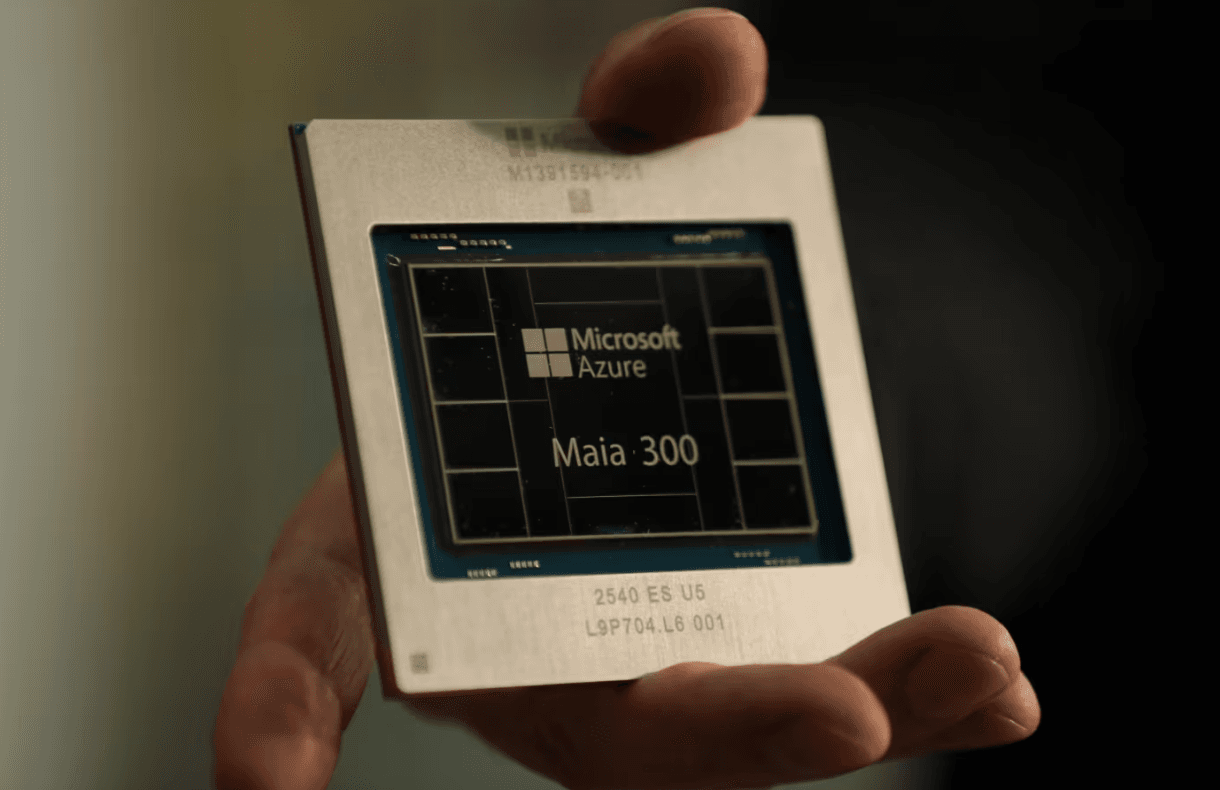
Microsoft announced Maia 300, the third processor in its Azure Maia line, and said it would scale the system to multi-gigawatt deployments starting in 2027. The headline number, 40% more tokens per megawatt than GPU systems, is the kind of claim that moves MSFT stock because it speaks to the cost of running AI, which is now the largest expense behind the business. It is also a claim that comes entirely from Microsoft, which is why this article separates what was announced from what has been shown. For anyone holding MSFT stock near $542, that difference decides how much of the move is evidence and how much is expectation.
What Is MSFT Stock Doing Near $542, and Why Did It Move on October 12?
MSFT stock rose roughly 1% to about $542 on October 12, 2026, within a few percent of its 52-week high of $553.72, and the move followed the Maia 300 announcement. Benzinga reported $542.16, up 1.33%, at publication. Motley Fool's page showed $541.15, up 1.14%, with a day range of $535.70 to $542.74, and Investing.com listed $539.69 at 1:09 p.m. Eastern. These quotes were taken at different minutes, so the spread of a few dollars is normal.
At $542 the stock sits about 2% below its high (calculation), with a market value of around $4.0 trillion according to Motley Fool. Investing.com's AI-assisted article reported gains of 8.90% over one month and 40.16% over three months, a run that raises the bar for any new catalyst. Investing.com also noted that the Nasdaq Composite fell about 0.44% midday while the S&P 500 was roughly flat, which is why the rise was linked to company news and not to a broad rally.
What Does Microsoft Claim About Maia 300?
Microsoft claims Maia 300 delivers 40% more tokens per megawatt than GPU systems, and that full-rack deployments can reach up to seven times the token throughput of Maia 200. Techzine, summarizing the announcement, listed eight HBM4 memory stacks, 18 TB/s of memory bandwidth, a 950-watt power rating and a rack of 96 accelerators. Production deployment is scheduled to begin in 2027, with scale-up toward multi-gigawatt capacity, and Benzinga said further details are expected at Microsoft Ignite in San Francisco next month.
A token is the unit an AI model reads and writes, and tokens per megawatt is a measure of how much AI output a data center gets for its electricity. A gain of that size matters because power, not only chips, limits how fast AI capacity can grow. The claim is also narrower than it sounds. It compares Maia 300 to unnamed GPU systems, and Techzine noted that the announcement does not identify which GPUs, which configurations or which workloads sit behind the 40% figure.
What Has Maia 200 Already Delivered?
Maia 200 is the part of the story that is already running, and it is the closest thing to evidence. Microsoft says it already powers live Copilot workloads and is being installed in the United States, Europe and Australia, according to Benzinga. Microsoft also claims up to 1.7 times better tokens per watt than GPU infrastructure for AI features in Teams, Copilot and Cowork, a figure Techzine attributed to the company, with GitHub Copilot and Microsoft Foundry slated to run on it by year-end.
That track record is useful but limited. Two words in the announcement deserve attention: up to. Every comparison is a best case, and the seven times throughput figure is measured against Maia 200, not against a rival, so it shows progress inside Microsoft's own line and not a lead over anyone else. Even so, a chip that already serves production traffic is a different kind of claim from a slide about a future product, and it gives the 2027 plan more credibility than a pure roadmap would.
-- Price
Which Maia 300 Claims Still Need Independent Proof?
Nearly every performance number still needs outside verification, because Techzine found no third-party benchmarks, testing or analyst review behind them. The 40% figure, the 1.7 times figure and the sevenfold rack throughput are all vendor-reported, and the deployment date of 2027 and the multi-gigawatt scale are targets and not results.
A Forkast analysis went further, arguing that Maia 300 is a structural hedge for Microsoft and not a replacement for Nvidia, and noting that no confirmed external deployments have been announced. Its spec comparison, which relies on vendor-reported figures, also suggested Maia trails Nvidia's B300 on sparse FP8 performance while offering higher memory bandwidth and lower power. Those comparisons are secondary and should be treated as one analyst's reading. The practical questions are what yields and costs look like in production, how well software runs on the chip compared with the Nvidia ecosystem customers already use, and whether the savings show up in margins. None of those can be answered from an announcement.
Why Does the October 28 Earnings Report Matter More Than the Chip for MSFT Stock Now?
The October 28 earnings report matters more because it will show whether Azure growth is paying for the AI buildout, which no chip announcement can do. Investing.com lists Microsoft's fiscal first-quarter report for October 28 after the market close, with consensus of about $4.71 in earnings per share and $90.61 billion in revenue. The same AI-assisted article says Azure growth recently accelerated to 43% and management has pointed toward roughly 45%, and estimates calendar 2026 capital spending near $175 billion. Those figures should be checked against Microsoft's own disclosures before anyone relies on them.
The logic is simple. A custom chip lowers future cost, but the spending happens now, and investors will look for Azure growth, margin commentary and any mention of Maia's share of capacity. If Azure growth holds near the guided level while capital spending stays in line, the chip story gains support. If growth slows or spending jumps, the 2027 promise starts to look like a distraction. For MSFT stock, the next two weeks are therefore about the quarter, and the chip will matter in how management talks about it.
How Can Traders Follow MSFT Stock Price Moves on WEEX Spot and Futures?
Traders who want price exposure to MSFT stock on WEEX can look at Spot and Futures, and the two carry different risks. Both track a price and do not give ownership of Microsoft shares, voting rights or dividends. Pair availability and leverage limits are listed on the WEEX trading page and can change, so they should be checked there before placing an order.
Spot is the simpler way to follow a multi-week story such as the run into earnings. A spot position uses the trader's own funds, has no leverage and no liquidation price, so the loss is capped at the amount invested. Futures suit shorter-term views and work differently. A futures contract allows leverage, which magnifies gains and losses, and a position can be liquidated if the price moves far enough against it. Funding fees may apply while it is open. Earnings reports often bring price gaps, so a leveraged position held through October 28 can lose margin quickly if the reaction goes the wrong way.
Position size, a stop level and a maximum acceptable loss are worth settling before the order, not after it. WEEX also publishes a 1,000 BTC protection fund at weex.com/protectfund. A protection fund is a platform safeguard, and it does not remove trading risk or guarantee against losses.
Conclusion
The Maia 300 announcement gave MSFT stock a clear story: lower AI running costs through custom silicon, scaled from 2027. What it did not give is proof. The headline numbers are Microsoft's own, the comparisons use unnamed GPUs, and the deployment is more than a year away, while Maia 200 offers the only evidence of chips already in service. The next meaningful test is the October 28 earnings report, followed by whatever new detail Microsoft shares at Ignite. Readers should check current prices and the original announcement before acting on any figure here.
FAQ
1. Why did MSFT stock rise on October 12, 2026?
MSFT stock rose about 1% to roughly $542 after Microsoft unveiled the Azure Maia 300 AI chip and plans for multi-gigawatt deployments from 2027, while the Nasdaq was lower.
2. What does Microsoft claim about the Maia 300 chip?
Microsoft claims Maia 300 delivers 40% more tokens per megawatt than GPU systems and up to seven times the rack throughput of Maia 200, with deployment starting in 2027.
3. Has Maia 300 been independently verified?
No independent benchmarks have been published. Techzine found every performance figure attributed to Microsoft, and the comparison uses unnamed GPU systems.
4. When does Microsoft report earnings?
Investing.com lists Microsoft's fiscal first-quarter report for October 28, 2026 after the market close. Readers should confirm the date with Microsoft's investor relations page.
5. Can traders follow MSFT stock on WEEX?
Traders can look for MSFT price exposure in WEEX Spot and Futures, which track the price and do not provide share ownership. Pair availability and leverage limits should be checked on WEEX.
This content is provided for general informational purposes only and doesn't constitute financial, investment, legal, or tax advice. Any events, rewards, online promotions, or related information mentioned herein should not be considered a recommendation, solicitation, or invitation to purchase, sell, trade, or otherwise deal in any crypto assets. Crypto assets are highly volatile and may result in loss. The availability of WEEX services, products, and related events may vary by region. You are responsible for ensuring that your participation is in accordance with applicable local laws and regulations.
You may also like

WEEX Convert Guide: How to Swap Crypto on Web and App and What the Quote Really Means
ASML Stock Falls Despite a Record Q3 and Higher Outlook: Is the AI Chip Equipment Boom Already Priced In?

SKHY Stock Falls Again: Is the SK Hynix Selloff About China’s CXMT and YMTC or AI Profit-Taking?

What Is a Limit Order? How It Works and When to Use It
Best Crypto Miner for Beginners: What to Check on Cost, Power, Hashprice and Profit Before You Buy

DeFi Vault vs Staking: Who Controls Your Yield and Your Exit?
Buy Limit Order: How to Buy Crypto Below the Market Price
Limit Sell Order: How to Set a Take-Profit Price in Crypto

Limit Order vs Market Order: Which One to Use When Trading Crypto
What Is a Limit Order? How It Works in Crypto With BTC Examples
OP Price and Unichain's OP Enterprise Move: What It Means for OP

Nvidia Stock Falls After Microsoft's Maia 300: Is Custom Silicon a Real Threat to NVDA?

SpaceX Stock (SPCX) Near $163: Can It Reclaim $176 After Pivotal Lifts Its Target to $230?
MU Stock Falls Below $1,000: Is the CXMT Threat Real or Just an Excuse to Take Profits?
Can META Reach $1,000? What Wells Fargo, Jefferies and Bernstein Targets Say About Meta Stock

Meta Stock Jumps as Muse AI Retention Data Lands: Is META Pricing In an AI Agent Win?

Stop Limit Order: How It Works and Why It Can Fail to Fill
Best Crypto Platform for Beginners: Pick by Goal, Not Brand

Best Crypto Podcasts for Beginners: A 4-Week Listening Plan

Best Cold Wallet Crypto for Beginners: 5 Picks Under $150
ETH Staking on WEEX vs On-Chain: Queues, Minimums, and Keys

Will Bitcoin Break $87,000 This Week? CPI, Fed Speakers and ETF Outflows to Watch
Conflux (CFX) Price Jumps on China's National Blockchain Network Plan: Does the Policy Actually Name CFX?

What Is Plume (PLUME)? Why the RWA Token Stays 93% Below Its High Even After the Layer 2 Rally
Best Crypto Broker for Beginners: What to Check in Fees, Regulation, Security and Support Before You Deposit
Wormhole Coin Price Near $0.03: What Is Wormhole (W) and What Do Traders Need to Know About W 2.0, Unlocks and Staking?

Who Is David Ellison? Skydance’s Strategy, Media Consolidation, and the Investment Case
What Is MegaETH (MEGA)? Why the Token Trades 78% Below Its High and What to Watch Before the Six Month Unlock

Evernorth (XRPN) Nasdaq Debut: What the Largest Public XRP Treasury Holds and What It Means for XRP Price

Best Crypto Wallet for Beginners 2025: Pick by What You Will Do
WEEX Convert Guide: How to Swap Crypto on Web and App and What the Quote Really Means
ASML Stock Falls Despite a Record Q3 and Higher Outlook: Is the AI Chip Equipment Boom Already Priced In?
SKHY Stock Falls Again: Is the SK Hynix Selloff About China’s CXMT and YMTC or AI Profit-Taking?
What Is a Limit Order? How It Works and When to Use It
Best Crypto Miner for Beginners: What to Check on Cost, Power, Hashprice and Profit Before You Buy
DeFi Vault vs Staking: Who Controls Your Yield and Your Exit?
Contents
Popular coins
Latest articles