
SKHY Stock Falls Again: Is the SK Hynix Selloff About China’s CXMT and YMTC or AI Profit-Taking?

 Prefer us on Google
SKHY stock closed at $162.23 on Monday, October 12, dipped near $153 in premarket the next morning, and was quoted at $157.06 on October 14 as memory stocks were still under pressure.
Behind the slide sit two stories that traders keep mixing together: a Chinese challenge in memory chips, and a crowd of investors heading for the exit after a huge run. Anyone asking why SKHY stock keeps falling gets both answers in the same headline, and that is the problem, because each story calls for a different reaction. The facts that separate them are mostly unproven claims, a few analyst quotes and some very large percentages, which is why the drop in SKHY stock is worth reading slowly. Whether SKHY stock has more room to fall depends on which story the next data supports.
How Far Has SKHY Stock Fallen, and What Is SKHY?
SKHY is the Nasdaq-listed American depositary receipt of SK Hynix, and its recent drop mirrors a much steeper fall in Seoul. An ADR is a certificate traded in the United States that represents shares of a foreign company, so its price follows the Korean shares and the exchange rate, and it does not have to equal the Korean price converted at face value. The conversion ratio and fees are set in the ADR documentation, which readers should check before comparing the two markets.
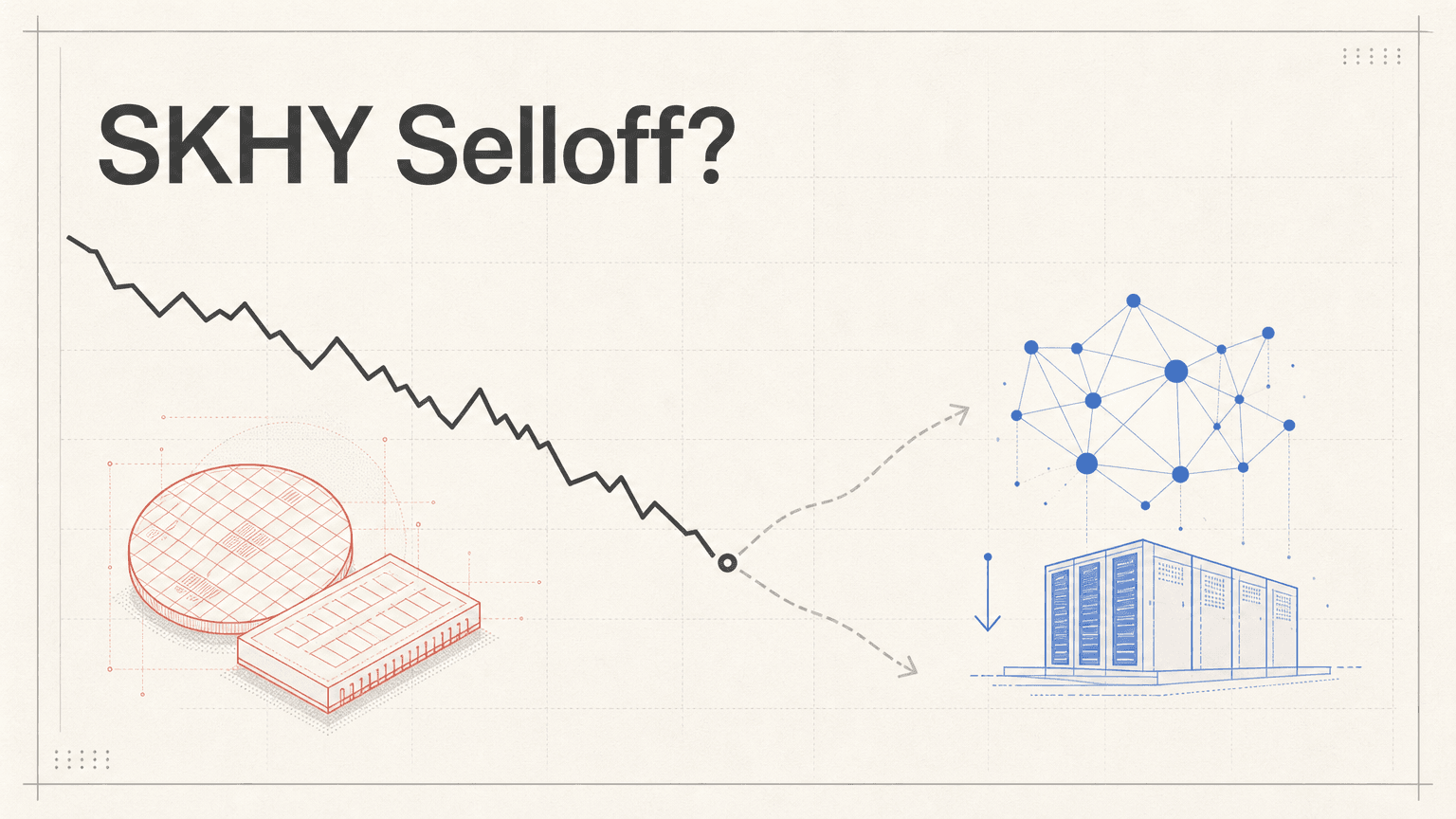
The numbers show how fast things moved. According to Benzinga, SK Hynix fell 10.09% in Seoul on October 13 to 1,443,000 won, its fifth straight decline, which took the shares down 21.6% over five sessions and 50.6% below the June 22 record close, though still up 121.7% for the year. It was also the first close below the 200-day moving average since May 2, 2025. A Reuters report carried by Yahoo Finance said SKHY closed at $162.23 on Monday, and Benzinga’s premarket indications for October 13 were about $152.94, down 5.7%, with an earlier reading at $153.60, down 5.32%. TokenPost recorded a premarket drop of 4.8% for SK Hynix at 4:18 a.m. Eastern. These differ because they were taken at different minutes.
A quote of $157.06 on October 14 puts SKHY stock about 3% below its October 12 close (calculation), but that is not a recovery from the October 13 low, because the October 13 close is not included in the sources used here. On October 14, Sina Finance also reported SK Hynix down more than 2% in premarket trading, with SanDisk and Western Digital down about 1%, and gave no reason.
What Did CXMT Actually Say, and Why Does It Hit SK Hynix?
CXMT said it expects to launch a server memory module built on a denser DRAM cell design around the end of 2026, and it has not published specifications, yields or volumes. Its president, Cao Kanyu, spoke at a chip conference in Shanghai, and IT Home reported the remarks on October 10, according to AIStockWire. The 4F² layout has a nominal cell footprint about one third smaller than the 6F² cells common today, but that does not establish the finished chip’s density or cost.
The reason it matters is price. Reuters quoted Saxo strategist Charu Chanana calling the news a clear trigger for the selloff, and the Yahoo Finance piece noted that SK Hynix’s gross margin rose from 0.71% in the September 2023 quarter to 79.27% in the March 2026 quarter and rose again in June, which leaves a lot to lose if a rival can make dense DRAM at scale and competitive prices. The counterpoints are equally specific. Rayliant Global Advisors’ Phillip Wool, quoted by Benzinga, called CXMT’s progress a milestone but the near-term threat limited, with Korean makers still dominating high-bandwidth memory. Samsung Securities, in the Seoul Economic Daily, said the earnings risk depends on mass-production yields, customer qualification and actual shipments. Its analysts added that high-bandwidth memory is absorbing production capacity and that new plants are ramping slowly, so falling prices may not cut profits as they did in earlier cycles.
Why Does the YMTC IPO Filing Matter for NAND and SK Hynix?
The YMTC filing matters because it points at NAND flash, a different product line where SK Hynix also competes, and it arrived on the same day as the Seoul crash. Benzinga reported that Yangtze Memory Technologies filed for an IPO on Shanghai’s STAR Market, with no valuation or offer price set. Counterpoint data cited in the same article ranks YMTC third in the world by NAND shipments in the second quarter, behind Samsung and SK Hynix and ahead of Kioxia and Micron. Excluding SK Hynix’s Solidigm unit, it ranks second.
Analysts quoted by Benzinga framed the risk as pricing power. Jeongku Choi said AI is driving a NAND super cycle and that YMTC is the fastest-growing vendor, Neil Shah said its Xtacking architecture lets it keep adding layers with mature lithography tools despite US export controls, and MS Hwang said the open question is whether YMTC can win design customers outside China. A pending US bill, the MATCH Act, names YMTC and targets the tools its roadmap depends on. Benzinga attributed the selloff to investors questioning whether three companies can keep the pricing power AI demand created. An IPO filing is not a market-share shift, so the signal is about the future, not about this quarter.
-- Price
What Points to AI Profit-Taking Instead?
Several details suggest the selloff owes as much to positioning as to China. UBP’s Vey-Sern Ling told Reuters that investors were jittery and looking for excuses to take profits on AI-related stocks that had outperformed this year, and noted that Chinese memory makers still face technology hurdles in advanced memory such as high-bandwidth memory. The Yahoo Finance report also said that Intel and Broadcom executives had warned that access to capital could constrain the AI boom, a separate worry that hits the same stocks.
The scale of the earlier gains makes the drop look like a reset. SK Hynix was still up 121.7% for the year in Seoul after losing half its value from the peak, and Micron, which fell in the same session, was up about 246% for the year at its October 12 close according to GuruFocus. The rebound on October 14 adds a small piece of evidence. The Seoul Economic Daily said SK Hynix traded at 1.473 million won at 11 a.m., up 2.08% from the prior close, and that it went from fifth in net selling to first in net buying among Mirae Asset’s top 1% of traders by one-month returns, described as bargain hunting. That is one broker’s best-performing clients and an intraday price, so it should not be read as a market-wide signal. A selloff that bounces the next morning looks more like nervous positioning than a verdict on a competitor that has not shipped a product.
What Could Settle the Debate for SKHY Stock?
The next facts that matter are CXMT’s yields and shipments, YMTC’s IPO terms and the AI sentiment indicators, and none of them has arrived yet. CXMT has not said how many modules it will ship or what yields it gets on 4F². YMTC has not set a valuation. MarketBeat flagged TSMC’s results on October 15 as the next major datapoint for the AI chip supply chain, which will say something about demand even if it says little about China.
Analyst targets show how far apart views remain. The Reuters report said the Street mean target for SKHY is $252, about 55% above Monday’s close, and the low target is $152, with the mean unchanged since September 30 even though the ADR fell 12% over that period. At the October 14 quote of $157.06, the Street mean of $252 sits about 60% above the price and the Street low of $152 about 3% below it (calculation, using targets as of Reuters’ report). Stale targets tell more about how slowly analysts update than about where the stock should trade. For anyone following SKHY stock, the practical test is whether the next reports confirm real pricing pressure in DRAM and NAND or show demand and margins holding.
How Can Traders Follow SKHY Stock Price Moves on WEEX?
Traders who want price exposure to SKHY stock on WEEX can look at Spot and Futures, and the two behave very differently. Both track a price. Neither gives ownership of SK Hynix shares or ADRs, voting rights or dividends. Pair availability, the reference price a pair follows and any leverage limits are shown on the WEEX trading page and can change, so they should be checked there before placing an order.
Spot suits traders who want to follow the CXMT and YMTC story over weeks. A spot position uses the trader’s own funds, has no leverage and no liquidation price, so the loss is capped at the amount invested. Futures suit shorter views and carry more risk. A futures contract allows leverage, which magnifies gains and losses, and a position can be liquidated if the price moves far enough against it. Funding fees may apply while it stays open. SKHY stock moved more than 5% in one premarket session, and Seoul shares moved 10% in one day, so a leveraged position can lose its margin before a headline has finished spreading.
Deciding position size, a stop level and a maximum acceptable loss first is safer than adjusting after the price moves. WEEX also publishes a 1,000 BTC protection fund at weex.com/protectfund. A protection fund is a platform safeguard, and it does not remove trading risk or guarantee against losses.
Conclusion
The fall in SKHY stock fits both stories, and the evidence does not yet favor either one. CXMT’s denser memory and YMTC’s IPO filing are real long-term questions about pricing power, but neither company has shown shipments, yields or a customer base beyond China at scale. At the same time, a stock that had more than doubled this year, a market worried about AI financing and a rebound in Seoul the next morning all point to profit-taking. The next data on CXMT output, YMTC’s terms and AI demand will decide how much of the drop was information and how much was positioning. Readers should check current prices and the original reports before acting on any figure here.
FAQ
1. Why is SKHY stock falling?
SKHY stock fell after China’s CXMT announced plans for denser server memory and YMTC filed for an IPO, while investors also took profits in AI-related stocks, according to Benzinga, Reuters and the Seoul Economic Daily.
2. What is SKHY stock?
SKHY stock is the Nasdaq-listed American depositary receipt of SK Hynix. Its price follows the Korean shares and the exchange rate, and the ADR documentation sets the conversion ratio.
3. Is China’s CXMT a real threat to SK Hynix?
CXMT is a long-term supply risk, but it has not published yields or shipment volumes, and Rayliant’s Phillip Wool called the near-term threat limited because Korean makers still dominate high-bandwidth memory.
4. How far is SKHY stock from analyst targets?
Reuters reported a Street mean target of $252 and a low target of $152 for SKHY stock, while the premarket indication on October 13 was about $152.94, so the price sat near the low target.
5. Can traders follow SKHY stock on WEEX?
Traders can look for SKHY price exposure in WEEX Spot and Futures, which track the price and do not provide share ownership. Pair availability and leverage limits should be checked on WEEX.
This content is provided for general informational purposes only and doesn't constitute financial, investment, legal, or tax advice. Any events, rewards, online promotions, or related information mentioned herein should not be considered a recommendation, solicitation, or invitation to purchase, sell, trade, or otherwise deal in any crypto assets. Crypto assets are highly volatile and may result in loss. The availability of WEEX services, products, and related events may vary by region. You are responsible for ensuring that your participation is in accordance with applicable local laws and regulations.
You may also like

SK Hynix Stock Jumps as OpenAI's New Model Revives the Memory Chip Trade

SK Hynix Stock Hits New Highs in Korea as Its US Listing Surges 8%: What's Driving Both
WEEX Stock Spot 2.0 Rewards Guide: Trade & Share $100K

WEEX Convert Guide: How to Swap Crypto on Web and App and What the Quote Really Means
ASML Stock Falls Despite a Record Q3 and Higher Outlook: Is the AI Chip Equipment Boom Already Priced In?
What Is a Limit Order? How It Works and When to Use It
Best Crypto Miner for Beginners: What to Check on Cost, Power, Hashprice and Profit Before You Buy

DeFi Vault vs Staking: Who Controls Your Yield and Your Exit?
Buy Limit Order: How to Buy Crypto Below the Market Price
Limit Sell Order: How to Set a Take-Profit Price in Crypto

Limit Order vs Market Order: Which One to Use When Trading Crypto
What Is a Limit Order? How It Works in Crypto With BTC Examples
OP Price and Unichain's OP Enterprise Move: What It Means for OP

Nvidia Stock Falls After Microsoft's Maia 300: Is Custom Silicon a Real Threat to NVDA?

SpaceX Stock (SPCX) Near $163: Can It Reclaim $176 After Pivotal Lifts Its Target to $230?

MSFT Stock Near $542: What Azure Maia 300 Actually Claims and What Still Needs Proof
MU Stock Falls Below $1,000: Is the CXMT Threat Real or Just an Excuse to Take Profits?
Can META Reach $1,000? What Wells Fargo, Jefferies and Bernstein Targets Say About Meta Stock

Meta Stock Jumps as Muse AI Retention Data Lands: Is META Pricing In an AI Agent Win?

Stop Limit Order: How It Works and Why It Can Fail to Fill
Best Crypto Platform for Beginners: Pick by Goal, Not Brand

Best Crypto Podcasts for Beginners: A 4-Week Listening Plan
Best Cold Wallet Crypto for Beginners: 5 Picks Under $150
ETH Staking on WEEX vs On-Chain: Queues, Minimums, and Keys

Will Bitcoin Break $87,000 This Week? CPI, Fed Speakers and ETF Outflows to Watch
Conflux (CFX) Price Jumps on China's National Blockchain Network Plan: Does the Policy Actually Name CFX?

What Is Plume (PLUME)? Why the RWA Token Stays 93% Below Its High Even After the Layer 2 Rally
Best Crypto Broker for Beginners: What to Check in Fees, Regulation, Security and Support Before You Deposit
Wormhole Coin Price Near $0.03: What Is Wormhole (W) and What Do Traders Need to Know About W 2.0, Unlocks and Staking?

Who Is David Ellison? Skydance’s Strategy, Media Consolidation, and the Investment Case
SK Hynix Stock Jumps as OpenAI's New Model Revives the Memory Chip Trade
SK Hynix Stock Hits New Highs in Korea as Its US Listing Surges 8%: What's Driving Both
WEEX Stock Spot 2.0 Rewards Guide: Trade & Share $100K
WEEX Convert Guide: How to Swap Crypto on Web and App and What the Quote Really Means
ASML Stock Falls Despite a Record Q3 and Higher Outlook: Is the AI Chip Equipment Boom Already Priced In?
What Is a Limit Order? How It Works and When to Use It
Contents
Popular coins
Latest articles


