
Goldman Sachs CEO Backs Senate Crypto Bill: The Institutional Blueprint for Wall Street On-Chain Liquidity in 2026

 Prefer us on Google

Summary
David Solomon's July 23, 2026 endorsement of the CLARITY Act is less a policy opinion than a liquidity-provisioning signal from the largest pool of institutional capital currently sitting adjacent to digital asset markets. Per reported comments to Politico, Solomon called the bill imperfect but necessary for building "market structure" that would let sidelined regulated institutions engage more directly with on-chain products. Our structural read diverges from the consensus framing of this as a simple "Wall Street splits on crypto" story. The real driver is that Goldman already operates live tokenized infrastructure and has capital tied up in ETF filings competing directly against a rival's product, meaning regulatory ambiguity is now an active drag on revenue timelines, not an abstract risk. JPMorgan's opposition, meanwhile, isn't really about crypto at all, it's a deposit-defense argument dressed in crypto-policy language. Understanding that distinction is the actual blueprint for how institutional liquidity migrates on-chain once jurisdictional clarity settles.
How Does Regulatory Clarity Actually Translate Into On-Chain Liquidity
Jurisdictional clarity functions as the single largest unlock for institutional capital allocation into digital assets because compliance departments at banks the size of Goldman cannot scale products built on legally ambiguous classification. Regulatory clarity itself does not create liquidity; it removes the legal veto that compliance and risk committees currently hold over scaling existing pilot infrastructure.
Why Classification Uncertainty Has Frozen Institutional Balance Sheets
The core mechanism blocking large-scale institutional on-chain settlement has never really been technological skepticism about blockchain rails; it has been the unresolved question of whether a given digital asset could be retroactively classified as a security years after a bank built custody, settlement, or trading infrastructure around it. As currently structured, the CLARITY Act would settle this by placing most digital assets under CFTC oversight rather than SEC jurisdiction, with specific compliance obligations mapped separately for exchanges, brokers, and token issuers. That single reclassification event is what converts a legal department's "we cannot approve scaling this" into "we now have a defensible compliance framework," and that shift alone is worth more to institutional liquidity provisioning than any specific technical upgrade to blockchain throughput or settlement speed.
What Solomon's Endorsement Signals About Capital Already Positioned On-Chain
Solomon's framing that "regulated institutions that have remained on the sidelines" would participate more actively once market structure clarifies is a direct acknowledgment that capital allocation decisions are currently being held hostage by legal risk rather than genuine market conviction. Our own view is that this statement reveals more than it intends to. A CEO overseeing $4.04 trillion in assets under supervision as of the second quarter of 2026, according to Goldman's own quarterly disclosure, does not lobby publicly for legislative movement unless internal product teams are already pressing against a regulatory ceiling. The public comment is downstream of an internal business case, not the other way around.
What Existing Institutional Infrastructure Is Already Bridging TradFi and On-Chain Rails
Goldman's own tokenized real estate fund, built with external partners on its proprietary blockchain-based digital asset platform, demonstrates that large banks have moved well past pilot-stage curiosity into operational deployment of real-world asset tokenization. This existing infrastructure is the actual blueprint referenced in this article's title, and it explains why the CLARITY Act matters more to Goldman specifically than to peers without comparable on-chain product lines.
How Tokenized Real-World Assets Solve Legacy Settlement Friction
Traditional cross-border and institutional settlement processes routinely take one to several business days to finalize, tying up capital in reconciliation windows that create counterparty risk and opportunity cost across every intermediary involved. Tokenized equivalents of real-world assets, whether real estate interests, money market fund shares, or other yield-bearing instruments, settle on distributed ledger rails in a fraction of that timeframe because ownership transfer and payment can be atomically linked within a single smart contract execution rather than routed through multiple correspondent institutions. This is the structural reason institutional desks are increasingly building parallel infrastructure for synthetic and tokenized exposure alongside legacy custody rails, and traders monitoring how this bridge between conventional and on-chain settlement is developing can track relevant instruments through the WEEX TradFi market, where tokenized exposure to traditional asset classes is increasingly benchmarked against legacy settlement timelines.
Why the Bitcoin Income ETF Filing Reveals a Competitive Liquidity Race
Goldman Sachs Asset Management's filing for a bitcoin-linked premium income ETF using a covered-call structure arrived only after a competing bitcoin income product from a rival asset manager had already launched, turning what looks like routine product development into a genuine liquidity race between the largest asset managers. Every quarter of continued regulatory ambiguity around how such products are classified and taxed is a quarter of assets under management flowing to whichever competitor secured first-mover clarity. That competitive dynamic, not abstract enthusiasm for bitcoin as an asset class, is the more plausible explanation for why Solomon chose to make his endorsement public now rather than staying neutral on pending legislation the way many bank CEOs typically do.
| Institutional Liquidity Driver | Mechanism | Direct Beneficiary |
|---|---|---|
| SEC/CFTC jurisdictional settlement | Removes retroactive reclassification risk for existing products | Banks with live tokenization infrastructure |
| Tokenized RWA settlement rails | Atomic ownership/payment transfer vs multi-day reconciliation | Institutions bridging legacy and on-chain custody |
| Competitive ETF product races | First-mover clarity captures AUM before rivals | Asset managers with pending crypto-linked filings |
| Stablecoin yield provisions | Determines whether crypto platforms compete with bank deposits | Contested between crypto platforms and depository banks |
-- Price
Why Is the Stablecoin Yield Provision the Bill's Actual Fault Line
The single most consequential technical detail inside the CLARITY Act is not the SEC-CFTC jurisdictional split that dominates headlines, but a narrower provision governing whether crypto platforms can pay yield on dollar-pegged stablecoins in a manner that functions economically like an insured bank deposit. This is where Goldman and JPMorgan's public positions genuinely diverge, and understanding why requires separating two banks with fundamentally different balance sheet exposure to the same piece of legislation.
How Deposit Flight Risk Actually Works Mechanically
If a stablecoin issuer can offer a competitive yield without holding the same regulatory capital, reserve ratios, or deposit insurance obligations that a chartered bank must maintain, rational depositors have a direct financial incentive to migrate dollars out of FDIC-insured accounts into yield-bearing stablecoin products. As referenced in prior public remarks from JPMorgan's Jamie Dimon, this isn't a hypothetical concern for community and regional banks specifically, since their lending capacity depends on a stable local deposit base in a way that a globally diversified investment bank's balance sheet does not. Our structural take here is that this argument is genuinely separate from whether crypto markets deserve clearer federal rules broadly; it's a defensive position specific to deposit-dependent lending institutions, and treating it as equivalent to "banks versus crypto" flattens what is actually a business-model-specific objection.
Why Goldman's Business Lines Don't Carry the Same Deposit Exposure
Goldman's core exposure runs through asset management, tokenized product infrastructure, and institutional custody rather than a deposit-heavy retail lending book, which is precisely why Solomon can support market-structure clarity broadly without facing the same balance sheet threat Dimon is defending against. This is the piece of nuance most coverage misses entirely. Two of the largest banks in the world are not contradicting each other on the same question; they are reacting rationally to how one specific yield provision interacts with two structurally different business models built around the same industry.
What Political Risk Still Sits Between the Bill and Passage
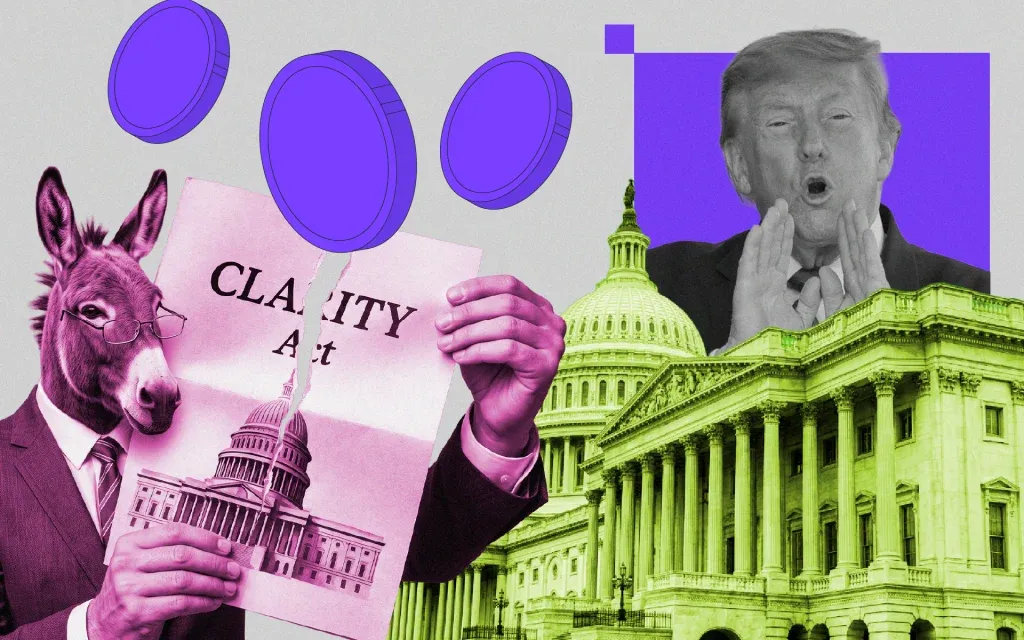
Republican senators circulated a revised draft in the week of July 20, 2026, adding new ethics restrictions on public officials while preserving the underlying SEC-CFTC jurisdictional framework, aiming for a floor vote before the Senate's August recess. That timeline leaves a narrow window, and the added language has not neutralized the bill's most politically volatile objection.
Why Ethics Provisions Remain the Bill's Weakest Point
Senate Democrats, including vocal critics like Elizabeth Warren, have already dismissed the revised ethics language as insufficient given ongoing scrutiny of crypto-related financial activity connected to current administration officials. This is worth stating plainly: no amount of technical clarity on CFTC jurisdiction resolves a conflict-of-interest objection rooted in a completely separate political concern. A bill can be commercially sound and structurally coherent for institutional liquidity purposes while still stalling entirely on a politically charged provision that has nothing to do with market mechanics.
What a Delayed Vote Costs Institutional Product Timelines
If the CLARITY Act does not clear the Senate before recess, its path shifts into an uncertain fall legislative calendar where competing priorities routinely push financial market-structure bills further down the docket, extending the compliance limbo that firms like Goldman are actively trying to exit. Every additional month of delay compounds differently depending on where an institution sits: for banks with live tokenized infrastructure already generating client demand, delay is direct opportunity cost; for banks still deciding whether to build at all, continued ambiguity simply reinforces the case for waiting even longer, which slows the entire sector's institutional liquidity build-out rather than just one firm's roadmap.
Positioning around legislative catalysts of this scale requires separating genuine structural signal, existing balance sheet exposure, competitive product timelines, and jurisdictional mechanics, from the short-term noise generated by any single week's floor statements or media cycle. Traders and allocators evaluating how institutional capital will eventually flow into tokenized and on-chain markets should apply a disciplined, risk-adjusted framework, weigh legislative probability rather than headline momentum, and continue building literacy around how settlement mechanics, custody frameworks, and jurisdictional classification interact once policy clarity actually translates into deployed capital.
Frequently Asked Questions About the Goldman Sachs Senate Crypto Bill Endorsement
1. Why does Goldman Sachs support the CLARITY Act specifically
Goldman supports the bill because it already operates live tokenized real estate infrastructure and has a competing bitcoin income ETF filing pending, meaning continued regulatory ambiguity directly delays revenue-generating products the bank has already built rather than remaining a purely theoretical policy concern.
2. What is the actual disagreement between Goldman and JPMorgan over this bill
The disagreement centers narrowly on a stablecoin yield provision rather than the bill's broader jurisdictional framework, with JPMorgan defending its deposit-dependent lending business against competition from yield-bearing stablecoins while Goldman's asset-management and tokenization business lines carry no equivalent deposit exposure.
3. How would the CLARITY Act change institutional access to on-chain markets
The bill would classify most digital assets as non-securities under primary CFTC oversight, removing the retroactive reclassification risk that has kept many regulated institutions from scaling tokenized products and on-chain settlement infrastructure beyond pilot programs.
4. Why might the bill fail to pass before the Senate's August recess
Senate Democrats have rejected the revised draft's ethics provisions as insufficient to address existing conflict-of-interest concerns tied to crypto-related activity connected to current administration officials, a political objection entirely separate from the bill's market-structure or stablecoin provisions.
5. How does tokenized real-world asset settlement differ from traditional settlement processes
Tokenized real-world assets settle through smart contracts that atomically link ownership transfer and payment, often within minutes, compared to traditional institutional settlement processes that can take one to several business days across multiple correspondent intermediaries.
This content is provided for general informational purposes only and doesn't constitute financial, investment, legal, or tax advice. Any events, rewards, online promotions, or related information mentioned herein should not be considered a recommendation, solicitation, or invitation to purchase, sell, trade, or otherwise deal in any crypto assets. Crypto assets are highly volatile and may result in loss. The availability of WEEX services, products, and related events may vary by region. You are responsible for ensuring that your participation is in accordance with applicable local laws and regulations.
You may also like

Pump.fun (PUMP) Price Prediction: Attributed Scenarios, Tokenomics and Risks
What Is Janction (JCT)? AI Layer 2, Tokenomics and Risks

What Is Block Street (BSB)? Tokenomics, Listings and the Unified Liquidity Layer

What Is Billions Network (BILL)? The ZK Identity Token, Tokenomics and Outlook
CRWV Stock After Q2: Demand Is Fine, the Interest Bill Isn't
Warren Buffett Berkshire Stock Transfer: The $147B Supply Math
KGHM Stock Forum: Copper, Silver, and the Argument the Thread Keeps Getting Backwards

Cost Basis Gap in Form 1099-DA: How to Avoid an IRS CP2000 Notice
How to Buy Netflix Stock: A Guide for International Investors
Austria Crypto Tax 2025: A Complete Guide

Crunch Time for the CLARITY Act: What’s in Store for Crypto?
Austria Crypto Tax 2025: A Complete Guide
WEEX Convert Guide: How to Swap Crypto on Web and App and What the Quote Really Means
ASML Stock Falls Despite a Record Q3 and Higher Outlook: Is the AI Chip Equipment Boom Already Priced In?
SKHY Stock Falls Again: Is the SK Hynix Selloff About China’s CXMT and YMTC or AI Profit-Taking?
What Is a Limit Order? How It Works and When to Use It
Best Crypto Miner for Beginners: What to Check on Cost, Power, Hashprice and Profit Before You Buy
DeFi Vault vs Staking: Who Controls Your Yield and Your Exit?
Buy Limit Order: How to Buy Crypto Below the Market Price
Limit Sell Order: How to Set a Take-Profit Price in Crypto

Limit Order vs Market Order: Which One to Use When Trading Crypto
What Is a Limit Order? How It Works in Crypto With BTC Examples
OP Price and Unichain's OP Enterprise Move: What It Means for OP

Nvidia Stock Falls After Microsoft's Maia 300: Is Custom Silicon a Real Threat to NVDA?
SpaceX Stock (SPCX) Near $163: Can It Reclaim $176 After Pivotal Lifts Its Target to $230?

MSFT Stock Near $542: What Azure Maia 300 Actually Claims and What Still Needs Proof
MU Stock Falls Below $1,000: Is the CXMT Threat Real or Just an Excuse to Take Profits?
Can META Reach $1,000? What Wells Fargo, Jefferies and Bernstein Targets Say About Meta Stock

Meta Stock Jumps as Muse AI Retention Data Lands: Is META Pricing In an AI Agent Win?
Stop Limit Order: How It Works and Why It Can Fail to Fill
Pump.fun (PUMP) Price Prediction: Attributed Scenarios, Tokenomics and Risks
What Is Janction (JCT)? AI Layer 2, Tokenomics and Risks
What Is Block Street (BSB)? Tokenomics, Listings and the Unified Liquidity Layer
What Is Billions Network (BILL)? The ZK Identity Token, Tokenomics and Outlook
CRWV Stock After Q2: Demand Is Fine, the Interest Bill Isn't
Warren Buffett Berkshire Stock Transfer: The $147B Supply Math
Contents
Popular coins
Latest articles


