What Is Walrus Coin (WAL)? Why It Is Rising and What Is Still Unconfirmed

 Prefer us on Google
Walrus coin has climbed roughly 60% since October 13, from about $0.035 to about $0.056 on October 15, and the question most readers ask is whether Walrus coin is a storage story, a Sui story or simply momentum.
Walrus coin (WAL) is the token of Walrus, a decentralized storage network built by Mysten Labs on Sui, and it is used to pay for storing data and to stake with the nodes that hold it. The timing lines up with an October 12 announcement tying Walrus to DATA Network, but no source reviewed confirms that deal as the cause. That gap between timing and proof is what makes Walrus coin worth reading carefully instead of chasing.
What Is Walrus Coin (WAL)?
Walrus coin is the native token of Walrus, a decentralized data storage network created by Mysten Labs and built around the Sui blockchain. The Walrus website describes the project as a data platform where data is portable, protected and verifiable, with products such as Walrus Memory for AI agents and Walrus Console for storing and connecting data. In practical terms, applications can store large files on a network of independent storage nodes instead of on a single company’s servers, while Sui records who stored what and who paid.
According to Phemex, Walrus went live on mainnet in March 2025 with more than 100 independent node operators, and the Walrus Foundation raised $140 million in a private token sale that month, led by Standard Crypto. Crypto.news also mentions the $140 million round as background. WAL is the asset that connects the pieces, since it pays for storage and rewards the nodes that keep data available, so interest in Walrus coin tends to follow interest in what builders are storing on the network.
How Does Walrus Storage Work?
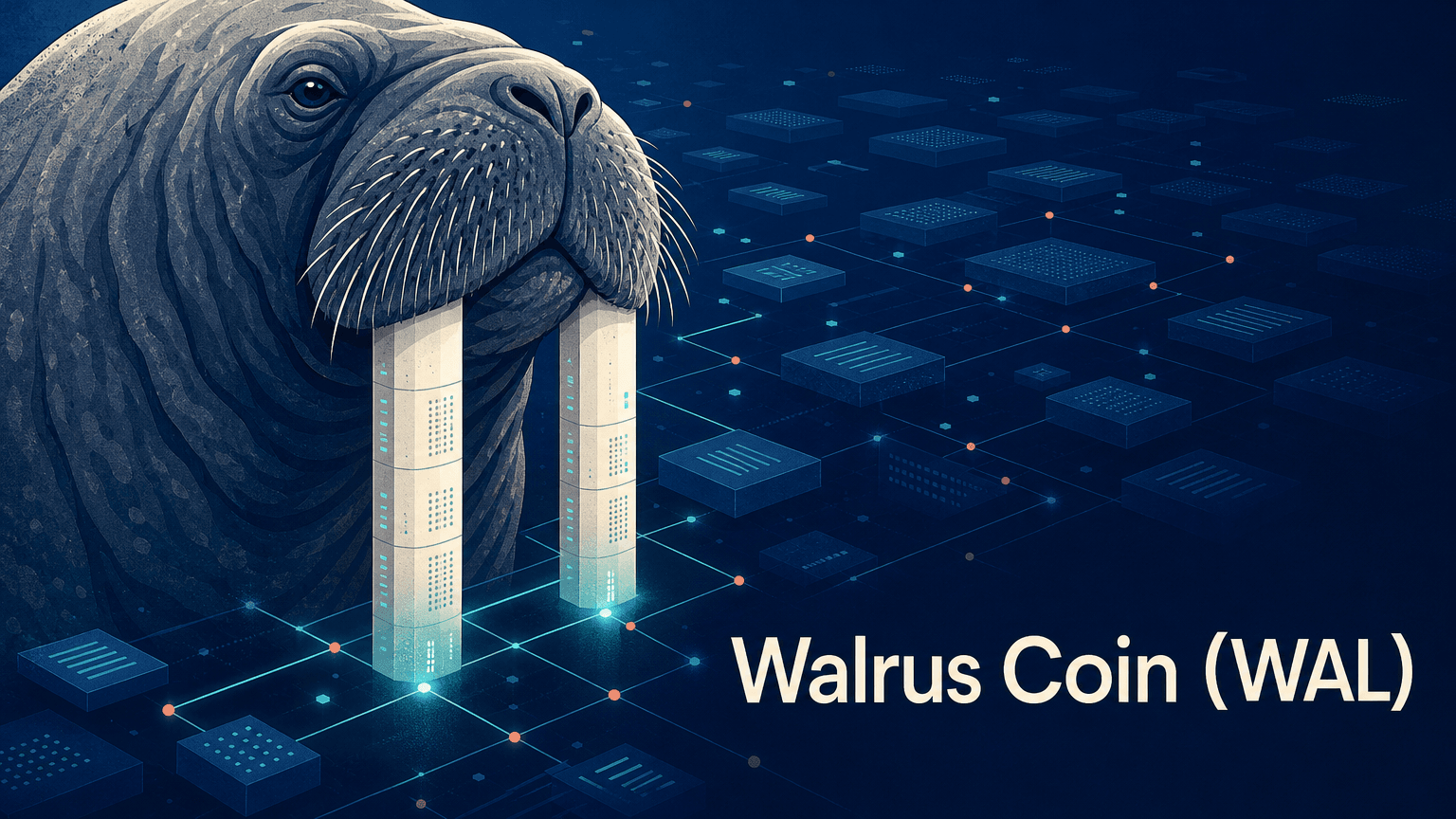
Walrus stores files by splitting them into encoded pieces and spreading those pieces across many storage nodes, so no single node holds the whole file. Phemex reports that Walrus calls stored files blobs, uses an erasure-coding scheme called RedStuff, and spreads the encoded pieces across 1,000 shards, with storage taking about 4.5 times the original file size. The same page says the design tolerates up to 333 faulty or malicious shards and that Walrus states data stays available even if up to two-thirds of nodes go offline. Those are the project’s own design claims as relayed by a third party, so they describe intent and not a guarantee.
Sui sits alongside the storage layer as the place where records and payments live. Because the proof that data was stored is anchored on Sui, applications can check that a file exists and is still available without trusting the node that holds it. This is the sense in which Walrus describes its data as verifiable, and it is also why the Sui Foundation’s involvement in the DATA Network deal matters to the story: the two projects share the same technology stack.
What Is the WAL Token Used For?
WAL is used to pay for storage and write fees and to stake with storage nodes, according to the official Walrus documentation. Storage is priced at $0.023 per gigabyte per month in US dollar terms, but the payment is made in WAL, and the amount of WAL adjusts with the WAL price through price votes submitted by the storage nodes. Phemex adds that users buy storage in two-week epochs, up to 53 epochs ahead, which is about two years.
The documentation also describes a burn: at each epoch change the system burns 3% of that epoch’s total rewards before paying the rest to nodes and stakers, and slashing a misbehaving node burns that operator’s commission, not delegated principal. The documentation does not describe governance rights for WAL, so that use should not be assumed. On supply, CoinGecko lists a maximum of 5 billion WAL with about 2.617 billion in circulation, which means roughly 52% is circulating, by the author’s arithmetic, and the rest is still to be released. Phemex says tokens outside circulation unlock monthly on a schedule running to 2033. The category split between team, investors and community is not in the documentation reviewed, so the Walrus whitepaper is the place to check it.
-- Price
Why Is Walrus Coin Rising?
No source reviewed gives a single confirmed reason for the rise, but several facts overlap in time. On October 12, 2026, the Sui Foundation announced a $30 million investment in DATA Network, the project formerly known as Story Protocol, according to the Sui blog and crypto.news. DATA Network plans to retire its own chain and move to Sui, with DATA tokens migrating one to one, and Walrus becomes the default storage layer for applications operated by DATA Foundation. The Sui blog is explicit that the default role covers only those applications.
Price moves came after that. Market data viewed on October 15 put WAL near $0.056, against about $0.035 on October 13, which is a rise of roughly 60% by the author’s arithmetic. A CoinGecko snapshot the same day showed $0.06008, up 20.1% over 24 hours and 64.6% over seven days, with a 24-hour range of $0.04685 to $0.06754 and trading volume of about $296 million against a market capitalization near $157 million. Neither the Sui blog nor crypto.news mentions the WAL token or any price reaction. They discuss the DATA token and the storage role only, so linking the deal to demand for Walrus coin is an inference, not a reported fact.
What Is Still Unconfirmed, and What Risks Should Traders Check?
The largest unknown is how much storage DATA Foundation’s applications will actually buy, and therefore how much WAL that would require. Trace, DATA Foundation’s registry for AI training data, could hold an encrypted copy of contributed files on Walrus in future, according to the Sui blog, but that is described as a plan and not a live feature. The reported figures of more than 250 million contributions and more than 3 million receipts a day are self-reported and unaudited, as crypto.news notes. No migration date has been published, and the investment terms were not disclosed.
Price risk deserves as much attention as the news. The CoinGecko 24-hour range shows a high about 44% above the low, by the author’s arithmetic, and volume of about 1.9 times market capitalization points to very active trading. A later reading of $0.05592 sat roughly 7% below the $0.06008 snapshot, though the two came from different times. Full dilution adds another layer: at $0.05592, the full 5 billion supply would be worth about $280 million, by the author’s arithmetic, and CoinGecko shows the all-time high of $0.7592 more than 90% above current levels. A rally after a headline can reverse as quickly as it formed.
Trading Walrus Coin on WEEX Spot and Futures
A coin that moves this fast makes the choice between Spot and Futures a real decision and not a formality. On WEEX Spot, a trader buys WAL outright with no leverage and no liquidation, so the downside is the price falling and not a forced close, which suits someone who wants exposure to the storage story and can sit through a 20% swing. Which WAL pair is currently available is shown on the WEEX trading page.
WEEX Futures offer leverage of up to 75x on supported contracts, and the maximum can differ by contract. At 75x, a move of about 1.3% against a position would use up the initial margin before fees and maintenance margin, by the author’s arithmetic, and WAL has recently moved far more than that within a single day. Futures also carry funding fees, so holding a position has a cost even when the price goes sideways. A trader who still chooses Futures usually keeps leverage well below the maximum and decides the exit before entering. WEEX also maintains a 1,000 BTC protection fund (weex.com/protectfund), which is an additional safeguard disclosed by the platform and does not remove market risk.
Conclusion
Walrus coin is the payment and staking token of a Sui-based decentralized storage network, and its recent rise of roughly 60% since October 13 coincides with the DATA Network announcement without being explained by it. What is confirmed is the deal itself and Walrus’s role as the default storage layer for DATA Foundation’s applications. What is not confirmed is any effect on WAL demand, the migration timeline or the size of the storage the new applications will buy. Readers who follow Walrus coin can track the DATA migration announcements and the Walrus documentation, and treat price targets from any source as opinion.
FAQ
1. What is Walrus coin?
Walrus coin (WAL) is the token of Walrus, a decentralized storage network built by Mysten Labs on Sui. It pays for storage and write fees and is staked with storage nodes.
2. Why is Walrus coin rising?
No source confirms one cause. Walrus coin rose after the October 12 announcement that Walrus will be the default storage layer for DATA Foundation applications, but the announcements do not mention WAL.
3. Does the DATA Network deal make Walrus the storage layer for all of Sui?
No. The Sui blog says the default role applies to applications operated by DATA Foundation. Walrus coin demand from the deal depends on how much storage those applications buy.
4. What is the supply of Walrus coin?
CoinGecko lists a maximum supply of 5 billion WAL, with about 2.617 billion circulating as of its October 15 snapshot. Phemex says the remaining Walrus coin supply unlocks monthly through 2033.
5. Is Walrus coin risky to trade?
Walrus coin is volatile, with a 24-hour range of about 44% on October 15 according to CoinGecko data. Futures add leverage and liquidation risk, so many traders use Spot or low leverage.
This content is provided for general informational purposes only and doesn't constitute financial, investment, legal, or tax advice. Any events, rewards, online promotions, or related information mentioned herein should not be considered a recommendation, solicitation, or invitation to purchase, sell, trade, or otherwise deal in any crypto assets. Crypto assets are highly volatile and may result in loss. The availability of WEEX services, products, and related events may vary by region. You are responsible for ensuring that your participation is in accordance with applicable local laws and regulations.
You may also like
PYTH USDT After the 100% Rule: Buyback Mechanics, Overbought Signals and Risks Before Trading
USDC Significant EMT Status in the EU: What Changes on November 12 Under MiCA
APR vs APY in Crypto: Why the Bigger Number Can Mislead You
Walrus (WAL) Jumps 30%: Sui Storage Token Rallies on AI Data
Bitcoin Price After Hot CPI: Why BTC Is Pinned Near $82,000
Sandisk Stock After a 524% Run: Why SNDK Keeps Sliding Now
CoreWeave Stock Plunges 15%: Why a Bond Yield Spooked CRWV
PENDLE Price and FLHYon: What Franklin's Bond Token Changes
WEEX 2026 New User Guide: Register, Complete KYC, and Claim the Welcome Bonus (Step-by-Step)

WEEX Convert Guide: How to Swap Crypto on Web and App and What the Quote Really Means
ASML Stock Falls Despite a Record Q3 and Higher Outlook: Is the AI Chip Equipment Boom Already Priced In?

SKHY Stock Falls Again: Is the SK Hynix Selloff About China’s CXMT and YMTC or AI Profit-Taking?
What Is a Limit Order? How It Works and When to Use It
Best Crypto Miner for Beginners: What to Check on Cost, Power, Hashprice and Profit Before You Buy

DeFi Vault vs Staking: Who Controls Your Yield and Your Exit?
Buy Limit Order: How to Buy Crypto Below the Market Price
Limit Sell Order: How to Set a Take-Profit Price in Crypto

Limit Order vs Market Order: Which One to Use When Trading Crypto
What Is a Limit Order? How It Works in Crypto With BTC Examples
OP Price and Unichain's OP Enterprise Move: What It Means for OP

Nvidia Stock Falls After Microsoft's Maia 300: Is Custom Silicon a Real Threat to NVDA?

SpaceX Stock (SPCX) Near $163: Can It Reclaim $176 After Pivotal Lifts Its Target to $230?

MSFT Stock Near $542: What Azure Maia 300 Actually Claims and What Still Needs Proof
MU Stock Falls Below $1,000: Is the CXMT Threat Real or Just an Excuse to Take Profits?
Can META Reach $1,000? What Wells Fargo, Jefferies and Bernstein Targets Say About Meta Stock

Meta Stock Jumps as Muse AI Retention Data Lands: Is META Pricing In an AI Agent Win?

Stop Limit Order: How It Works and Why It Can Fail to Fill
Best Crypto Platform for Beginners: Pick by Goal, Not Brand

Best Crypto Podcasts for Beginners: A 4-Week Listening Plan
Best Cold Wallet Crypto for Beginners: 5 Picks Under $150
PYTH USDT After the 100% Rule: Buyback Mechanics, Overbought Signals and Risks Before Trading
USDC Significant EMT Status in the EU: What Changes on November 12 Under MiCA
APR vs APY in Crypto: Why the Bigger Number Can Mislead You
Walrus (WAL) Jumps 30%: Sui Storage Token Rallies on AI Data
Bitcoin Price After Hot CPI: Why BTC Is Pinned Near $82,000
Sandisk Stock After a 524% Run: Why SNDK Keeps Sliding Now